

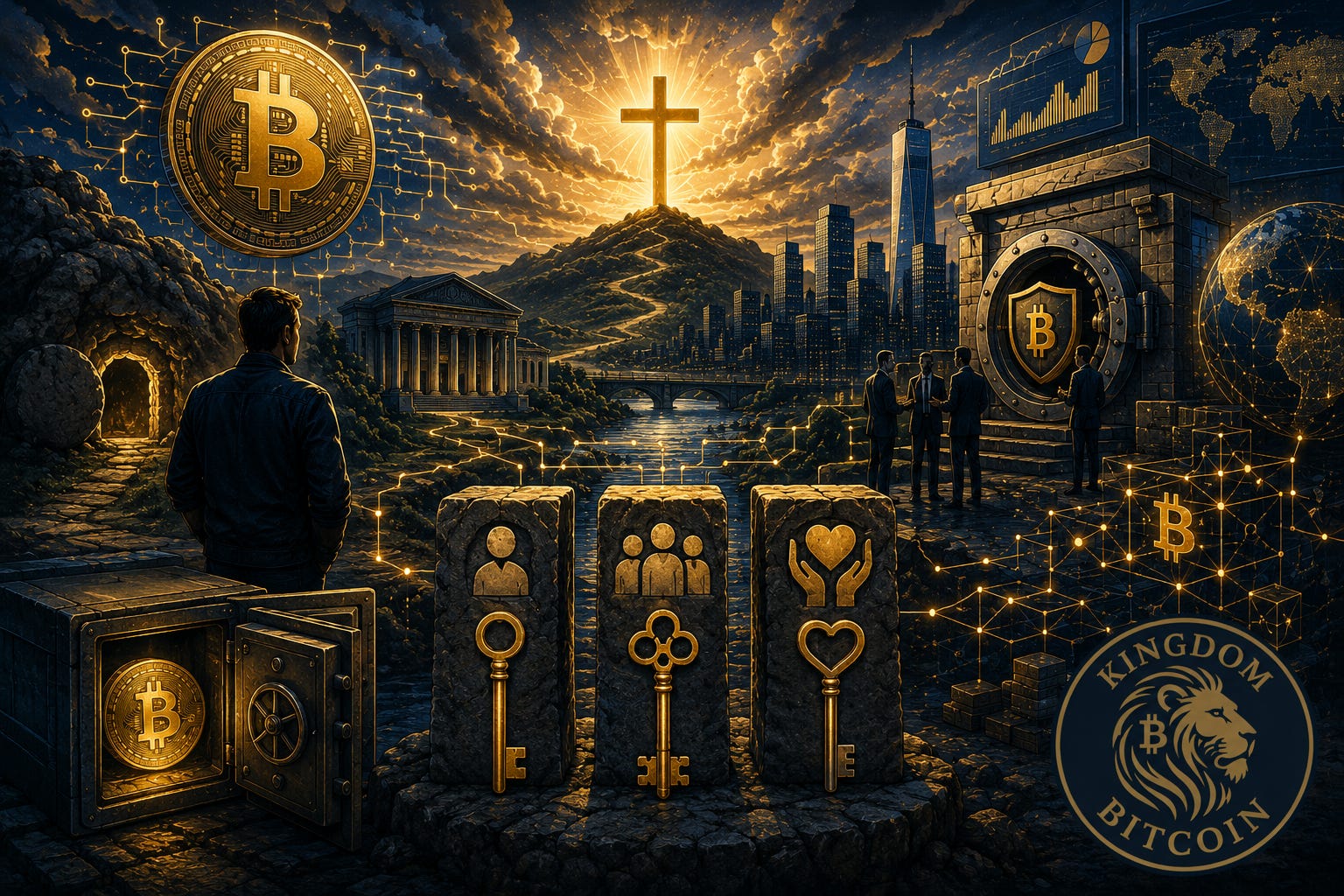
Three Biblical Lessons on Bitcoin, Custody, and the Return of the Intermediary
Bitcoin’s greatest achievement may not be that it eliminated the intermediary. It made the intermediary optional. Wall Street can offer custody, convenience, reporting, inheritance tools, and financial integration. Those services may be enormously valuable. But a free people should understand the difference between choosing an intermediary and requiring one.
When Bitcoin Exposure Is Not the Same as Bitcoin Ownership
King Ahab wanted Naboth’s vineyard.
From Ahab’s perspective, the transaction seemed perfectly reasonable. The king offered Naboth a better vineyard or its fair value in money. Economically, this was not robbery. It was an exchange between a willing buyer and a man who apparently possessed an asset the king wanted.
Naboth refused.
“The Lord forbid that I should give you the inheritance of my ancestors.” The vineyard was not merely acreage with a market price attached to it. It represented inheritance, possession, family history, and stewardship across generations. Ahab saw exposure to land value. Naboth saw something entrusted to him that could not be reduced to a replacement asset.
That distinction is increasingly important in bitcoin.
For years, Bitcoin culture emphasized one phrase relentlessly: “Not your keys, not your coins.” The logic was simple. If you control the private keys, you control the bitcoin. If someone else controls the keys, you possess a claim upon an intermediary rather than direct control over the asset itself.
Then Wall Street arrived. And to Wall Street’s credit, it built something people clearly wanted.
Bitcoin ETFs allow investors to gain exposure to bitcoin through familiar brokerage accounts. They simplify reporting. They integrate with existing wealth-management systems. They fit inside retirement accounts, estate structures, advisory platforms, and portfolios that would never comfortably hold a hardware wallet.
That convenience is real. But convenience can blur categories.
Owning bitcoin directly, holding bitcoin through a custodian, and owning shares of a Bitcoin ETF are three different relationships to the same underlying asset. In direct self-custody, you control the private keys capable of authorizing transactions on the Bitcoin network. With custodial bitcoin, another institution controls those keys on your behalf. With an ETF, you own shares representing an economic interest in a trust that holds bitcoin through institutional custody.
The price exposure may look similar. The property relationship is not.
This matters because Wall Street is now building increasingly sophisticated bridges between native bitcoin and traditional financial markets. Investors who already hold bitcoin can, through institutional mechanisms, increasingly migrate that exposure into ETF structures without first turning everything back into dollars. That is a remarkable development.
Wall Street spent fifteen years asking whether Bitcoin was real. Now it is getting remarkably good at putting a wrapper around it.
There is nothing inherently wrong with the wrapper. For some investors, it may be the wisest structure available. A widow with limited technical experience may be better served by an ETF than by a seed phrase hidden under the guest-room mattress. A family office may value regulated reporting and professional controls. A retirement plan may have no practical mechanism for direct bitcoin ownership.
Biblical stewardship is not measured by maximum technical independence.
It is measured by faithfulness. But faithfulness begins with understanding.
James Madison wrote about property as something broader than merely physical possessions. Property included the rights a person could legitimately exercise and enjoy. That insight belongs here because Bitcoin forces us to distinguish between economic exposure and direct possessory control.
Do you want participation in bitcoin’s price? Do you want a legally structured beneficial interest in bitcoin held by others? Or do you want the ability to possess and transfer the bearer asset itself?
Those are not theological purity tests. They are stewardship questions.
Naboth’s vineyard reminds us that property can carry characteristics that price alone does not capture. Direct bitcoin ownership provides portability, transferability, censorship resistance, and control that an ETF share does not reproduce in precisely the same way. An ETF may offer conveniences and protections direct ownership does not.
One is not automatically righteous. The other is not automatically compromised. The danger comes when we stop knowing the difference.
Bitcoin was never important merely because its price could rise. It was important because, for the first time in the digital age, an individual could hold scarce monetary property directly without requiring a bank, broker, government, or corporation to maintain the ownership relationship.
That option is historically significant. Institutional adoption does not erase it. But institutional success could cause us to forget it.
The first question in this new custody era should therefore not be whether ETFs are good or bad.
It should be simpler. What do I actually own?
Once we understand that, the next question becomes even more important.
What happens when a decentralized monetary network increasingly sits behind centralized custodians?
That is where Part Two begins.
Kingdom Principle 👑
Stewardship begins by knowing the difference between possession and exposure.
God entrusts resources to us with the expectation that we understand what we hold, why we hold it, and where responsibility resides. Direct ownership may offer one form of stewardship. Professional custody or an ETF may offer another. Wisdom is not found in repeating slogans but in understanding the tradeoffs clearly.
The Christian should not worship independence or convenience. We should seek faithfulness. Whatever structure we choose should serve responsibility, family continuity, generosity, and the purposes God has placed before us.
Prayer 🙏
Heavenly Father, give us wisdom to understand what You place into our hands and humility to recognize where we need help. Protect us from pride that confuses independence with wisdom and convenience that causes us to surrender responsibility without understanding what we have given away.
Teach us to steward bitcoin, investments, property, and every resource with clarity, diligence, and purpose. Help us prepare our families, understand our ownership structures, and make decisions rooted in truth rather than fear or fashion. May every asset remain a servant, every institution remain accountable, and Jesus Christ remain the ultimate owner of everything entrusted to us.
In Jesus’ name, Amen. 🙏📖🔑₿🏛️🌿🕊️👑