

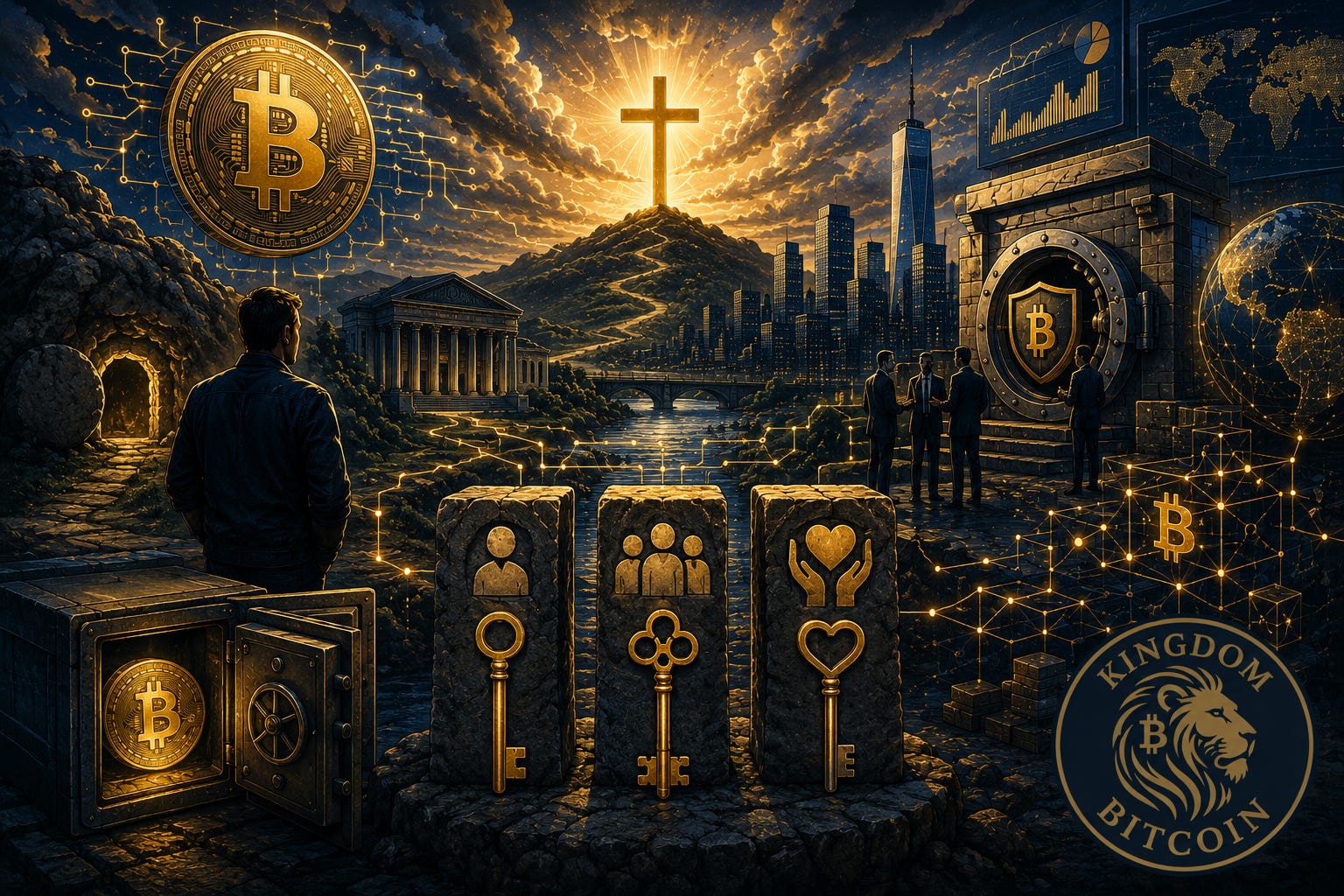
Three Biblical Lessons on Bitcoin, Custody, and the Return of the Intermediary
Bitcoin’s greatest achievement may not be that it eliminated the intermediary. It made the intermediary optional. Wall Street can offer custody, convenience, reporting, inheritance tools, and financial integration. Those services may be enormously valuable. But a free people should understand the difference between choosing an intermediary and requiring one.
How Decentralized Money Can Still Develop Centralized Gatekeepers
Israel looked at the nations around them and saw kings.
Kings could coordinate armies, enforce order, settle disputes, and create the kind of visible structure that made neighboring nations look organized. Israel wanted the same. Samuel warned them carefully, not because every king would be wicked, but because concentrated authority changes the relationship between the ruler and the people. “He will take the best of your fields and vineyards and olive groves,” Samuel told them.
The warning was not against order. It was against forgetting what concentration eventually permits. That is the tension now emerging around Bitcoin custody.
Bitcoin remains decentralized at the protocol layer. Thousands of independent nodes can verify the rules. Miners can propose blocks, but they cannot simply create extra bitcoin because quarterly earnings were disappointing. BlackRock cannot vote itself another million coins, and Coinbase cannot rewrite the twenty-one-million supply because a board meeting ran long.
The rules remain stubborn. The way people access those rules can still become concentrated. That is the custody paradox.
A decentralized monetary network can remain decentralized in governance while a growing share of economically important bitcoin sits behind a relatively small number of custodians, exchanges, ETF structures, banks, and wealth platforms. Those two realities are not contradictory. They simply describe two different layers of the system.
Protocol decentralization asks, “Who can change the rules?”
Custody concentration asks, “Who controls access to the assets?”
Those are not the same question. Both matter.
This is where institutional Bitcoin becomes more complicated than the early slogans.
The original innovation was not that institutions must disappear. It was that institutions no longer had to be indispensable. An individual could generate a private key, receive bitcoin, verify the network, and hold value without asking permission from a broker, bank, exchange, or government.
That option changed the architecture.
Now institutions are returning, but this time by choice.
That can be useful.
Professional custodians can provide security, operational controls, estate-planning support, regulated reporting, insurance arrangements, and institutional-grade systems that most households will never build themselves. ETFs can make Bitcoin exposure accessible to retirement accounts and advisers who are not about to explain seed phrases at the Thanksgiving table.
Convenience is not the enemy. Concentration is simply something worth understanding.
James Madison understood this distinction in political form. The Founders did not create checks and balances because they assumed every future leader would be corrupt. They created them because they assumed human nature would remain human. Power had to be divided because any system that requires perfect virtue from one actor is fragile by design.
Bitcoin reflects a similar instinct. Decentralization is not distrust of everyone. It is refusal to require perfect trust in anyone. That does not mean every large custodian is dangerous. It means size creates consequences.
When a major custodian holds large pools of bitcoin, operational failures matter more. Regulatory pressure matters more. Political influence matters more. A freezing order, security breach, internal failure, or legal dispute can affect a much larger group of users than it would in a more distributed ownership model.
Again, none of this changes Bitcoin’s protocol. It changes the human architecture around it. That distinction is essential.
Bitcoin’s network may continue producing blocks exactly as designed while millions of investors interact with it almost entirely through centralized wrappers. The monetary rules remain decentralized. The user experience becomes concentrated.
There is a strange irony here.
Bitcoin did not spend seventeen years removing the middleman merely so we could discover that the middleman has excellent customer service.
Although, to be fair, excellent customer service is genuinely useful.
The deeper question is whether convenience becomes dependency without us noticing. Israel wanted a king because kings solved real problems. Samuel did not deny that. He simply warned them about what they were giving up in exchange.
We should think the same way about custody. What does the institution provide? What responsibility does it assume? What power do we surrender? What options remain if the relationship changes?
A healthy Bitcoin ecosystem should be able to support both institutional custody and direct ownership without forcing everyone into one model. That is the real victory. The goal is not a world without intermediaries. The goal is a world where intermediaries must earn trust because people still have alternatives. That is a profoundly different architecture from one where the gatekeeper is unavoidable.
And it leads to the final question in this series.
If the answer is not “everyone self-custody everything,” then what does faithful custody actually look like for a household?
That is where Part Three begins.
Kingdom Principle 👑
Wise architecture assumes human fallibility before power becomes concentrated.
Scripture does not reject authority, institutions, or structure. It warns against allowing any human system to become so concentrated that accountability disappears and dependency becomes unavoidable. Healthy stewardship preserves options, distributes responsibility, and keeps power beneath truth.
Bitcoin offers a rare monetary architecture where institutions can serve without becoming absolutely necessary. The challenge is to preserve that choice while using institutions wisely when they genuinely add value.
Prayer 🙏
Heavenly Father, give us wisdom to recognize both the value and the limits of institutions. Protect us from romanticizing independence and from surrendering responsibility merely because convenience is easier.
Teach us to understand where power, access, and custody actually live. Give wisdom to households, custodians, regulators, and builders so that Bitcoin’s growing infrastructure remains resilient, accountable, and open to choice. May every intermediary serve rather than dominate, and may our trust remain ultimately anchored in Jesus Christ, not in any institution, market, or technology.
In Jesus’ name, Amen. 🙏📖👑🔑₿🏛️🕊️