

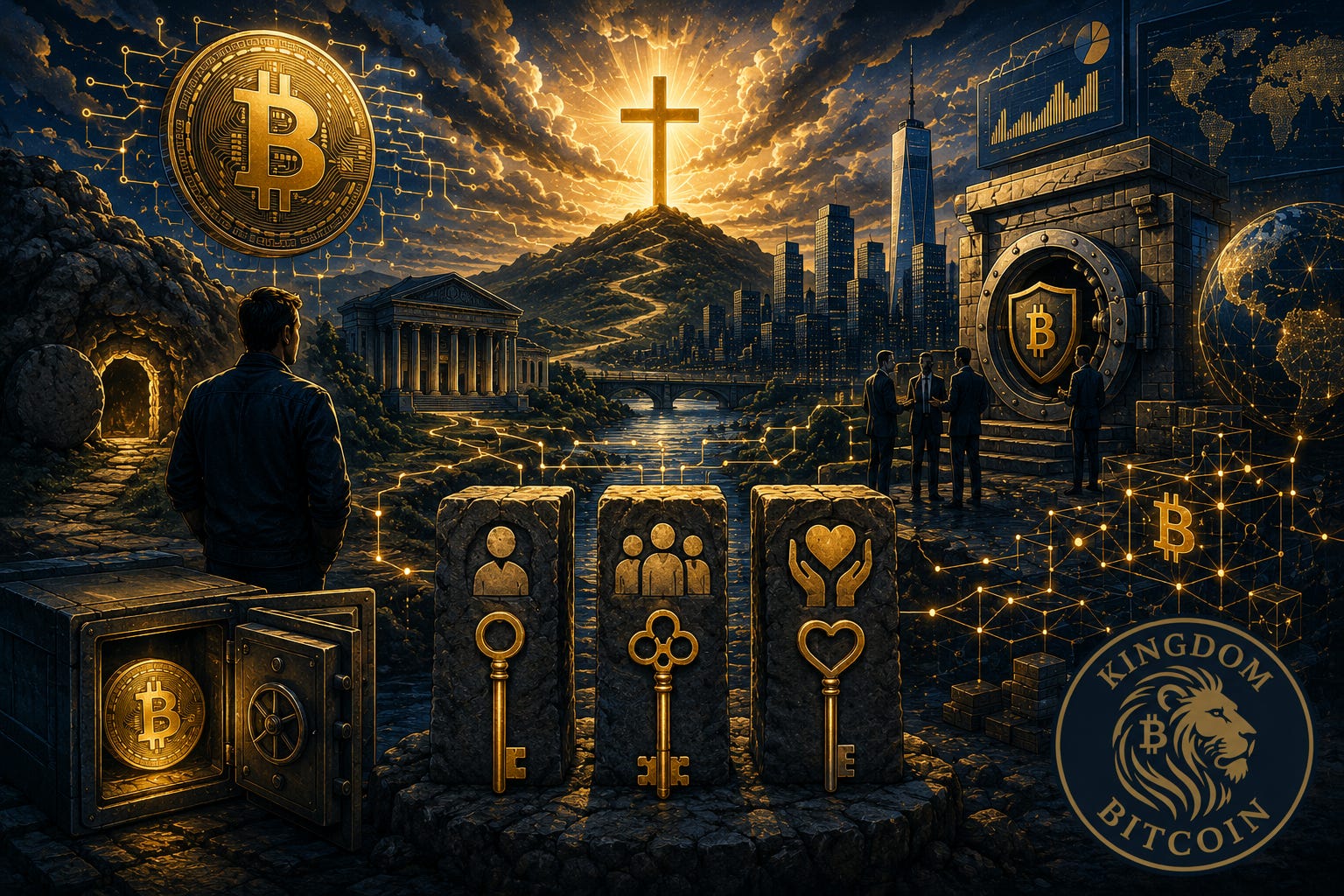
Three Biblical Lessons on Bitcoin, Custody, and the Return of the Intermediary
Bitcoin’s greatest achievement may not be that it eliminated the intermediary. It made the intermediary optional. Wall Street can offer custody, convenience, reporting, inheritance tools, and financial integration. Those services may be enormously valuable. But a free people should understand the difference between choosing an intermediary and requiring one.
Self-Custody, Wall Street, and the Stewardship Choice
A shepherd can own an entire flock and still be a poor steward.
He may know the number of sheep on paper, but if he cannot tell you where they are, who tends them, what protects them, or what happens when he is gone, then ownership has become abstraction. Proverbs says, “Be sure you know the condition of your flocks, give careful attention to your herds.” That is not merely agricultural advice. It is a command to remain close enough to what has been entrusted to you that responsibility never becomes invisible.
Bitcoin custody asks the same thing.
The slogan “Not your keys, not your coins” remains useful because it reminds people that direct control matters. If someone else holds the private keys, someone else ultimately controls movement of the bitcoin. But the slogan is incomplete as a stewardship framework. The deeper question is not whether every person should self-custody everything. It is whether you know where responsibility lives.
For some households, direct self-custody may be wise. For others, multisignature may reduce the risk of one lost or compromised key. Collaborative custody may combine personal control with professional recovery support. Qualified custodians may provide institutional security, reporting, insurance structures, and continuity that a family could not reproduce alone. An ETF may offer the simplest access for retirement accounts or investors who want exposure without operational responsibility.
Each structure solves one problem and introduces another. That is the part tribal arguments usually miss.
Self-custody reduces counterparty risk but increases personal operational risk. Institutional custody reduces some operational burdens while increasing dependence on another party. ETFs simplify access but turn direct possession into a financial claim. Multisignature can improve resilience but adds complexity.
There is no spiritually superior hardware wallet.
Biblical stewardship is not measured by how independently you can operate. It is measured by how faithfully you manage what God has placed into your hands.
Jesus’ parable of the wise and foolish builders gives us the right image. Both men built houses. On a sunny afternoon, both structures may have looked perfectly respectable. The difference appeared only when rain fell, streams rose, and winds struck the house.
Custody works the same way.
A plan can look excellent while the owner is healthy, passwords work, the exchange is open, the custodian is solvent, and everyone remembers where the recovery instructions are stored. Then the storm comes. Death. Incapacity. Fraud. A lost device. An institutional failure. A family member who never learned what any of it meant.
The architecture is revealed under pressure.
That is why every household holding meaningful bitcoin should eventually confront uncomfortable questions. Does your spouse know what you own? Could your family recover it if you died tomorrow? Are your estate documents aligned with the technical custody plan? Have you actually tested the recovery process rather than merely assuming the twelve words written years ago will somehow perform a miracle when needed?
One of my favorite absurdities in Bitcoin is the person who spends years warning everyone about counterparty risk and then creates a custody plan that depends entirely upon his own memory.
Congratulations. You eliminated the bank and replaced it with Dave. The goal is not maximum sovereignty. It is durable stewardship.
Benjamin Franklin and the American Founding generation understood that liberty required competence. Self-government was never imagined as freedom from every relationship or institution. It required citizens capable of judgment, responsibility, discipline, and voluntary cooperation.
The same is true financially. Sovereignty without competence is not liberty. It is unmanaged risk.
This is why institutional Bitcoin should not be viewed simply as Bitcoin’s defeat. BlackRock, Fidelity, banks, custodians, and ETFs can bring Bitcoin to millions of people who may never want to manage seed phrases, hardware devices, or multisig policies. That accessibility can be genuinely valuable.
Bitcoin gives humanity something historically unusual. The option not to outsource possession. That option matters even if many people choose not to exercise it.
A healthy financial architecture should allow a person to choose an intermediary because the service is valuable, not require one because no alternative exists. That distinction is the difference between assistance and dependency.
This is where the entire series lands.
Part One asked what we actually own.
Part Two asked where power becomes concentrated.
Part Three asks what faithful stewardship requires.
The answer is not a slogan.
Know what you own. Know who controls it. Know what can fail. Know how your family recovers it. Know why you chose the structure in the first place.
And above all, remember what custody is for. The goal is not to collect keys. The goal is to become faithful with what has been entrusted to us.
Bitcoin may have won the monetary battle by making the intermediary optional.
Now the stewardship battle is ours.
Kingdom Principle 👑
Freedom reaches maturity when responsibility is understood rather than merely outsourced.
God does not call us to independence for independence’s sake. He calls us to faithfulness. That may include direct custody, professional help, shared responsibility, or a combination of all three.
The wise steward understands the tradeoffs, prepares for failure, teaches the household, and refuses to confuse convenience with wisdom or sovereignty with maturity. Freedom becomes durable when responsibility remains visible.
Prayer 🙏
Heavenly Father, give us wisdom to steward every resource You place into our hands with clarity, humility, and preparation. Teach us where to accept responsibility directly, where to seek wise help, and how to protect our families from both unnecessary dependence and reckless independence.
Help us build custody plans that survive storms, inheritance structures that bless rather than confuse, and households that understand both the technical and moral purpose of what they hold. May Bitcoin remain a tool for responsibility rather than pride, and may every key, account, asset, and institution remain beneath the lordship of Jesus Christ.
In Jesus’ name, Amen. 🙏📖🔑🏠₿🛡️🕊️👑