

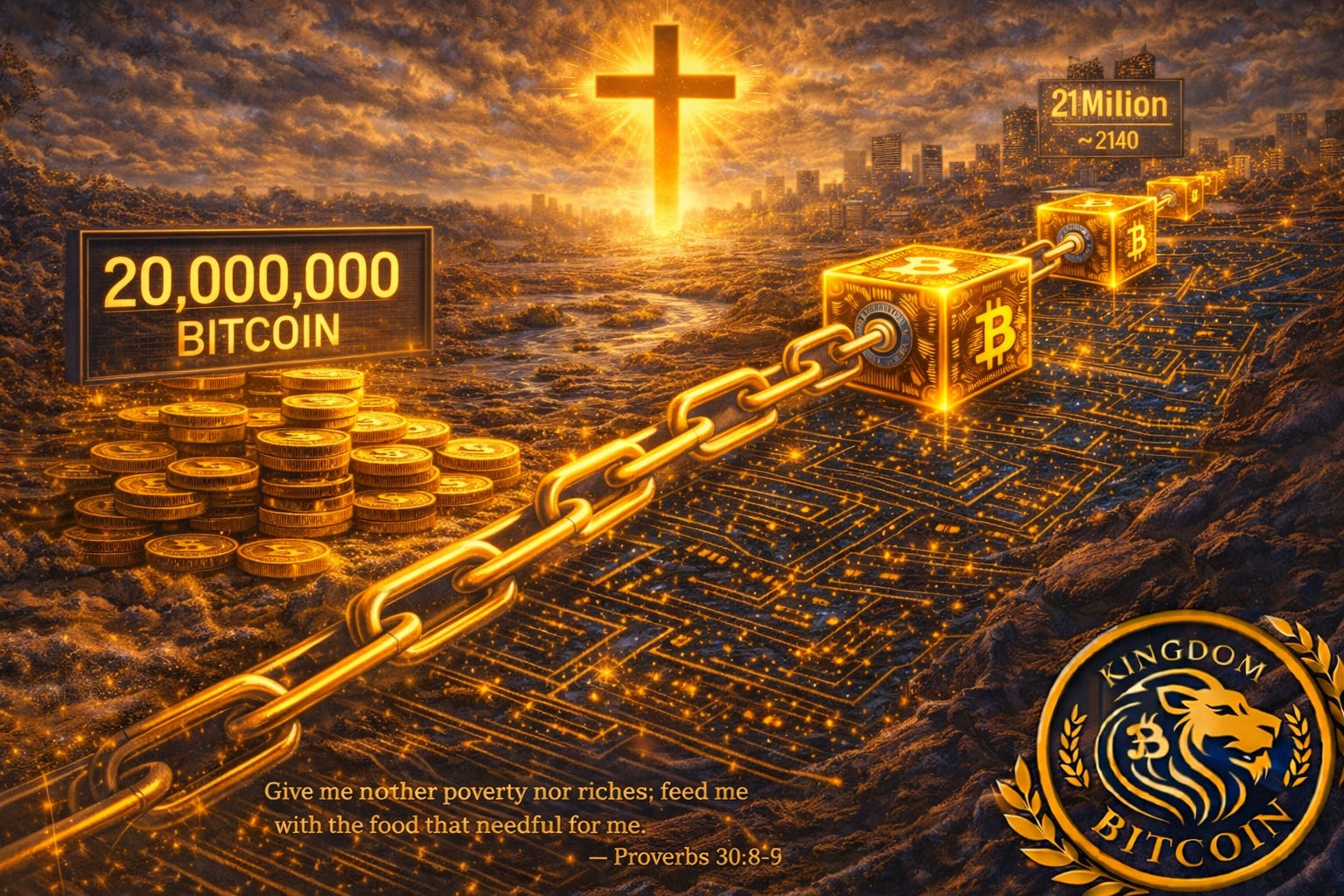
This week bitcoin quietly crossed one of the most important milestones in monetary history.
Twenty million bitcoin now exist.
More than ninety-five percent of the supply that will ever circulate has already been issued. And yet the final one million will not arrive quickly. They will emerge gradually over the next century, stretching all the way to around the year 2140.
That timeline alone should make builders stop and think.
Some of the people who will use the final bitcoin have not yet been born. Yet the rules governing their money were written before they arrived. In an age where policies change with election cycles and currencies expand with political convenience, bitcoin quietly continues honoring the same promise it made in 2009.
Block by block.
Hash by hash.
Halving by halving.
This moment is not merely a technical milestone. It is a sermon in code.
Think about what has happened in only seventeen years. From an obscure white paper in 2008 to a global monetary network securing trillions in value. From a handful of cypherpunks mining blocks on laptops to institutions, sovereign nations, and millions of individuals participating in the network.
And now, with twenty million bitcoin issued, the vast majority of the monetary base already exists. Few monetary systems in human history have reached such scale while keeping their original rules intact. One of the most powerful economic realities of bitcoin is also the simplest.
Demand is uncertain.
Supply is not.
Every commodity in human history eventually responds to rising demand with increased production. When gold prices rise, miners search for new deposits. When oil prices rise, drilling expands. Supply flexes to meet human appetite.
Bitcoin does not.
Its issuance schedule was written into the protocol at the beginning and has not changed for seventeen years. The world may demand more bitcoin tomorrow than it does today. Institutions may allocate billions. Nations may adopt it as strategic reserve infrastructure. Entrepreneurs may build entire financial systems on top of it.
But the supply does not respond.
Blocks continue arriving roughly every ten minutes. Subsidies continue declining every four years. Scarcity continues tightening regardless of human enthusiasm.
Human demand fluctuates. Bitcoin supply does not.
And when a growing world discovers an asset whose supply cannot respond to demand, the result is not chaos it is price discovery. In a world where money expands during every crisis, bitcoin does the opposite. It refuses.
Scripture speaks directly to the wisdom of limits and ordered provision.
“Give me neither poverty nor riches; feed me with the food that is needful for me, lest I be full and deny you and say, ‘Who is the Lord?’ or lest I be poor and steal and profane the name of my God.”
- Proverbs 30:8–9
That passage reflects a profound economic insight. Flourishing does not come from endless expansion or reckless scarcity. It comes from ordered sufficiency. Honest limits. Provision that encourages stewardship rather than excess.
Bitcoin’s monetary design quietly echoes that principle while its structure reminds us of one of the oldest economic lessons in Scripture.
In Genesis 41, Joseph interpreted Pharaoh’s dream of seven years of abundance followed by seven years of famine. Joseph’s wisdom was not merely prophetic. It was structural. During the years of plenty, Egypt stored grain so the nation could survive the years of scarcity.
Joseph understood something many modern systems forget. Abundance without discipline eventually leads to crisis.
Bitcoin embeds discipline directly into its architecture. It does not assume human restraint. It enforces mathematical restraint.
The American founders wrestled with similar questions about limits. They understood that liberty required structure and restraint. James Madison once wrote that if men were angels no government would be necessary. Because they are not, systems must be designed with checks that limit power.
Bitcoin applies that same insight to money. It assumes human incentives and binds them to transparent rules. This is why bitcoin ultimately belongs to builders more than speculators. Speculators chase volatility. Builders study structure.
They understand that when demand expands while supply remains fixed, something powerful begins to unfold. Not overnight. Not in straight lines. But gradually, relentlessly, over time.
Scarcity begins to assert itself.
There is also a fascinating theological symmetry hidden within bitcoin’s final supply that few people discuss.
Twenty-one million.
In Scripture the number seven often symbolizes completion and divine order. The seven days of creation, the rhythm of Sabbath rest, and the cycles of restoration throughout the Old Testament all reflect this pattern.
Twenty-one is three times seven.
Seven speaks to divine perfection and completion. Three carries its own profound symbolism, representing the Holy Trinity. The Father, The Son, and The Holy Spirit.
Three multiplied by seven forms twenty-one.
Whether intentional or simply a remarkable coincidence, bitcoin’s final supply reflects a striking sense of order. Twenty-one million units distributed across more than a century, forming a monetary system where scarcity is transparent, predictable, and resistant to political pressure.
Contrast that with the modern financial world.
Central bank balance sheets expand during crises. Currency supply grows whenever governments require financing. The measuring stick stretches whenever pressure builds. Yet bitcoin refuses.
Seventeen years into bitcoin’s life, the network continues to operate exactly as designed. Miners secure the chain. Transactions propagate across the globe. Blocks arrive roughly every ten minutes. The issuance schedule continues its slow march toward finality.
Twenty million bitcoin now exist. One million remain. The slow arrival of that final million may become one of the clearest economic lessons of our age.
Scarcity is not the enemy of flourishing. Properly ordered scarcity is what makes stewardship possible. Bitcoin is not merely software. It is a sermon in code about discipline, limits, and stewardship.
And the world is only beginning to hear it.
Prayer 🙏₿⏳
Dear Lord,
Teach us to steward resources faithfully in a world that often pursues expansion without wisdom. Guard our hearts from haste, greed, and the illusion that abundance can be manufactured without consequence. Help us honor limits, practice discipline, and build systems that reflect truth and integrity.
May our work serve generations we may never meet, and may our ultimate trust always remain in You above every market and every system.
In Jesus’ name, Amen. 🙏🕊️
Luckily there is an infinite supply of bunco artists