

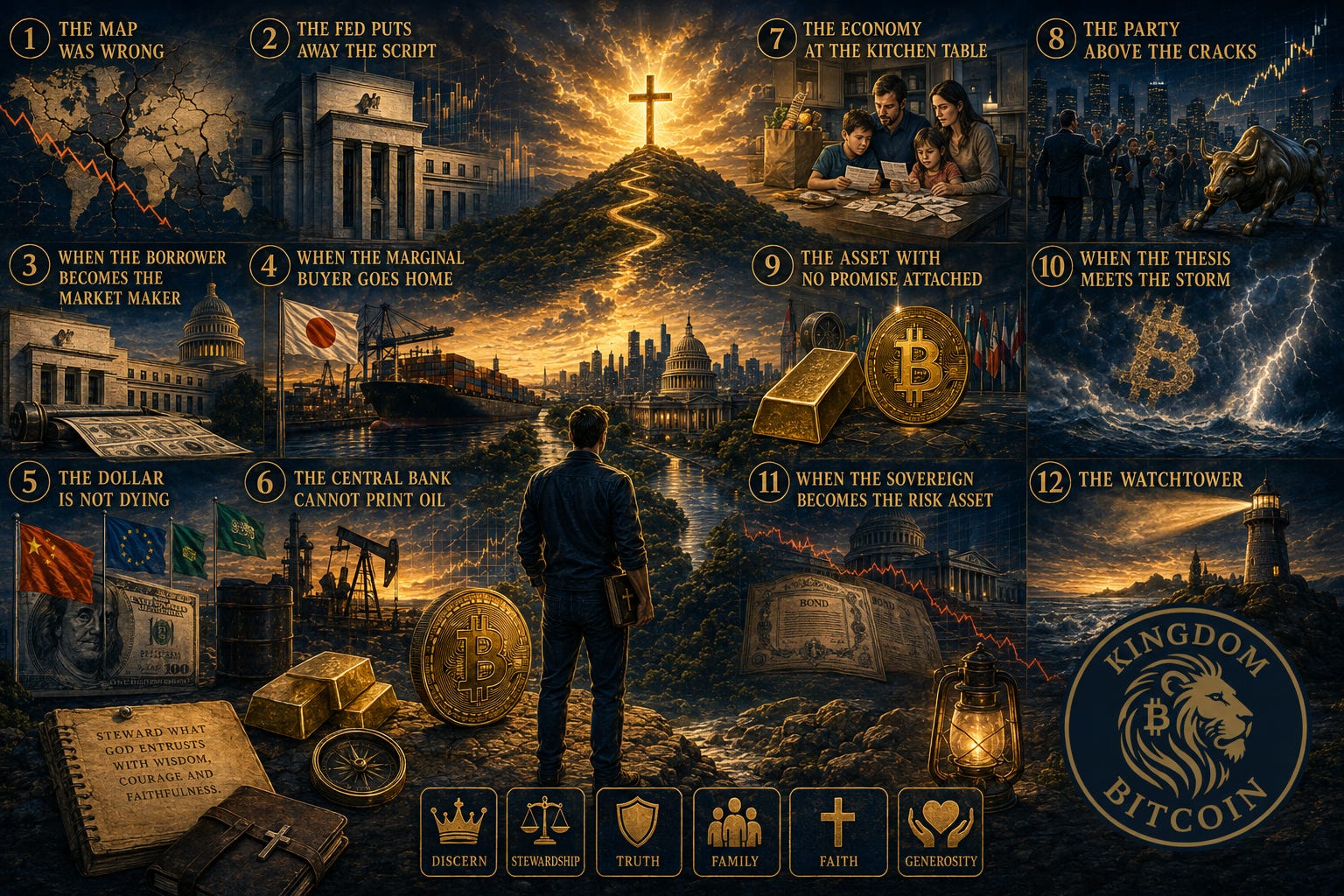
As 2026 enters its final months, the global financial system is being squeezed by rising sovereign debt, stubborn inflation, geopolitical conflict, shifting capital flows, and a growing question about who still trusts the promises beneath modern money. The Sovereign Squeeze examines how these forces connect, why Bitcoin matters within them, and how Christians can navigate the changing financial landscape with wisdom, stewardship, and confidence rooted in Jesus Christ rather than markets.
In the eighteenth year of King Josiah’s reign, workers repairing the temple discovered something extraordinary buried inside the house of God: the Book of the Law. The kingdom had not been operating without religion, institutions, priests, or traditions. What it had lost was the standard beneath them. When the words were read aloud, Josiah tore his robes because he realized an entire nation had drifted while believing normalcy was evidence of faithfulness. Renewal began when the standard was rediscovered.
Something structurally similar is happening at the Federal Reserve in 2026, although no one should confuse central banking with biblical revival. Kevin Warsh did not arrive merely as a new chairman occupying Jerome Powell’s old chair. He arrived with a different philosophy about what the institution itself should be. Since taking office in May, Warsh has questioned years of unconventional monetary intervention, argued that the Fed bears responsibility for persistently elevated inflation, emphasized the role of money and the balance sheet, and deliberately reduced the amount of forward guidance markets had become accustomed to receiving. At Jackson Hole in August, he essentially told markets that the Fed would return to discipline rather than provide a running commentary on every future decision.
That change matters because the Federal Reserve does much more than move one interest rate. Think of its toolkit in four pieces. The policy rate changes the cost of short-term money. Forward guidance tells markets what policymakers expect to do next. The balance sheet changes how much financial liquidity the Fed injects or removes through its holdings of securities, while reserve management attempts to keep the banking system supplied with enough cash to function smoothly. For years, investors learned to listen not merely to what the Fed did, but to what it promised it might do later.
Warsh is putting away part of that script.
Under Powell, markets often received a fairly detailed roadmap. A disappointing inflation report could be softened by reassurance about the likely path ahead, while an unexpectedly strong employment number could be interpreted inside a larger policy narrative. Warsh has intentionally made the data more important again. When the Fed stops cushioning every surprise with guidance, every CPI report, payroll number, and inflation-expectations survey carries greater weight.
That may make markets more volatile. It may also make them listen.
The Fed has held its target rate at 3.50% to 3.75% throughout 2026, but July produced something unusual: three policymakers dissented because they wanted a rate increase. Markets now enter September assigning meaningful probability to another hike. This is not what nearly anyone expected entering the year, when the dominant assumption was that the Federal Reserve would be cutting rates rather than debating whether money was still too easy.
The problem is that the inflation the Fed is confronting is particularly cruel.
War, energy disruption, and the partial closure of the Strait of Hormuz have pushed fuel prices sharply higher. U.S. headline inflation is running above core inflation, with energy doing much of the damage. The Fed can make mortgages more expensive, cool hiring, weaken consumer demand, and discourage investment, but it cannot reopen a shipping lane.
The central bank cannot print oil.
There is an almost comic cruelty to raising a family’s borrowing costs because gasoline became more expensive due to war thousands of miles away. Yet the Fed’s concern is not merely the original price shock. It is what happens if people begin believing elevated inflation is permanent.
That is where expectations become policy.
Bond-market measures currently suggest investors still expect inflation to settle back toward the low-two-percent range over time. Households are far less convinced, with consumer surveys showing expectations closer to three or four percent.
That difference should concern us.
A family does not negotiate wages based upon a five-year breakeven chart. It negotiates from grocery receipts, gasoline prices, insurance premiums, rent, and the cost of getting a child through another school year. When households begin assuming everything will cost substantially more next year, their behavior adapts, and eventually the expectation itself can help keep inflation alive.
This is why monetary credibility matters.
Scripture tells us that “honest scales and balances belong to the Lord.” The verse is not a monetary-policy manual, but it gives us a moral category modern economics sometimes loses beneath technical language. A measurement system must be trustworthy enough for people to plan around it. When people lose confidence in the measure, the consequences travel into wages, contracts, borrowing, investment, and household decisions.
America’s Founders understood that institutional restraint mattered for exactly this reason. Hamilton and Jefferson disagreed fiercely over banking and federal financial power, but neither believed the architecture of money was trivial. Hamilton emphasized public credit and institutional capacity. Jefferson feared concentrated financial power and dependency. Their disagreement still echoes because healthy republics must somehow hold two truths together: institutions need enough authority to function, and enough restraint that authority does not quietly become its own justification.
Warsh’s approach represents an attempt to restore that restraint to central banking. He has expressed skepticism toward enormous balance sheets and extraordinary policies becoming ordinary simply because markets enjoy them. There is wisdom in that instinct. Emergency tools should remain emergency tools, because once every economic discomfort becomes a reason for extraordinary intervention, markets stop pricing only assets and begin pricing the likelihood of rescue.
But restraint comes with costs.
Higher rates can weaken employment, increase mortgage payments, depress asset prices, and pressure highly leveraged businesses. A smaller Fed balance sheet can reveal dependencies the financial system built during years of abundant liquidity. Discipline feels admirable in a speech and considerably less charming when your refinancing bill arrives.
That tension matters enormously for Bitcoin.
Many Bitcoiners instinctively assume inflation should be bullish for bitcoin because its supply is fixed. Over long periods, that may prove directionally meaningful. But if the Fed responds to inflation by raising real rates and draining liquidity, bitcoin can fall because investors still treat it as a liquid risk asset.
That does not invalidate Bitcoin’s architecture. It exposes the difference between the asset and the market trading it.
Bitcoin’s protocol does not lower its supply because Warsh becomes hawkish. It does not increase issuance because unemployment rises. The network keeps producing blocks according to rules that do not attend Jackson Hole.
Price responds to liquidity. The monetary rule does not.
That may become one of the most important distinctions in this entire series. Bitcoin can struggle during a period of monetary discipline while simultaneously becoming more intellectually compelling in a world increasingly concerned about discretionary money. The short-term market and the long-term monetary thesis can move in opposite directions.
Josiah’s great contribution was not inventing a new law. It was rediscovering a neglected standard.
The Federal Reserve is now asking its own version of that question: what does monetary discipline mean when inflation remains above target, extraordinary tools have become familiar, and markets have spent years learning to anticipate the referee?
Warsh appears determined to make markets play the ball again.
But as the Fed retreats from managing every corner of the financial system, another institution in Washington is becoming considerably more active.
The United States Treasury.
And that is where the story becomes even more interesting.
Kingdom Principle 👑
Discipline sometimes requires accepting immediate discomfort to preserve long-term credibility.
God’s order does not change merely because obedience becomes inconvenient. Honest standards matter most when pressure creates an incentive to abandon them. The challenge for every institution, household, and steward is to distinguish necessary flexibility from the gradual surrender of principle.
Monetary discipline cannot save a nation, and no Federal Reserve chairman can engineer human flourishing through interest rates. Yet trustworthy institutions require boundaries. As Christians, we should value leaders willing to confront uncomfortable realities while remembering that wisdom also requires humility about the limits of their tools.
Prayer 🙏
Heavenly Father, give wisdom to those entrusted with the enormous responsibility of monetary policy. Help them pursue truth rather than popularity, discipline rather than convenience, and humility rather than the illusion that every economic problem can be solved from a policy committee.
Give households endurance when higher prices and higher rates squeeze both sides of the family budget. Protect workers from unnecessary hardship, leaders from pride, and markets from becoming addicted to intervention. Teach us to prepare wisely, remain generous, and understand the difference between short-term volatility and long-term truth.
May the Holy Spirit give us discernment when institutions change direction, and may Jesus Christ remain the unchanging standard beneath every economic system, market, and decision we make.
In Jesus’ name, Amen. 🙏📖⚖️🏦🔥₿🕊️👑