

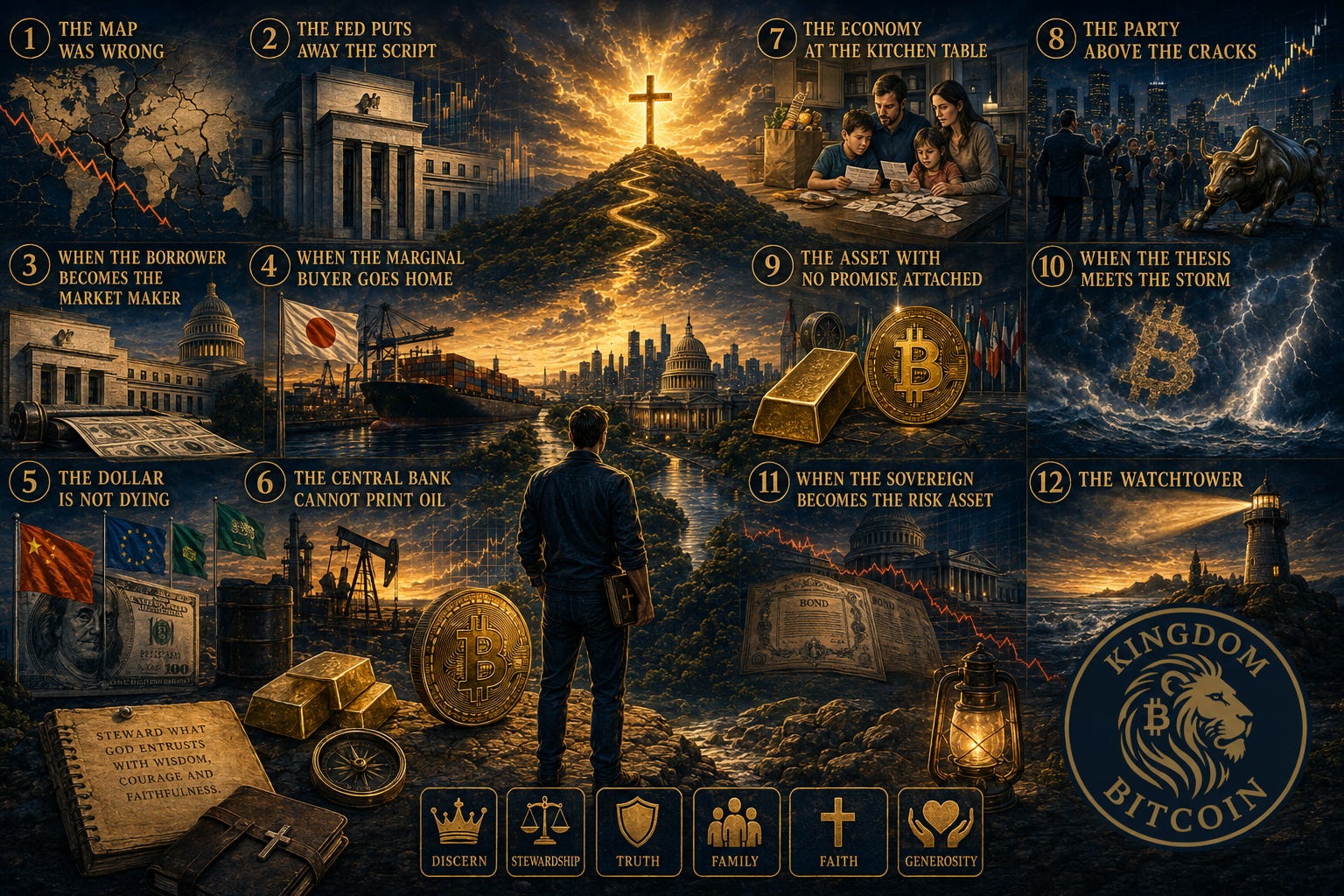
As 2026 enters its final months, the global financial system is being squeezed by rising sovereign debt, stubborn inflation, geopolitical conflict, shifting capital flows, and a growing question about who still trusts the promises beneath modern money. The Sovereign Squeeze examines how these forces connect, why Bitcoin matters within them, and how Christians can navigate the changing financial landscape with wisdom, stewardship, and confidence rooted in Jesus Christ rather than markets.
The prophet Habakkuk lived in a world that appeared increasingly difficult to understand. Violence was rising, justice seemed distorted, and the geopolitical order around Judah was shifting toward something he could sense but not control. His response was not to pretend certainty. “I will stand at my watch and station myself on the ramparts,” he said. The watchman could not determine which army crossed the horizon, but he could remain awake enough to recognize what was approaching.
That is the posture I want to leave with you after twelve parts. Not panic. Not prediction addiction. Discernment.
The final months of 2026 contain enough catalysts to make even the most committed macro tourist reconsider taking up gardening. The Federal Reserve faces inflation above target and a possible rate increase. The Bank of Japan is tightening as Japanese capital becomes increasingly willing to remain at home. The Strait of Hormuz remains impaired, keeping an energy risk premium embedded in the global economy. Treasury is expanding long-end buybacks while America finances deficits approaching $2 trillion, and financial markets remain remarkably calm despite nearly every paragraph I just wrote.
The mistake would be trying to predict every outcome. A better approach is to identify the signals that tell us which environment is actually developing.
That distinction matters because forecasts create emotional attachment. We say the Fed will hike, oil will fall, Bitcoin will rally, or the dollar will weaken, and before long we are no longer analyzing information. We are defending our identity. John Adams once reminded a courtroom that facts are stubborn things. Markets have a similarly rude habit of refusing to honor our preferred narrative.
So let us build a watchtower instead.
The first thing I am watching is the thirty-year Treasury yield around the Federal Reserve’s next major decision. If the Fed tightens and long-term yields fall, the bond market is effectively saying monetary discipline still commands credibility. Investors would be signaling that higher short-term rates increase confidence that inflation will eventually be controlled. In that environment, the dollar could strengthen, long-duration assets remain under pressure, and both gold and Bitcoin may struggle.
But if the Fed hikes and the thirty-year yield rises anyway, the message becomes very different.
That would suggest investors are looking beyond the central bank toward fiscal deficits, refinancing needs, future Treasury supply, and the government’s growing interest burden. It would mean tighter monetary policy failed to make long-duration sovereign debt more attractive. That is the environment where fiscal dominance stops sounding like an academic phrase and starts becoming visible in market prices.
The second signal is energy.
If Hormuz meaningfully reopens and Brent moves toward levels associated with normalized supply, the entire inflation picture changes. Headline inflation could move rapidly toward core inflation, central banks would gain room to stop tightening, real wages could improve, and markets might receive the rare gift of easing inflation without a deep recession. Bitcoin would likely benefit from improving liquidity conditions, although gold could lose some urgency as a geopolitical hedge.
If the energy disruption worsens, the opposite happens.
Central banks would face the cruel choice we discussed earlier: tolerate higher inflation or tighten demand against a shortage they cannot solve. Households would experience the pain first through gasoline, diesel, freight, food, and eventually the price of almost everything moved by truck, ship, or aircraft. Monetary policy can influence how much people buy. It still cannot command another barrel through the strait.
The third signal is Japan.
A stronger yen, higher Japanese rates, and attractive domestic bond yields can continue pulling Japanese capital back toward home. If that process remains gradual, markets may absorb it. If it accelerates into a genuine carry-trade unwind, leveraged positions across equities, credit, and Bitcoin could be sold quickly as investors reduce risk and repay yen funding.
Remember what happened in Acts 27.
When the storm became violent, cargo went overboard before anyone held a committee meeting about long-term intrinsic value.
The fourth signal sits inside crypto itself: stablecoin supply. Stablecoins function as part of the digital-asset ecosystem’s liquidity reservoir. Their total supply has contracted from its June peak, even while Bitcoin staged a powerful August rebound. That tells me we should remain careful about declaring that an entirely new Bitcoin bull market has arrived. A rally fueled by short covering and exhausted sellers is different from one fueled by expanding pools of fresh capital.
I want to see the reservoir refill. Then there is credit.
Investment-grade and high-yield spreads remain extraordinarily calm while sovereign yields, war, inflation uncertainty, and private-credit concerns sit in the background. That tranquility may prove justified. It may also be telling us that financial markets have become accustomed to assuming policymakers will respond if anything significant breaks.
That assumption itself is worth watching.
Because if a credit accident arrives, the first move will probably be ugly for nearly everything, including Bitcoin. Liquidity crises do not begin as philosophical debates about sound money. They begin with collateral calls. The more consequential Bitcoin move may come afterward, when we learn how policymakers respond to a financial accident in a world already carrying enormous sovereign debt and uncomfortable inflation.
This is why I remain constructive about Bitcoin without needing it to behave perfectly every week.
Bitcoin is not a prophecy market. It is a monetary network.
Its maximum supply remains twenty-one million whether the Federal Reserve hikes, Japan repatriates, Hormuz reopens, gold rallies, or the S&P finally discovers that corrections remain legal. Its price will respond to liquidity, positioning, leverage, regulation, and human emotion. Its monetary rules will not.
That separation is the intellectual foundation beneath everything we have explored.
Over these twelve chapters, we have examined central banks, Treasury debt, Japan, China, Europe, war, energy, household affordability, AI, credit, gold, and Bitcoin. Yet the objective was never to turn readers into amateur hedge-fund managers staring at Japanese bond yields during breakfast. The objective was to understand the environment well enough to steward faithfully within it.
Build margin. Reduce leverage that can force bad decisions. Develop useful skills. Own productive assets thoughtfully. Understand custody. Think generationally. Remain generous. And please do not spend your entire life watching the thirty-year Treasury while your children grow up in the next room.
The watchman watches because something beyond himself matters. Habakkuk climbed the tower to gain perspective, not to worship the horizon. That is where this series should end. Watch the bonds. Watch the currencies. Watch the oil. Watch the liquidity. Understand the Bitcoin. But above all, watch your heart. Because markets will change again.
Jesus Christ will not.
Kingdom Principle 👑
The watchman is called to discern the age, not worship it.
Biblical wisdom does not require us to predict every outcome. It requires us to remain awake, examine reality truthfully, recognize changing conditions, and respond with faithful stewardship rather than fear. A framework allows us to say, “If this happens, I will watch that,” without pretending we possess control over tomorrow.
Bitcoin matters because it offers a scarce bearer asset outside the liability structure of sovereign debt. Yet even Bitcoin must remain beneath wisdom, family, generosity, calling, and the lordship of Jesus Christ. We study the system so we can steward within it, not so the system becomes the object of our attention.
Prayer 🙏
Heavenly Father, give us the discernment of the watchman without the anxiety of someone who believes everything depends upon his forecast. Teach us to recognize changing seasons, evaluate evidence honestly, prepare wisely, and remain flexible when reality proves our assumptions incomplete. Give our leaders wisdom as they navigate debt, inflation, war, energy, and financial instability, and protect them from sacrificing long-term truth for temporary comfort.
Help our households build margin, reduce fragile dependence, remain generous, and prepare future generations with wisdom rather than fear. May the Holy Spirit sharpen our discernment, may Bitcoin and every financial asset remain a servant rather than an idol, and may Jesus Christ remain the unchanging foundation beneath every market, nation, and season.
Watch the world carefully. Guard the heart even more carefully.
In Jesus’ name, Amen. 🙏📖🗼🧭🌍🏛️⚖️₿🕊️👑