

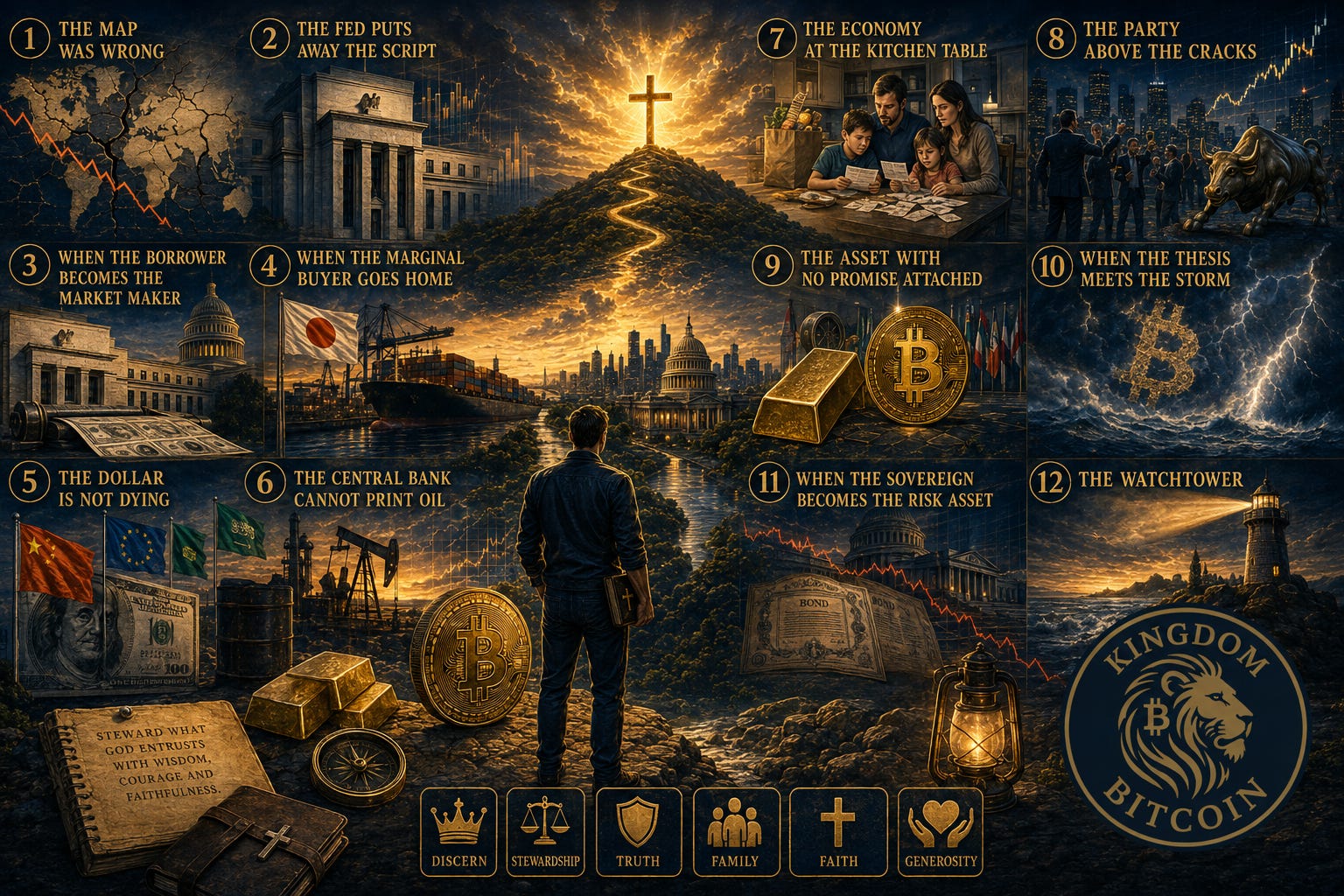
As 2026 enters its final months, the global financial system is being squeezed by rising sovereign debt, stubborn inflation, geopolitical conflict, shifting capital flows, and a growing question about who still trusts the promises beneath modern money. The Sovereign Squeeze examines how these forces connect, why Bitcoin matters within them, and how Christians can navigate the changing financial landscape with wisdom, stewardship, and confidence rooted in Jesus Christ rather than markets.
The city of Samaria was starving.
An enemy army had surrounded it, cutting off the flow of food until ordinary provisions became grotesquely expensive. Second Kings records that the siege became so severe that items no sane person would ordinarily consider food were suddenly assigned extraordinary prices. The problem was not that Samaria had experienced excessive consumer enthusiasm, nor that citizens had received overly generous stimulus checks. The problem was brutally simple: supply could no longer reach the people who needed it.
That ancient story is an uncomfortable picture of the inflation challenge confronting the world in 2026. The conflict involving Iran, Israel, and the United States has disrupted the Strait of Hormuz, one of the most important energy corridors on earth. Under normal conditions, roughly one-fifth of global oil consumption and a significant share of liquefied natural gas move through that narrow passage. When tankers cannot move normally, war-risk insurance explodes, shipping routes lengthen, and energy that technically exists becomes economically harder to deliver. Scarcity does not require the resource to disappear. Sometimes it only requires the road to close.
The world has absorbed the shock better than it might have because inventories were relatively high, strategic reserves were released, alternative pipelines carried some production around Hormuz, and global oil markets entered the year with surplus capacity. Even so, Brent crude moved from roughly $63 early in 2026 to an intraday peak near $126 before retreating toward the mid-$90s. Gasoline and diesel followed, with diesel becoming especially important because trucks do not simply consume fuel. They carry nearly everything else we consume. When diesel rises, the price eventually sneaks into groceries wearing a different name tag.
This is what economists mean by a supply shock. Inflation can occur because consumers have too much money chasing too few goods, but it can also occur because fewer goods are available regardless of how much money consumers possess. Those are very different diseases. Treating both with exactly the same medicine can be a little like prescribing a treadmill to someone whose refrigerator has stopped receiving food.
The Federal Reserve can raise interest rates. It can make mortgages more expensive, reduce corporate borrowing, weaken hiring, pressure asset prices, and encourage households to postpone purchases. What it cannot do is manufacture crude oil, escort tankers through Hormuz, construct an LNG terminal before next Thursday, or negotiate peace through the federal funds rate. The central bank can reduce demand until people buy less energy. It cannot create more energy.
The central bank cannot print oil.
That sentence explains much of the monetary dilemma now confronting both the Federal Reserve and the European Central Bank. U.S. headline inflation has been running above core inflation, with energy providing much of the difference, while European inflation has also been pushed higher by the same geopolitical shock. Policymakers fear that even externally caused inflation can become domestically entrenched if households and businesses begin building higher prices permanently into wages, contracts, and expectations. They therefore tighten against a problem they cannot directly solve because failing to respond might allow the temporary shock to become a lasting monetary condition.
America has lived through a version of this before. In 1973, the Arab oil embargo exposed how vulnerable an advanced economy could become when energy supply was weaponized geopolitically. Gasoline lines became visual symbols of a problem that eventually reached inflation, industrial production, politics, and American confidence. Congress later created the Strategic Petroleum Reserve because leaders understood that energy security and national security had become inseparable. The lesson was not that strategic reserves could eliminate future crises. It was that resilience requires preparing before the tanker stops arriving.
George Washington would have recognized the underlying principle from a different battlefield. At Valley Forge, military courage alone could not keep an army effective when food, clothing, equipment, transportation, and supply systems failed. Wars are often remembered through generals and battles, but logistics frequently determine whether armies can fight at all. Civilization works the same way. We celebrate financial markets, technology, and monetary policy, but beneath them sits a physical world of ships, pipelines, farms, electricity, semiconductors, roads, and human labor.
That reality matters for Christians because Scripture never treats creation as an abstraction. God provides manna, rain, harvests, vineyards, oil, livestock, and daily bread. Jesus teaches us to pray for bread, not merely purchasing power. Money represents claims upon real things, but money cannot become the thing itself. A society can create additional currency far more easily than it can create additional energy, food, housing, or productive capacity.
This is where Bitcoin requires careful thought.
A supply shock can strengthen Bitcoin’s intellectual case while weakening its market price. That may sound contradictory until we separate the monetary architecture from investor behavior. Bitcoin has a fixed issuance schedule, which means geopolitical chaos cannot cause someone to create another ten million coins to offset financial stress. That constraint becomes more interesting in a world where governments increasingly respond to crises with monetary and fiscal intervention.
Yet when oil spikes, inflation rises, central banks tighten, and investors need liquidity, bitcoin can still be sold aggressively. It trades twenty-four hours a day, has deep global liquidity, and remains owned by investors who often treat it as a risk asset. In a sudden crisis, markets do not politely sort assets according to their philosophical purpose. They sell what can be sold.
That is why I resist the lazy claim that every geopolitical crisis must immediately be bullish for Bitcoin. Sometimes the first consequence of crisis is tighter liquidity, higher rates, margin calls, and lower asset prices. The deeper Bitcoin thesis often appears later, when governments respond to economic damage with deficits, liquidity programs, emergency support, or policies that expand the financial claims against a constrained real economy.
The sequence matters. First comes the shock. Then comes the tightening. Then comes the political pain. Then comes the response. And it is often the response that eventually strengthens the case for scarce monetary assets.
The siege of Samaria ended suddenly when the invading army fled, and abundance returned so quickly that prices collapsed almost overnight. Scripture reminds us that scarcity can feel permanent right up until conditions change. We should therefore avoid turning today’s oil shock into tomorrow’s permanent forecast.
But we should learn from it. Central banks manage money. Governments manage policy. Markets manage price. None of them commands creation.
And whenever we forget that distinction, the physical world eventually sends the invoice.
Kingdom Principle 👑
Wisdom distinguishes a shortage of money from a shortage of things.
God created a world of real limits, real resources, real seasons, and real dependencies. Monetary policy can influence demand, but it cannot replace the physical goods upon which human flourishing depends. Honest stewardship begins by recognizing whether a problem comes from insufficient money, excessive money, or insufficient production and supply.
Bitcoin matters within that distinction because its scarcity cannot be politically relaxed when conditions become painful. Yet Bitcoin is still a financial tool operating within a physical world. It cannot produce oil, grow wheat, build homes, or replace wise energy policy. Scarce money should help us respect reality, not pretend money is reality itself.
Prayer 🙏
Heavenly Father, bring peace where war has disrupted lives, families, commerce, and the resources upon which millions depend. Give wisdom to leaders confronting energy shortages and inflation, and protect them from pretending financial tools can solve problems that ultimately require diplomacy, production, courage, and peace.
Teach our households to prepare without fear, consume without waste, and recognize the difference between financial abundance and true provision. May the Holy Spirit give us discernment in seasons of scarcity, may Jesus Christ remain our source of peace, and may every resource entrusted to us be used with gratitude, wisdom, and generosity.
In Jesus’ name, Amen. 🙏📖🛢️🌍⚓⚖️₿🕊️👑