

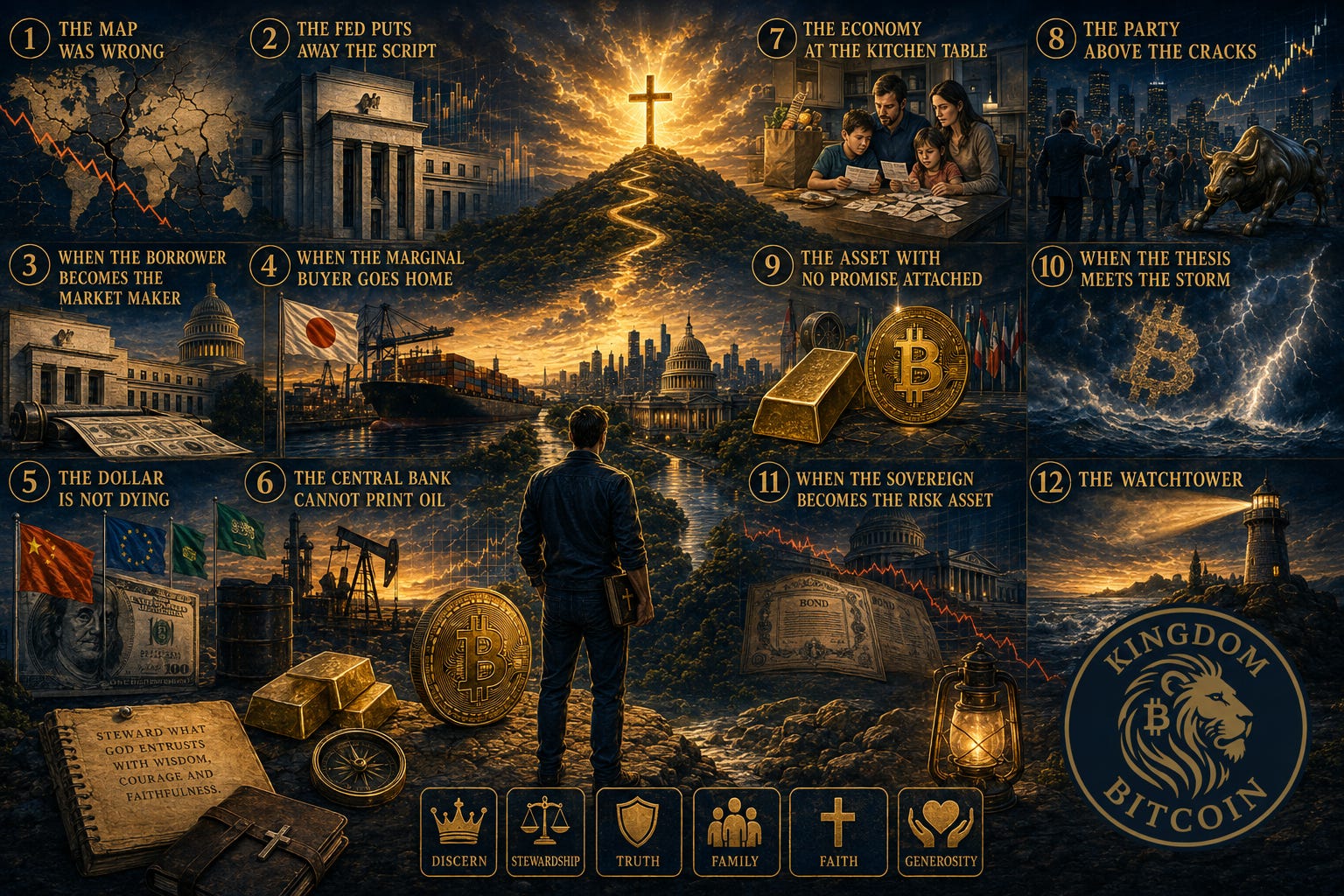
As 2026 enters its final months, the global financial system is being squeezed by rising sovereign debt, stubborn inflation, geopolitical conflict, shifting capital flows, and a growing question about who still trusts the promises beneath modern money. The Sovereign Squeeze examines how these forces connect, why Bitcoin matters within them, and how Christians can navigate the changing financial landscape with wisdom, stewardship, and confidence rooted in Jesus Christ rather than markets.
Ruth walked into the fields of Bethlehem with no Bloomberg terminal, no retirement account, and certainly no economist explaining that aggregate conditions remained resilient. She was a widow, a foreigner, and economically vulnerable, gathering what remained behind the harvesters so she and Naomi could eat. Israel’s law commanded landowners not to harvest every corner of their fields precisely because God understood that an economy is ultimately experienced by people, not statistics. Boaz went further, protecting Ruth’s dignity while allowing her to work, gather, and participate rather than reducing mercy to dependence. The story is ancient, but the principle could not be more current: God sees the household hidden inside the number.
That matters because the American economy in 2026 looks very different depending upon where you are standing. Unemployment is around 4.1%, which hardly sounds catastrophic, yet labor-force participation has fallen sharply and recent payroll data has been weak. Average hourly earnings have risen, but not quite enough to outrun headline inflation, leaving real wages slightly negative. Initial unemployment claims remain relatively contained, suggesting companies are not firing aggressively, but they are not hiring enthusiastically either. Economists call this a low-fire, low-hire economy; the person sending out résumés calls it exhausting.
This is where headline statistics can become unintentionally pastoral in the worst possible way. Telling a struggling family that aggregate data remains healthy may be numerically correct and emotionally useless. Inflation is measured through baskets, weights, averages, substitutions, and methodologies necessary to understand an enormous economy, but no household lives inside the average basket. Families live inside their own basket. If your biggest expenses are housing, healthcare, childcare, gasoline, insurance, and groceries, your experience can differ dramatically from the number scrolling across CNBC.
Housing makes the divide impossible to ignore. The average 30-year mortgage rate remains around 6.7%, median existing-home prices are still above $430,000, and prices have continued rising even while housing starts have fallen sharply. That is a cruel combination because higher mortgage rates make existing homes less affordable while weaker construction limits the new supply that could relieve prices over time. Rent has softened nationally in some markets, which is welcome, but geography matters enormously; some high-demand cities continue experiencing meaningful increases. A national average may bring comfort until the landlord sends your actual renewal notice.
America once understood homeownership as more than an asset trade. The Homestead Act of 1862 reflected a broader American conviction that property, rootedness, work, and self-government were connected, even though the history around western land expansion carries serious injustices that should not be romanticized. Earlier American thinkers likewise associated broad property ownership with independence because someone capable of supporting a household possessed greater freedom to resist coercion. Today, a young family looking at a $430,000 home financed above 6% may wonder whether the American Dream now requires a private-equity term sheet. The joke lands because the problem is not funny.
Healthcare creates another gap between measured inflation and lived inflation. Official medical-care inflation can look relatively modest while individual families experience insurance premiums, deductibles, prescription costs, and out-of-pocket expenses rising far faster. The measurement is not fraudulent; it simply measures a complex system differently than a household experiences the monthly cash leaving its account. This is one reason consumer sentiment remains extraordinarily weak even while equity markets sit near highs. A rising S&P 500 feels excellent if you own enough of it, but it does not lower the deductible when your child needs an MRI.
Then there is debt. Aggregate household delinquency does not suggest universal distress, yet certain populations are showing serious strain. Subprime auto delinquencies have reached troubling levels, and student-loan delinquency has surged after the return of federal repayment enforcement. The upper portion of the economy can borrow against appreciating assets, benefit from equities, and absorb higher prices with relatively little behavioral change. The household living paycheck to paycheck encounters the same price increase as a forced decision about what gets postponed.
This is what people mean by a K-shaped economy, although we should use the phrase carefully. Some data challenges the popular claim that the top ten percent suddenly accounts for an unprecedented share of consumption, while wealth concentration undeniably leaves households with very different cushions against economic shocks. The distinction matters. Two families may spend similar percentages of income, but one has equities, home equity, cash reserves, and access to cheap credit while the other has a car payment and a checking account approaching fumes.
James writes that withheld wages cry out before God, while Leviticus commands Israel to leave part of the harvest for the poor and the foreigner. Scripture consistently refuses to separate economic structures from human dignity. It does not guarantee equal outcomes, condemn wealth, or teach that government should eliminate every hardship. It does insist that economic arrangements should be judged partly by what they do to people who possess the least ability to absorb distortion.
This is also where Bitcoin needs to remain in its proper place. Bitcoin does not fix your grocery bill, lower your mortgage rate, increase your salary, eliminate your medical deductible, or make childcare cheaper. If someone tells a family under financial strain that all they need is more bitcoin, that is not financial education. It is evangelism for an asset wearing a pastoral collar.
Bitcoin’s relevance is more specific and more important. Households need a way to carry some portion of today’s labor into tomorrow without being forced into increasingly complex speculation merely to preserve purchasing power. Bitcoin offers a scarce monetary asset whose supply cannot expand in response to political pressure, but its price remains volatile and its ownership demands education, risk management, and patience. It can be one component of long-term household stewardship, not a substitute for income, emergency savings, productive assets, disciplined spending, generosity, or marketable skills.
That distinction is central to Kingdom Bitcoin. Financial freedom begins long before a hardware wallet. It begins when a household creates margin, reduces fragile debt, increases productive capacity, understands what it owns, teaches children how money works, and refuses to allow fear to determine every financial decision. Bitcoin becomes more useful inside a healthy household than as an attempted rescue for an unhealthy one.
Ruth did not need a lecture about national GDP. She needed access to the field, protection from exploitation, the dignity of work, and enough provision to carry her household forward. Boaz understood that prosperity carried responsibility, and his stewardship created room for someone vulnerable to flourish without stripping away agency. That is an economic vision worth recovering.
The economy ultimately arrives at the kitchen table. The Federal Reserve can measure it. Wall Street can trade it. Washington can debate it. But families have to live inside it.
And if we want to understand whether an economy is truly flourishing, perhaps we should spend less time admiring the headline and more time asking whether ordinary households can still build a future beneath it.
Kingdom Principle 👑
Economic statistics matter, but God sees the household inside the number.
Biblical stewardship refuses both economic naivety and economic despair. God cares about work, wages, property, provision, debt, generosity, and the dignity of people navigating difficult circumstances. He calls those with resources to steward them wisely and those under pressure to pursue wisdom without allowing fear to become their master.
Bitcoin may help households preserve part of the fruit of their labor across time, but no asset replaces the deeper work of household formation. Margin, skills, disciplined spending, generosity, honest work, wise investing, and faith remain the stronger foundation.
Prayer 🙏
Heavenly Father, look with mercy upon families who are working faithfully yet feel the future moving farther away. Give provision to those struggling with housing, healthcare, debt, employment, and rising everyday costs, and give leaders wisdom to see beyond aggregate statistics into the lives of the people their decisions affect. Raise employers like Boaz who understand that prosperity carries responsibility and that human dignity matters alongside productivity.
Teach our households to work faithfully, build margin, avoid destructive debt, grow in wisdom, and remain generous even when the economic environment feels uncertain. Help us use Bitcoin and every financial tool with discipline rather than desperation, and keep our confidence rooted in Jesus Christ, who sees every household, knows every need, and remains our provision in every season.
In Jesus’ name, Amen. 🙏📖🌾🏠💼⚖️₿🕊️👑