

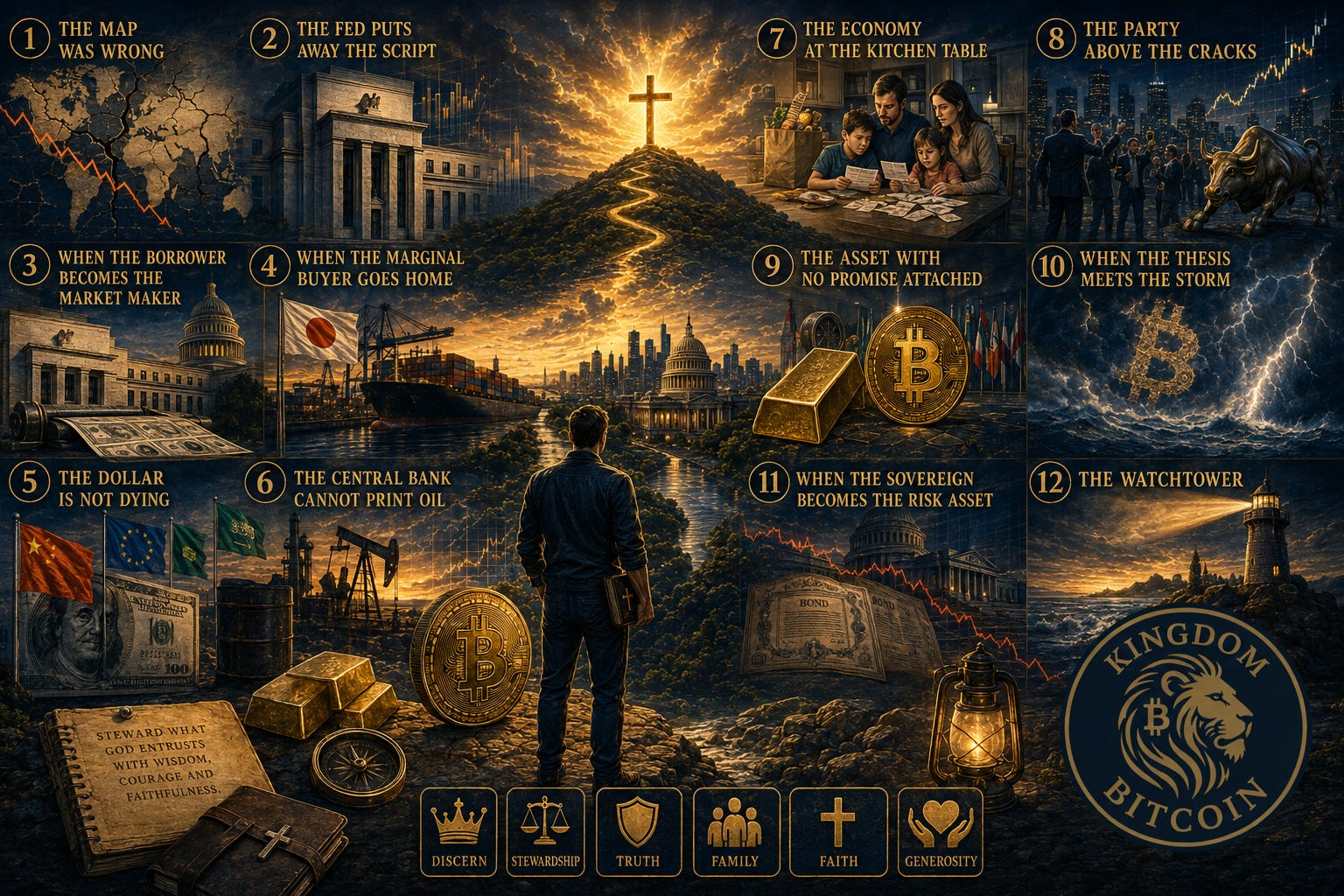
As 2026 enters its final months, the global financial system is being squeezed by rising sovereign debt, stubborn inflation, geopolitical conflict, shifting capital flows, and a growing question about who still trusts the promises beneath modern money. The Sovereign Squeeze examines how these forces connect, why Bitcoin matters within them, and how Christians can navigate the changing financial landscape with wisdom, stewardship, and confidence rooted in Jesus Christ rather than markets.
At the beginning of 2026, Wall Street walked into the year carrying a map that looked remarkably tidy. The Federal Reserve had cut rates three times during the second half of 2025, inflation appeared to be drifting toward something more manageable, the dollar had just suffered its weakest year since 2017, and nearly every major forecast assumed more rate cuts were coming. Japan was expected to normalize slowly, Europe was supposed to remain cautious, gold had already enjoyed an extraordinary run, and Bitcoin’s retreat from its October 2025 high looked like another familiar post-rally correction. The map said easier money, lower rates, a softer dollar, and gradually improving financial conditions. Then reality looked at the map and apparently decided not to use it.
By September, the Federal Reserve had not cut once in 2026. Three FOMC members dissented at the July meeting because they wanted to raise rates, the European Central Bank had already hiked, and the Bank of Japan was operating with its highest policy rate in decades while considering another move. Long-term government borrowing costs reached levels not seen for years across the United States and Europe and records in parts of Japan. Oil had traveled from roughly $63 a barrel at the beginning of the year to an intraday peak near $126 before settling closer to the mid-$90s. Somehow, through war, inflation, rising bond yields, and a hawkish new Federal Reserve chairman, the S&P 500 had still avoided even a normal ten-percent correction.
That is what economists call a regime change, although “the old playbook stopped working” may be more useful around the kitchen table. A forecast says where we think the road is going. A regime describes the conditions governing the road itself. When the regime changes, relationships investors assumed were durable begin behaving differently, and portfolios built for yesterday discover they are standing in tomorrow. This is why understanding the times matters more than defending the forecast.
Scripture gives us an extraordinary picture in the men of Issachar, described as those “who understood the times and knew what Israel should do.” Their gift was not clairvoyance. They were not staring into a prophetic Bloomberg terminal. They possessed discernment, the ability to observe the conditions around them, understand what those conditions meant, and respond wisely rather than merely repeating what had worked before.
That posture is desperately needed now. The defining economic problem of 2026 is not simply that inflation returned. It is that inflation arrived in a form central banks are poorly equipped to fix. The war in the Middle East and the disruption around the Strait of Hormuz created a major energy supply shock, helping push U.S. headline inflation above core inflation as gasoline and energy prices surged. The Federal Reserve can increase the cost of borrowing, weaken demand, and cool hiring, but Kevin Warsh cannot manufacture a barrel of oil in the Eccles Building basement no matter how hawkish the press conference becomes.
That creates an uncomfortable dilemma. Do nothing, and households may begin believing that three or four percent inflation is simply normal. Tighten aggressively, and policymakers risk weakening employment and investment without solving the underlying shortage causing the price increase. The bond market currently appears more confident than households that inflation will eventually retreat, with longer-term market expectations remaining relatively anchored while consumer surveys show significantly higher expectations. That gap matters because inflation becomes more dangerous when it moves from prices into psychology.
Once people expect prices to rise persistently, behavior changes. Workers demand higher wages because they anticipate higher expenses, businesses raise prices because they anticipate higher costs, and households accelerate purchases because waiting seems irrational. Inflation stops being merely something the economy experiences and begins becoming something the economy expects. The central bank is then fighting not only the price of gasoline, but a story people have begun telling themselves about the future.
This is where I think Christians need to recover a much richer understanding of discernment. Ecclesiastes tells us there is a season for everything, yet we often manage money as though every season behaves alike. We want one strategy, one forecast, one favorite economist, and preferably one chart that reassures us we understood everything correctly. The Holy Spirit, however, does not call us to worship our models. He calls us to wisdom.
George Washington understood something similar during the Revolution. He eventually stopped trying to defeat the British by repeatedly fighting the kind of conventional war they were built to win. Survival itself became strategy. He retreated when necessary, preserved the Continental Army, changed tactics, and recognized that winning the war mattered more than winning every engagement. The map changed, so the strategy had to change without the mission changing with it.
That distinction should shape the way we think about money now. Our principles should remain durable even when our tactics change. Work matters. Margin matters. Avoiding foolish leverage matters. Generosity matters. Owning productive assets matters. Protecting the purchasing power of savings matters. None of those principles requires us to predict whether the next Fed move is twenty-five basis points higher or lower.
Bitcoin belongs inside this conversation, but perhaps not in the way its loudest advocates sometimes suggest. Bitcoin has a fixed supply schedule and a monetary architecture resistant to discretionary expansion, but its market price still lives inside global liquidity. When interest rates rise and financial conditions tighten, investors can sell bitcoin just as they sell equities, credit, and other liquid assets. Scarcity describes the protocol. It does not guarantee the price path.
That distinction is critical because Bitcoin’s usefulness is larger than a promise that it always rises when the macroeconomic world becomes uncomfortable. It asks whether there should be at least one monetary asset whose issuance cannot be revised because policymakers misread the year, a war changes the inflation outlook, or financial markets need another rescue. Bitcoin cannot make our forecasts correct. It can make one important monetary rule unusually difficult to change.
The lesson of 2026 is therefore not that economists are useless or that markets are unknowable. It is that humility should always accompany conviction. The wise investor, builder, parent, and steward learns to distinguish what is permanent from what is conditional, what is principle from what is positioning, and what is truth from what was merely consensus.
The map was wrong.
That does not mean we stop navigating.
It means we learn to read the terrain.
And if the regime has truly changed, the next institution we must understand is the one entrusted with managing the price of money itself: the Federal Reserve.
Kingdom Principle 👑
Discernment begins when we stop forcing new conditions into old assumptions.
God does not call us to predict every economic turn. He calls us to wisdom, vigilance, humility, and faithful stewardship within the season we have actually been given. The men of Issachar understood the times so they could act faithfully within them, not so they could boast about having the best forecast.
The same is true for us. Markets change, governments change, monetary regimes change, and yesterday’s strategy may become tomorrow’s vulnerability. Biblical principles remain. We are called to work faithfully, prepare wisely, avoid fear, reject greed, preserve margin, remain generous, and seek the Holy Spirit’s discernment when the terrain shifts beneath us.
Prayer 🙏
Heavenly Father, give us the wisdom to understand the times without becoming consumed by them. Protect us from pride when our forecasts are right and stubbornness when reality proves them wrong. Teach us to distinguish lasting principles from temporary conditions and to respond to changing seasons with courage rather than fear.
Guide our leaders as they navigate inflation, war, debt, employment, and financial instability. Give households patience, discernment, and the discipline to prepare without panicking. Help us use Bitcoin, markets, savings, and every financial tool with wisdom while remembering that none of them deserves our ultimate trust.
May the Holy Spirit sharpen our discernment, may Jesus Christ remain the foundation beneath every decision, and may we become people who understand the times well enough to know what faithful stewardship requires.
In Jesus’ name, Amen. 🙏📖🧭⚖️🏦₿🌍🕊️👑