

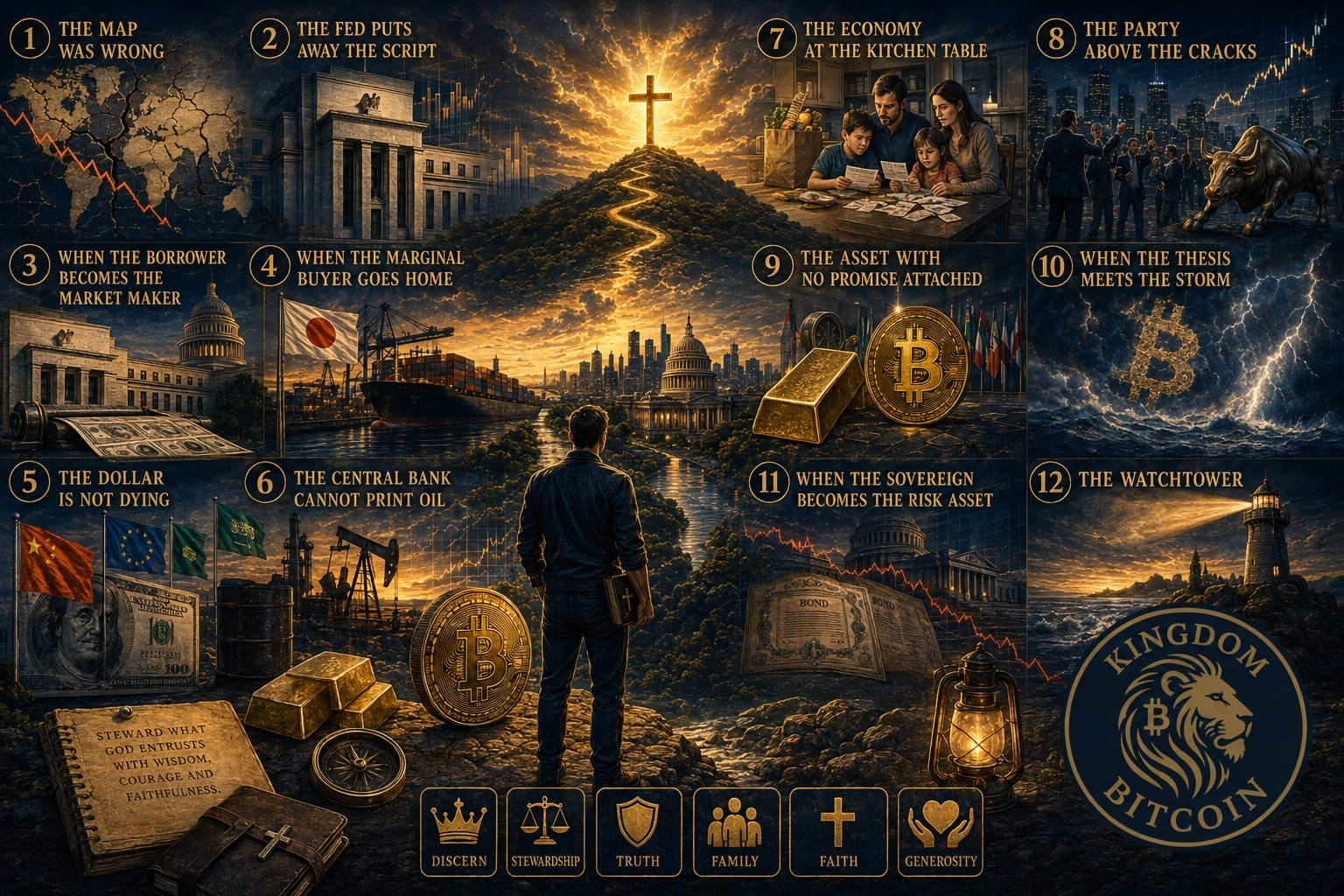
As 2026 enters its final months, the global financial system is being squeezed by rising sovereign debt, stubborn inflation, geopolitical conflict, shifting capital flows, and a growing question about who still trusts the promises beneath modern money. The Sovereign Squeeze examines how these forces connect, why Bitcoin matters within them, and how Christians can navigate the changing financial landscape with wisdom, stewardship, and confidence rooted in Jesus Christ rather than markets.
Abraham stood before the Hittites with a problem every father eventually understands in some form: he needed to secure something that would outlive the present moment. Sarah had died, and Abraham wanted a permanent burial place rather than borrowed access to someone else’s land. Ephron offered him the field, but Abraham insisted on paying the full price publicly. Scripture says he weighed out four hundred shekels of silver “according to the weight current among the merchants,” and the field, cave, and trees were legally transferred into his possession. The transaction was tangible, witnessed, and settled.
There is something almost startlingly modern in Genesis 23. Abraham did not receive an account statement promising future access to the field. He acquired the asset itself. The silver used for payment carried no interest payment, quarterly earnings call, or sovereign promise attached to it. The transaction worked because both parties recognized a scarce asset, an honest weight, and a transfer of ownership that could be witnessed by the community.
That brings us to gold.
If Bitcoiners want to understand what happened over the last eighteen months, we need enough intellectual honesty to say something that may make the orange-pill choir uncomfortable: gold won this round. Gold rose roughly 65% during 2025, its strongest annual performance since 1979, reached an extraordinary peak near $5,600 in January 2026, and even after a violent correction remained up more than 25% over the following twelve months. Bitcoin, facing many of the same arguments about deficits, currency debasement, sovereign risk, and distrust of fiat money, moved in the opposite direction. It peaked above $126,000 in October 2025, fell toward $58,000 by late June, and entered September around $79,000.
Same broad monetary anxiety. Very different outcome.
The easy explanation would be that gold is real money and Bitcoin is not. The equally lazy Bitcoin response would be that gold belongs in a museum and Bitcoin simply has not received the memo yet. Neither explanation teaches us much.
The better answer is about who owned each asset and how those owners financed the position.
Gold’s most important marginal buyers were central banks. China’s central bank has now purchased gold for twenty-one consecutive months, accelerating purchases into periods of price weakness. Poland added more than eighty tonnes this year. Across the official sector, central banks continued accumulating hundreds of tonnes while surveys showed an overwhelming majority expecting global gold reserves to rise further.
These buyers behave differently from traders.
A central bank does not receive a margin call because gold falls 12% on Tuesday. It does not need to sell because its convertible bond trades below par. It does not watch a premium-to-net-asset-value ratio and discover that its financing model stopped working. Reserve managers can be patient, unlevered, and remarkably insensitive to short-term price movements.
When gold fell, many of them bought more. Bitcoin’s marginal buyer had become something very different.
The institutionalization of Bitcoin brought enormous benefits. Spot ETFs expanded access, public companies accumulated large holdings, treasury companies raised capital to acquire bitcoin, and miners operated within increasingly sophisticated capital markets. But financialization works both ways. The same structures that create buyers during rising markets can create forced sellers when conditions reverse.
ETF redemptions can translate investor withdrawals into real bitcoin selling. Bitcoin treasury companies financed through equity, convertible debt, preferred stock, or other structures may stop buying when their market valuation falls below the value of their holdings. Miners facing collapsing profitability may sell reserves simply to fund operations. Leverage turns conviction into a balance-sheet requirement.
Gold did not have the same forced-seller problem. That is the lesson. Assets do not trade only according to what they are. They also trade according to who owns them, how those owners financed the position, and what happens to those owners when price moves against them.
Imagine two farmers who own identical fields. One owns his land outright. The other borrowed heavily against his field, promised fixed payments, and needs crop prices to remain high to service the debt. The soil may be identical, but when drought arrives, the economic behavior of those owners will be completely different.
That is essentially what happened.
Bitcoin’s monetary architecture did not suddenly become less scarce. Twenty-one million did not quietly become twenty-five million. The network continued producing blocks, validating transactions, and enforcing the same rules it had before.
What changed was the financial architecture sitting on top of the asset. This should humble Bitcoiners rather than discourage them.
The ETF era gave Bitcoin legitimacy, liquidity, institutional access, and enormous new pools of capital. It also tied the asset more directly to redemptions, leverage, capital markets, and investors who may have purchased Bitcoin exposure without sharing a Bitcoiner’s willingness to sit through a 50% drawdown while quoting Austrian economics.
Financialization gave Bitcoin a bid. It also gave Bitcoin a leash.
Gold entered this period with a different ownership structure, and that structure mattered enormously. David Einhorn captured the distinction well when he argued that the current gold story is less about ordinary inflation than confidence in fiscal and monetary policy. Central banks increasingly looked at sovereign debt issued by other governments and chose to hold more of an asset with no counterparty standing behind it.
That should get our attention.
The Founders understood hard money from a world very different from ours. Article I of the Constitution constrained states from making anything but gold and silver coin a tender in payment of debts, reflecting deep suspicion of unstable paper promises after the monetary chaos of the Revolutionary era. They did not possess a perfect monetary system, nor should we romanticize eighteenth-century finance. But they understood instinctively that the quality of money and the credibility of government promises were connected.
Bitcoin extends that old question into a digital age. Can value exist without another party’s liability? Gold says yes through physical scarcity. Bitcoin says yes through digital scarcity. Gold has already earned sovereign trust over millennia. Bitcoin is still trying to earn it. And we should be willing to let the evidence teach us rather than forcing the evidence to flatter our thesis.
Truth does not fear unfavorable evidence.
Gold behaved like the sovereign hedge in this cycle because the people buying it were behaving like sovereign reserve managers. Bitcoin behaved like leveraged technology because many of the marginal buyers were financed like leveraged technology.
That does not prove Bitcoin’s hard-money thesis is dead. It tells us the thesis had not yet become the market structure.
Which leads to the next and most uncomfortable chapter in this series. If Bitcoin was supposed to hedge monetary debasement, why did it fail precisely when the thesis should have worked?
And what has changed since?
Kingdom Principle 👑
Truth does not fear unfavorable evidence.
Faithful stewardship requires enough humility to admit when reality does not behave the way our preferred narrative said it should. Gold outperformed Bitcoin during a period when sovereign-credit concerns, inflation, and fiscal anxiety should theoretically have supported both. Rather than explain that away, wisdom asks why.
The answer teaches us something deeper about markets and ourselves. Sound assets can be held through fragile structures, and strong convictions can be financed through weak balance sheets. God calls us not merely to believe strongly, but to examine honestly, test everything, and hold fast to what is good. Bitcoin does not need us to protect it from evidence.
Prayer 🙏
Heavenly Father, give us humility to pursue truth even when it challenges our assumptions. Protect us from tribal thinking, financial pride, and the temptation to bend evidence until it supports what we already wanted to believe. Teach us to understand not only the assets we hold, but the structures, incentives, leverage, and human behavior surrounding them.
Help us recognize the difference between conviction and stubbornness, between scarcity and wisdom, and between a valuable monetary tool and the eternal security found only in You. May the Holy Spirit sharpen our discernment, may Jesus Christ remain the standard against which every claim is measured, and may our stewardship always prefer truth over being proven right.
In Jesus’ name, Amen. 🙏📖⚖️🥇₿🏛️🕊️👑