

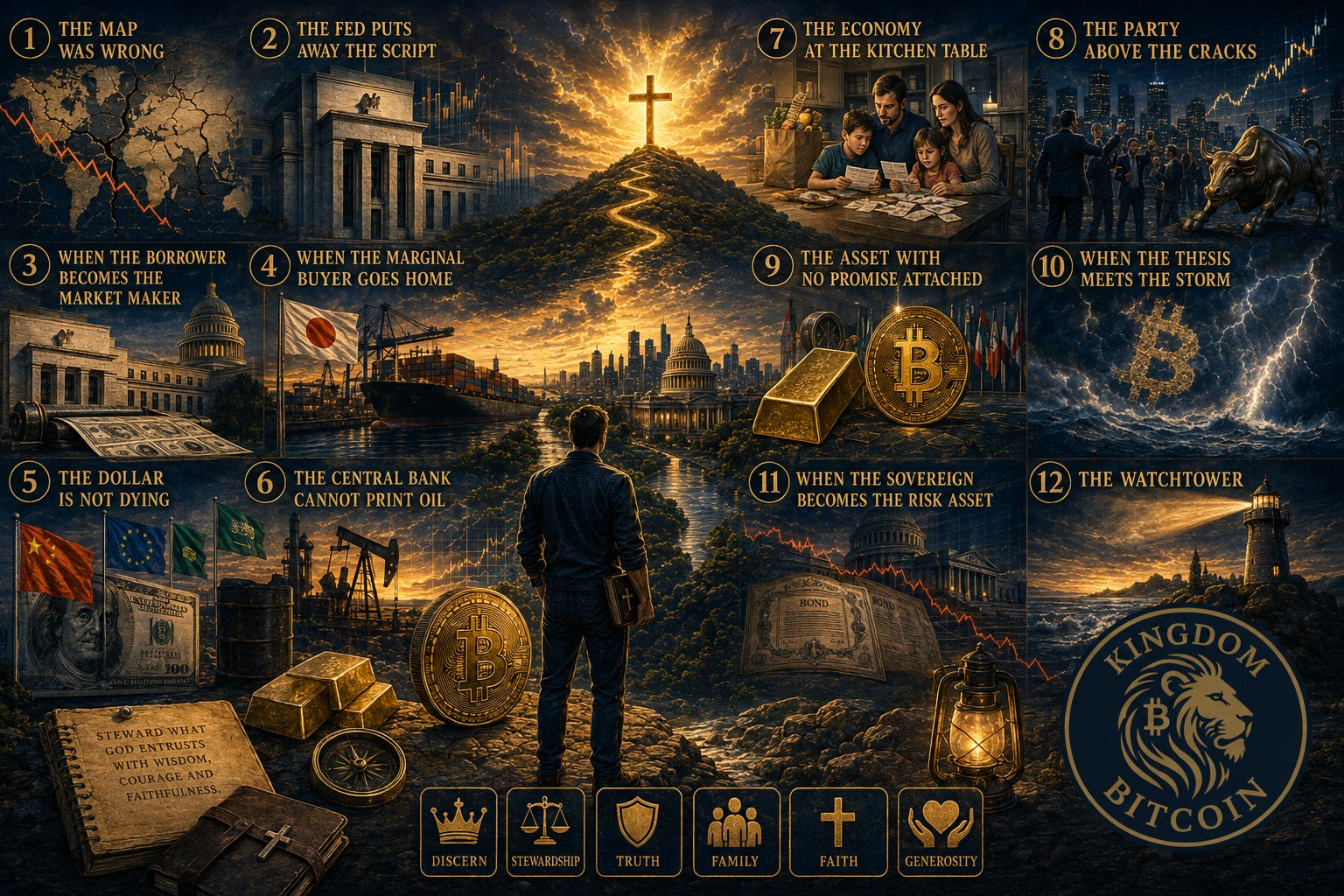
As 2026 enters its final months, the global financial system is being squeezed by rising sovereign debt, stubborn inflation, geopolitical conflict, shifting capital flows, and a growing question about who still trusts the promises beneath modern money. The Sovereign Squeeze examines how these forces connect, why Bitcoin matters within them, and how Christians can navigate the changing financial landscape with wisdom, stewardship, and confidence rooted in Jesus Christ rather than markets.
For more than three decades, Japan quietly played a role in global finance that most households never noticed. Japanese interest rates hovered near zero, domestic bonds offered almost nothing, and enormous pools of savings from insurers, pensions, banks, and households went searching elsewhere for return. Much of that capital flowed into U.S. Treasuries, European sovereign debt, and global credit. America became accustomed to a large, disciplined foreign buyer willing to finance our long-term promises. The problem with anything that feels permanent in markets is that eventually someone discovers it was merely persistent.
That is what is changing now. The Bank of Japan has raised its policy rate to 1.00%, its highest level in roughly three decades, while Japanese government bond yields have risen dramatically. The 10-year JGB has approached 3%, and the 30-year has moved above 4%, levels that would have sounded absurd when Japan was synonymous with zero rates. Suddenly, a Japanese life insurer can earn meaningful yield at home without taking U.S. duration risk and paying to hedge dollars back into yen. The world did not lose a buyer because Japan became hostile to America. The buyer simply found a better reason to come home.
Genesis gives us an unexpectedly useful picture in Jacob. After years in Laban’s household, building wealth and navigating repeatedly changing terms, the Lord tells him, “Go back to the land of your fathers and to your relatives, and I will be with you.” Jacob’s return was spiritual and familial, not a bond-allocation decision, so we should not torture the analogy until it confesses. But the principle travels well: people and capital respond when the conditions of home change. Japan spent decades sending savings outward because home offered very little. Now home is beginning to pay again.
This matters because bond markets are governed at the margin. A Treasury auction does not need every investor in the world to disappear before yields rise. It only needs the next buyer to demand a higher return. That buyer is the marginal buyer, the institution whose willingness to purchase the next bond helps determine the clearing price for everyone else. If that buyer once accepted 2% and now requires 5%, the financing environment changes even if millions of existing bondholders never sell. Markets may allow everyone a vote, but the person writing the next large check gets an unusually loud one.
For years, Japanese institutions were unusually reliable marginal buyers because their domestic alternative was unattractive. A Japanese insurer buying a U.S. Treasury earns the American yield, but it often pays a meaningful cost to hedge dollar exposure back into yen. As Japanese yields rise, that advantage can disappear. The same Treasury that once looked obviously superior can become less attractive than a Japanese government bond sitting a train ride from headquarters. Recent Japanese selling of foreign bonds suggests this is no longer theoretical.
That does not mean foreigners are abandoning America or the dollar is collapsing. Foreign investors still own enormous amounts of U.S. assets, and the dollar remains central to global finance. The important change is subtler: one of the world’s largest pools of patient foreign capital is no longer an automatic buyer of long-term American debt. During the Revolution, America understood this kind of dependence firsthand. Robert Morris knew that armies required credit, credibility, and lenders willing to believe tomorrow’s republic would honor today’s promises. Sovereignty was never the absence of interdependence; it was the ability to remain free while managing that interdependence wisely.
The yen carry trade adds another layer. For years, investors could borrow cheaply in yen and deploy that capital into higher-yielding assets elsewhere. When Japanese rates rise and the yen strengthens, those trades become less attractive and can unwind quickly, forcing investors to sell assets to repay funding. Bitcoin can be one of the first assets sold because it is liquid, global, and trades twenty-four hours a day. When investors need cash, they rarely pause to admire the philosophical purity of the asset they are selling.
That short-term vulnerability does not erase Bitcoin’s longer-term monetary significance. Bitcoin does not owe anyone a coupon, require a pension fund to roll its debt, or hold a thirty-year auction where officials must persuade the next buyer that the promise is still attractive. Its price can fall violently when liquidity disappears, and we should say that plainly. But structurally, Bitcoin belongs to a different category because its scarcity is not financed by someone else’s willingness to keep lending. It is an asset without a sovereign liability attached to the other side.
Ecclesiastes tells us to “invest in seven ventures, yes, in eight; you do not know what disaster may come upon the land.” Scripture is not secretly teaching modern portfolio theory, but it recognizes uncertainty and warns against building everything around one assumption. Japan’s return home reminds us that capital has seasons, incentives change, and yesterday’s reliable buyer may become tomorrow’s seller without anyone behaving irrationally. The wise steward does not panic when the flow changes. He asks what changed, why it changed, and what dependencies his own future quietly rests upon.
The marginal buyer is going home. That does not mean America loses its ability to finance itself, and it certainly does not mean Bitcoin automatically wins. It means the price of sovereign promises is increasingly being set by buyers with better alternatives. When the world’s great pools of capital become more selective, every borrower eventually rediscovers an ancient truth. The lender may be patient, but the lender is never obligated to remain.
Kingdom Principle 👑
Capital has seasons, but faithful stewardship cannot depend upon yesterday’s assumptions remaining permanent.
God calls us to wisdom in changing conditions. Ecclesiastes reminds us that uncertainty is part of life beneath the sun, which is precisely why concentration, dependency, and complacency deserve examination. The wise steward understands who finances the promises around him, what happens when incentives change, and where true security ultimately resides.
Bitcoin offers no guarantee against short-term volatility, but it introduces a monetary asset that does not require another government, institution, or future generation to honor a debt in order for the asset to exist. That distinction becomes increasingly important when the world’s traditional lenders begin reconsidering where they want their capital to live.
Prayer 🙏
Heavenly Father, give us discernment as global capital shifts and assumptions that once appeared permanent begin to change. Teach our leaders to cherish public credit, honor commitments, and avoid presuming that lenders, allies, or future generations will forever finance choices made today. Give us wisdom to understand interdependence without becoming dependent upon systems we have never bothered to examine.
Help our households prepare without fear, diversify without greed, and hold every financial asset in proper perspective. May the Holy Spirit guide our stewardship, may Jesus Christ remain our true security, and may we build lives whose foundations do not depend upon yesterday’s buyer returning tomorrow.
In Jesus’ name, Amen. 🙏📖💴🏛️⚖️₿🕊️👑