

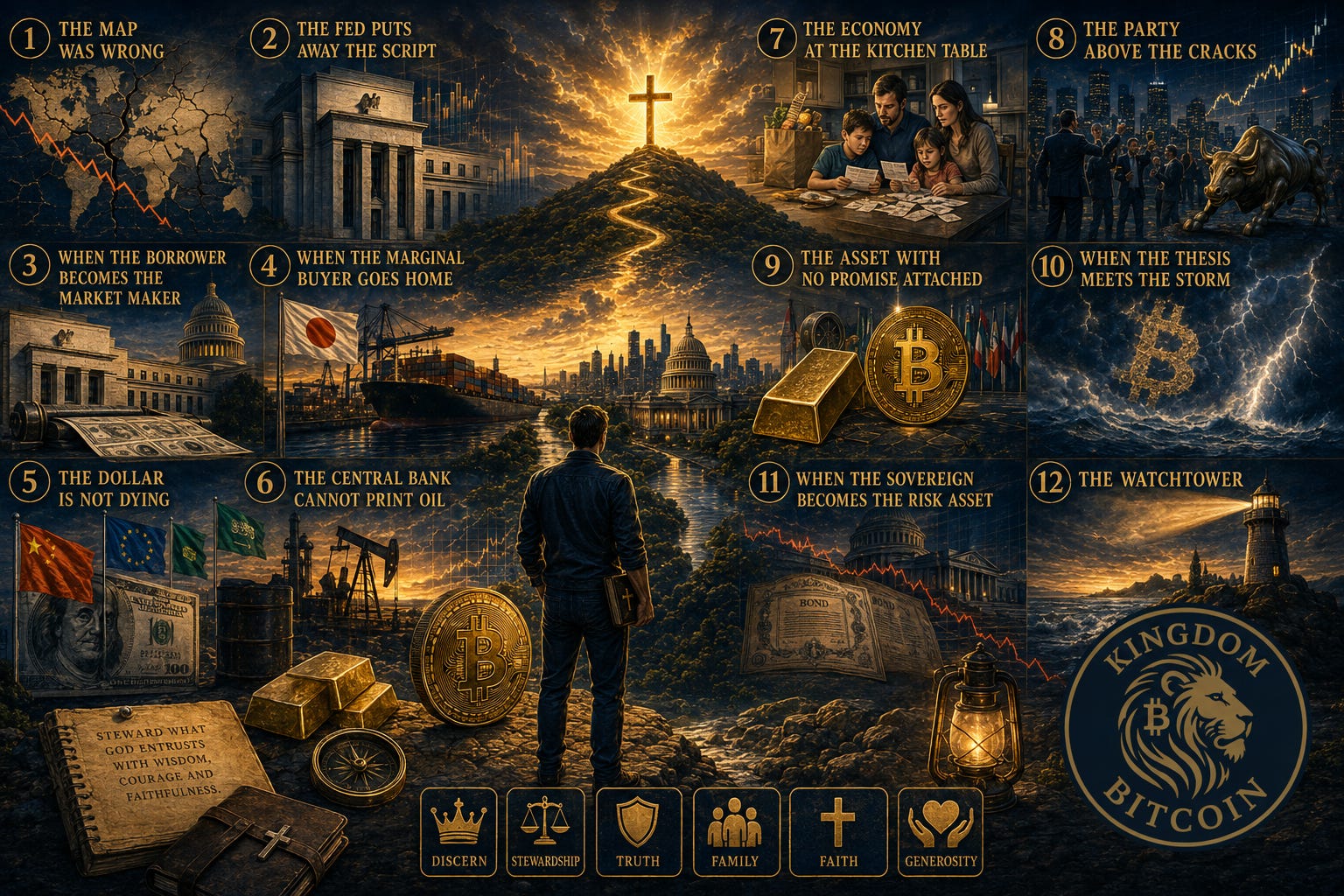
As 2026 enters its final months, the global financial system is being squeezed by rising sovereign debt, stubborn inflation, geopolitical conflict, shifting capital flows, and a growing question about who still trusts the promises beneath modern money. The Sovereign Squeeze examines how these forces connect, why Bitcoin matters within them, and how Christians can navigate the changing financial landscape with wisdom, stewardship, and confidence rooted in Jesus Christ rather than markets.
Babylon looked permanent until it wasn’t. Daniel served under rulers who commanded armies, controlled trade, minted money, and spoke as though empire had discovered a loophole in mortality. Then Babylon gave way to Persia, kings changed, and Daniel remained. His confidence did not survive because he had perfectly diversified his imperial exposure. It survived because he understood something every reserve manager eventually relearns: earthly systems can be enormously powerful without being eternal.
That is the right way to think about the U.S. dollar in 2026. The dollar is not dying, despite the dramatic headline that appears every time China buys gold or two countries settle a trade without using it. It remains the dominant reserve currency and the central language of global banking, trade, collateral, and financial markets. Yet its share of allocated foreign-exchange reserves has declined from roughly 64% in 2017 to about 57% today. That is not collapse. It is slow diversification.
Where that diversification is going matters even more. China’s renminbi still represents only about 2% of allocated reserves, despite years of predictions that Beijing would inherit the dollar’s crown. Central banks are not stampeding from Washington into Beijing’s arms. They are increasingly adding an asset with no government attached to the other side of the balance sheet: gold. Gold now represents roughly 12.5% of global reserves, while China’s central bank has purchased it for twenty-one consecutive months and accelerated buying during periods of weakness. Reserve managers are not necessarily rejecting America; they are reducing dependence upon any single promise.
China makes the story more interesting because the yuan has strengthened this year even while Chinese growth has slowed. Producer-price deflation has ended, Beijing has resisted the aggressive easing many expected, and China continues gradually reducing Treasury exposure while accumulating gold. Europe presents a different problem, with the European Central Bank tightening into energy-driven inflation while fiscal strains become more visible across sovereign bond markets. German long-term yields have reached levels not seen in more than a decade, while French borrowing costs have risen enough to challenge old assumptions about the eurozone’s hierarchy of risk. A shared currency can unify the notes in the wallet. It cannot magically unify the balance sheets behind them.
America has navigated a reserve transition before. In 1944, representatives from forty-four nations gathered at Bretton Woods in New Hampshire and designed a postwar monetary order centered on the dollar, with foreign governments able to convert dollars into gold. The system reflected more than American military power. The United States emerged from war with deep capital markets, enormous productive capacity, substantial gold reserves, and institutions the world was willing to trust. Reserve status was not awarded by slogan. It was earned through credibility and architecture.
The Founding generation understood that relationship long before Bretton Woods. John Adams spent critical years in Europe persuading governments and financiers that the American experiment deserved recognition and credit, and Dutch financing helped sustain the young republic. Independence could be declared with parchment, but nations still required people willing to trust their promises. That is why I resist both extremes in today’s dollar debate. “The dollar can never lose its position” is historically arrogant, while “the dollar is about to collapse” is analytically lazy. Empires can weaken gradually while remaining extraordinarily powerful.
Bitcoin belongs in this discussion, but honesty requires keeping it in its actual place. Most Central Banks today are materially buying gold, not bitcoin, and pretending otherwise would turn conviction into marketing. Gold possesses thousands of years of monetary history, established sovereign custody practices, deep physical markets, and lower volatility. Bitcoin has not yet earned that role at sovereign scale. Truth does not become less useful because it is inconvenient to our preferred thesis.
Bitcoin asks the next question. If reserve managers increasingly value assets that do not depend upon another sovereign’s promise, what happens as a digitally native bearer asset with fixed supply, global portability, no issuer, and increasingly mature custody continues developing? Bitcoin does not need to replace the dollar to matter, nor does it need every central bank to add it next quarter. Its use case strengthens whenever a government, institution, company, or household decides some portion of stored value should sit outside the liability structure of sovereign debt. Gold proved that desire already exists. Bitcoin asks whether part of that desire eventually becomes digital.
This is why the dollar can remain dominant while Bitcoin becomes more important. Those ideas are not contradictory, because reserve systems do not need to crown one new king before they begin distributing trust more broadly. The dollar can remain the world’s primary financial language, gold can continue winning the sovereign diversification bid, and Bitcoin can mature into a separate form of scarce global collateral. Daniel said of God, “He changes times and seasons; he deposes kings and raises up others.” Christians should resist monetary idolatry in every direction, refusing to worship the dollar because America issued it or Bitcoin because no government did.
The better question is not whether the dollar dies. The better question is what nations, institutions, and households choose to hold alongside it as trust becomes more distributed and sovereign promises become more expensive to finance. That is a far more serious conversation than another countdown clock to de-dollarization. It also leads directly to the next force in this series, because reserve transitions usually move slowly while geopolitics can rewrite prices before breakfast. War does not wait for the monetary committee to finish its meeting.
Kingdom Principle 👑
No earthly monetary order is eternal, which is why stewardship must distinguish durable principles from temporary dominance.
Scripture reminds us that kingdoms rise and fall, but God remains sovereign over history. The dollar’s strength, gold’s resurgence, China’s ambitions, and Bitcoin’s growth all matter, yet none deserves worship. Faithful stewardship requires us to understand the systems around us without confusing their present importance with permanence.
The wise Christian does not panic at every headline about de-dollarization or dismiss every sign of diversification because the dollar remains dominant. We watch carefully, tell the truth about what is changing, and keep our confidence anchored above every earthly currency.
Prayer 🙏
Heavenly Father, give us wisdom to understand shifting power without becoming fearful of it. Teach our leaders to preserve credibility, honor commitments, and steward America’s financial influence with humility rather than entitlement. Give nations wisdom to pursue stability without turning money into another instrument of domination.
Help our households prepare faithfully, diversify wisely, and resist the temptation to make any currency, metal, or digital asset our ultimate security. May the Holy Spirit sharpen our discernment, and may Jesus Christ remain the one unchanging foundation beneath every season, empire, and monetary order.
In Jesus’ name, Amen. 🙏📖🌍💵🥇🇨🇳🇪🇺₿🕊️👑