

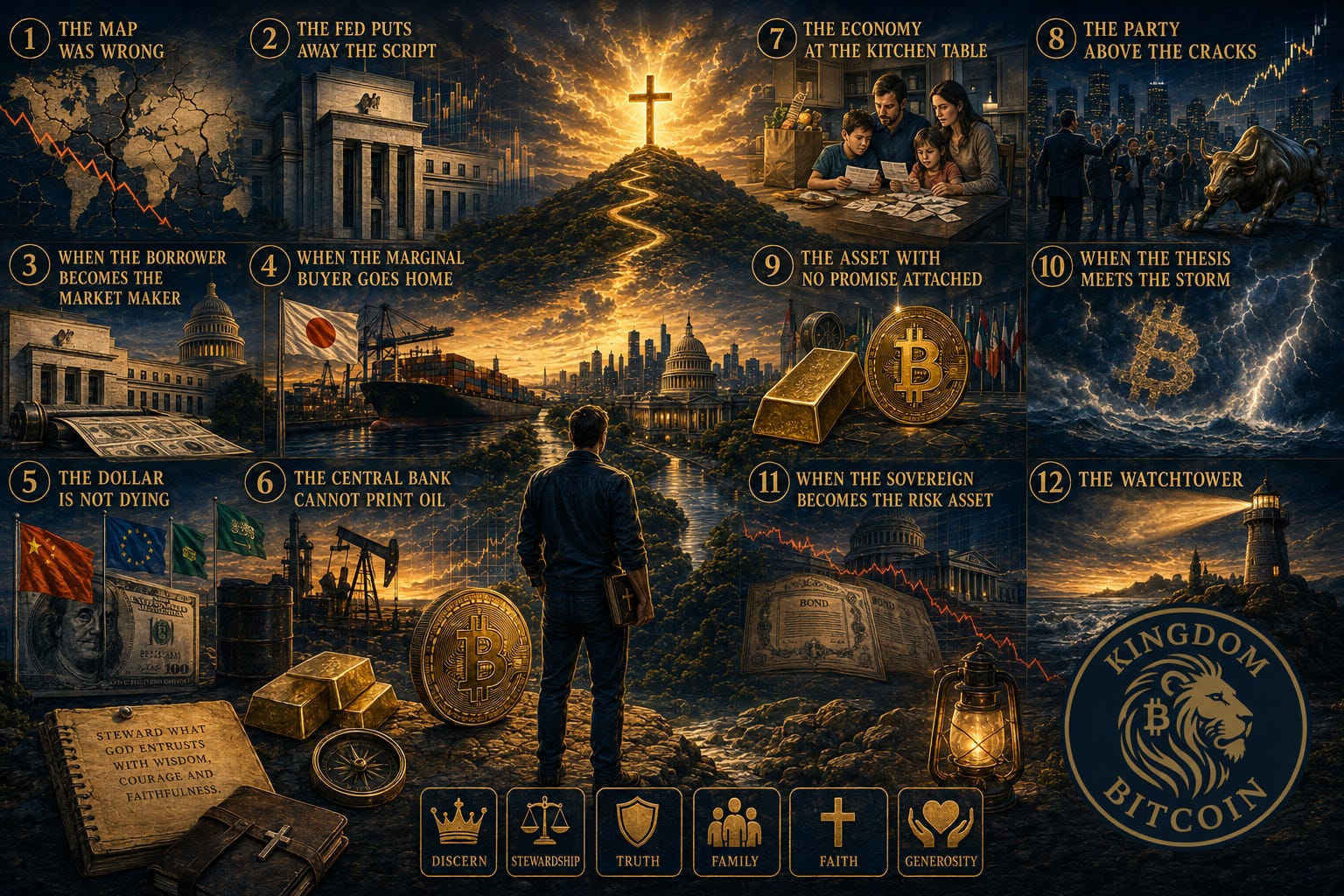
As 2026 enters its final months, the global financial system is being squeezed by rising sovereign debt, stubborn inflation, geopolitical conflict, shifting capital flows, and a growing question about who still trusts the promises beneath modern money. The Sovereign Squeeze examines how these forces connect, why Bitcoin matters within them, and how Christians can navigate the changing financial landscape with wisdom, stewardship, and confidence rooted in Jesus Christ rather than markets.
Alexander Hamilton understood something about national power that remains true more than two centuries later: a government’s promises are only as strong as the confidence behind them. After the Revolution, the United States had independence, a Constitution taking shape, and enough debt to make the celebration considerably less festive. Hamilton believed establishing sound public credit was essential because a nation that could not borrow credibly would struggle to defend itself, build infrastructure, or command respect abroad. The young republic had won sovereignty on the battlefield, but now it had to prove that sovereignty could be financed.
That is why the most important chart in global markets over the next few months may not be Bitcoin, gold, the S&P 500, or even the federal funds rate. It may be the yield on the thirty-year U.S. Treasury bond. The 30-year yield has moved above 5%, touching levels unseen for nearly two decades, while long-term sovereign yields have also surged in Germany, France, and Japan. Japanese 30-year government bonds have reached record territory, French yields have climbed to levels associated with a very different era of European risk, and German long rates are at multi-year highs. When developed governments all begin paying materially more for long-term money at the same time, the issue is bigger than one central bank having a difficult quarter.
For generations, Treasuries have been treated as the foundation of modern finance because the United States government is presumed capable of honoring its obligations. They function as collateral, reserves, pricing benchmarks, and the denominator against which enormous portions of the financial world judge risk. In textbooks, the Treasury rate is often called the “risk-free rate,” which is useful shorthand but dangerous theology. No financial asset created by human beings is literally free of risk. The real question is what kind of risk the market has chosen to ignore because history made ignoring it reasonable.
The arithmetic is becoming harder to ignore. Federal debt has crossed $40 trillion, the annual deficit remains near 6% of GDP, and net interest expense is approaching roughly $1.1 trillion. Foreign investors still hold trillions of dollars of Treasuries, but their share of the overall market has declined dramatically over the decades as America’s borrowing needs expanded faster than foreign demand. Japan, traditionally one of America’s largest and most dependable creditors, now has increasingly attractive yields available at home. China has been reducing Treasury exposure for years while steadily adding gold.
None of this means the Treasury market is collapsing. That phrase is too dramatic and, more importantly, too imprecise. The United States still possesses enormous taxing capacity, deep capital markets, global military power, the dominant reserve currency, and institutions capable of mobilizing resources at extraordinary scale. The more interesting question is what price investors increasingly require to hold promises extending thirty years into the future. Bond markets rarely send a press release saying credibility has weakened; they simply raise the rent.
Psalm 146 warns, “Do not put your trust in princes, in human beings, who cannot save.” That is not an argument against government or public credit. It is a warning about placing ultimate confidence in institutions incapable of bearing ultimate weight. Governments can be powerful, competent, necessary, and still subject to arithmetic, human nature, and time.
This brings us to fiscal dominance, a phrase that sounds designed to ensure normal people immediately change the subject. The concept is actually simple. Fiscal dominance begins to emerge when government debt and borrowing needs become large enough that monetary policy cannot be made without increasingly considering the government’s ability to finance itself. The central bank may want higher rates to control inflation, while the Treasury faces exploding interest costs precisely because rates are higher.
Imagine a father trying to discipline household spending while simultaneously discovering that every act of discipline raises the interest rate on the family’s mortgage. That tension eventually changes the conversation. The United States is not yet trapped in some unavoidable mathematical death spiral, but the tension between monetary restraint and fiscal financing is becoming more visible. The Fed wants inflation credibility. Treasury wants a functioning bond market. Both are legitimate goals, yet they can collide when debt is enormous.
This is why September 16 was unusually revealing. Markets were debating whether the Federal Reserve would raise rates, but I care almost as much about what the thirty-year Treasury did after the decision. If the Fed tightens and the 30-year yield falls, the market is effectively saying, “We believe you.” Investors would be signaling that tougher monetary policy strengthens long-term inflation credibility enough to make government bonds more attractive.
But imagine the opposite. The Fed raises rates to demonstrate discipline, and the 30-year yield rises anyway. That would suggest investors are looking past the central bank’s short-term action toward larger concerns about deficits, future issuance, inflation, and sovereign financing. The central bank tightens, yet the government’s long-term borrowing cost still increases.
That would be a very different signal.
It would say the price of sovereign duration is becoming less responsive to monetary-policy credibility and more responsive to fiscal arithmetic. Treasury could respond with larger buybacks, different issuance strategies, greater coordination with foreign central banks, or eventually increasing pressure for monetary support. Each measure might be perfectly defensible in isolation. Taken together, however, they could convince markets that government debt is no longer simply financing policy. Policy is increasingly being organized around financing the debt.
George Washington warned against burdening posterity because he understood that public debt is ultimately a moral relationship between generations. Habakkuk uses even sharper imagery, warning of those who pile up what is not theirs and asking how long before creditors suddenly arise. Scripture is not providing a sovereign-debt trading strategy, but it repeatedly recognizes a truth economists occasionally hide beneath decimal points: obligations accumulate, and someone eventually bears them.
This is where gold and Bitcoin become unusually interesting. Gold has already been repriced by central banks as an asset without a sovereign promise attached. Bitcoin offers a newer version of that characteristic: no government issuer, no refinancing schedule, no coupon payment, no future taxpayer required to make the asset whole. Its supply does not expand because servicing yesterday’s bitcoin became politically uncomfortable.
That does not mean Bitcoin becomes risk-free because Treasuries become riskier. Bitcoin remains volatile, can fall violently during liquidity shocks, and has yet to earn anything remotely resembling the sovereign reserve role gold enjoys. But if the market increasingly questions whether the supposedly risk-free asset contains more fiscal risk than previously assumed, the intellectual case for owning some assets outside sovereign liability structures grows stronger.
Bitcoin does not need America to fail.
That is one of the most important things Christians and Bitcoiners alike should understand. The constructive thesis is not collapse. It is diversification of trust.
I want America to flourish, our currency to remain credible, our debts to be honored, our institutions to function, and our children to inherit something stronger than an interest bill. Wanting some wealth outside sovereign promises is not rooting against the country. In many ways, it is the same prudential instinct that led the Founders to build checks and balances around power they hoped would be exercised well.
We are approaching a moment when the question may no longer be whether governments can borrow.
They can. The question is what the world will increasingly charge them to do it.
And if the sovereign itself is becoming part of the risk equation, then the final task is not predicting disaster. It is learning how to stand on the watchtower, recognize the signals, and steward wisely whatever comes next.
Kingdom Principle 👑
The borrower may command enormous power, but arithmetic eventually retains veto authority.
Scripture respects legitimate authority while refusing to confuse earthly power with permanence. Governments can tax, borrow, regulate, and influence markets, but they cannot repeal mathematics or escape the moral responsibility attached to promises made across generations. Wisdom therefore asks not merely whether a debt can be financed today, but whether the structure surrounding it remains truthful and sustainable tomorrow.
Bitcoin matters because it offers an asset whose existence is not another party’s debt. That characteristic deserves attention as sovereign obligations grow, but Bitcoin must remain a tool rather than an object of fear-driven worship. Our deepest security belongs neither in Treasuries nor bitcoin, but in the God whose Kingdom carries no refinancing risk.
Prayer 🙏
Heavenly Father, give wisdom and courage to those entrusted with America’s finances. Help our leaders cherish public credit, speak truthfully about debt, resist shifting unnecessary burdens onto future generations, and pursue policies that preserve both monetary credibility and long-term national strength. Guard us against fearmongering on one side and complacency on the other.
Teach our households to understand the promises beneath the assets we own and to steward wealth with humility, patience, and discernment. May the Holy Spirit help us recognize changing conditions without becoming captive to them, may Bitcoin and every financial tool remain in its proper place, and may Jesus Christ remain the only sovereign in whom our ultimate trust is secure.
In Jesus’ name, Amen. 🙏📖🇺🇸🏛️📉⚖️🥇₿🕊️👑