

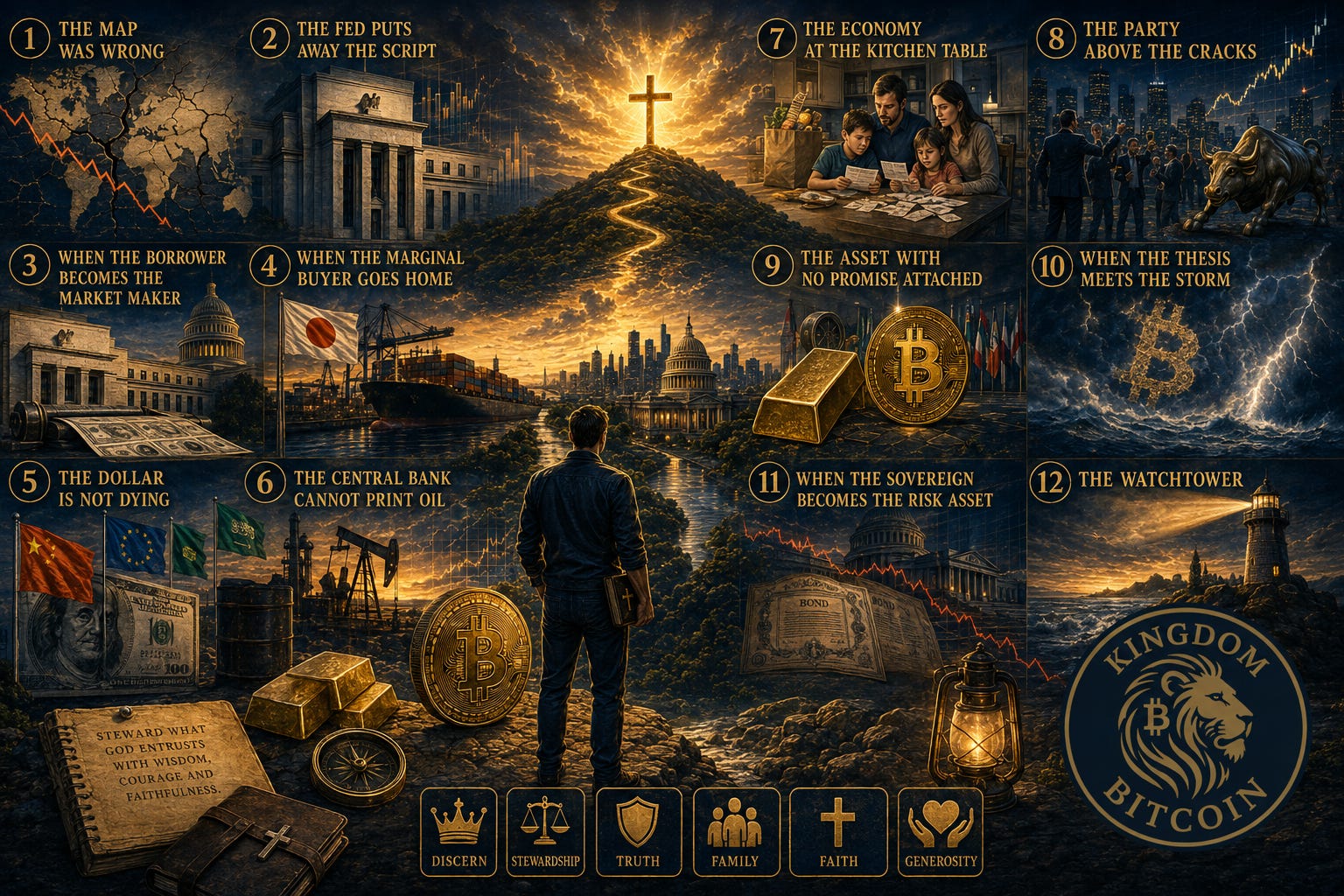
As 2026 enters its final months, the global financial system is being squeezed by rising sovereign debt, stubborn inflation, geopolitical conflict, shifting capital flows, and a growing question about who still trusts the promises beneath modern money. The Sovereign Squeeze examines how these forces connect, why Bitcoin matters within them, and how Christians can navigate the changing financial landscape with wisdom, stewardship, and confidence rooted in Jesus Christ rather than markets.
King Belshazzar was throwing quite a party. Daniel 5 describes a banquet for a thousand nobles, wine flowing freely while Babylon’s ruling class celebrated inside walls they assumed were impenetrable. Then a hand appeared and began writing on the wall. Daniel interpreted the message with words no portfolio manager wants attached to his holdings: “You have been weighed on the scales and found wanting.” While the party continued upstairs, the foundation of the kingdom was already failing beneath them.
There are moments in markets when that story feels uncomfortably familiar. The S&P 500 is up nearly 12% in 2026 and has not even suffered a normal 10% correction despite war in the Middle East, oil briefly reaching roughly $126, a Federal Reserve contemplating higher rates, and the 30-year Treasury reaching its highest yield in almost two decades. The VIX, Wall Street’s familiar fear gauge, remains around 16, while investment-grade and high-yield credit spreads sit near cycle lows. In plain English, the market is pricing remarkably little fear into an environment offering no shortage of reasons to possess some.
Perhaps markets know something the bond market does not. Perhaps artificial intelligence productivity will explode, corporate earnings will grow into valuations, energy disruption will fade, inflation will retreat, and long-term yields will eventually fall. Those are not ridiculous possibilities. But another possibility deserves equal attention: equity and credit markets may simply be the last guests at Belshazzar’s banquet to notice the handwriting.
Credit spreads are especially important because they tell us how much additional yield investors demand to lend money to companies rather than the U.S. government. When spreads are narrow, markets believe corporate defaults and financial stress are relatively unlikely. Today, investment-grade spreads are around 81 basis points and high-yield spreads near 265 basis points, exceptionally calm readings given the macro environment. The bond market is charging the federal government dramatically more to borrow for thirty years while charging risky corporations remarkably little extra compensation for credit risk. Somewhere inside that contradiction is a story worth understanding.
Then there is artificial intelligence. The largest technology companies are guiding toward roughly $725 billion of capital expenditures in 2026, up dramatically from 2025, as Microsoft, Alphabet, Amazon, Meta, and others race to build data centers, secure chips, expand power capacity, and develop the infrastructure necessary for the AI age. This is not the software boom of the 2010s, when another million users could often be served at relatively modest incremental physical cost. AI eats chips, transformers, electricity, cooling systems, land, memory, water, and increasingly large quantities of capital.
Apparently artificial intelligence has become smart enough to help grow GDP and expensive enough to annoy the Federal Reserve at the same time.
That last point is more important than the joke. AI-related hardware prices have risen enough to contribute meaningfully to core inflation, creating an unusual feedback loop. The same investment boom supporting economic growth is also consuming scarce components and infrastructure at a scale that can contribute to price pressure. The Federal Reserve then considers tighter policy partly because inflation remains elevated, which raises the cost of financing the very investment boom helping support the economy.
There is another question hiding underneath the spending: who ultimately finances all of it? Reports of enormous financing arrangements linking chip suppliers, AI companies, and data-center projects have already caused credit markets to twitch. When Nvidia was reported to be considering large financing support around OpenAI infrastructure and chip purchases, its equity price moved, but the more revealing reaction came from credit-default swaps, where the market suddenly demanded more compensation for insuring Nvidia debt. Equity investors remained excited about growth. Credit investors briefly asked who was paying for dinner.
We have seen versions of this movie before. The railroad boom transformed America and still produced spectacular financial failures. The internet revolution changed civilization and still produced the dot-com crash. Housing remained fundamental to human flourishing while mortgage structures helped create the 2008 financial crisis. A technology can be genuinely revolutionary while the capital structure surrounding its adoption becomes irrational.
Benjamin Franklin understood the difference between optimism and prudence. His generation was building something unprecedented, yet the culture of the Founding repeatedly emphasized thrift, discipline, enterprise, and skepticism toward obligations that could not be supported. Franklin did not oppose ambition; he opposed the assumption that enthusiasm could substitute for arithmetic. America became a nation of builders partly because builders eventually learn that visions still have invoices.
That lesson should shape how Christians think about the AI boom. I believe artificial intelligence will be one of the most consequential technologies of our lifetime. The question is not whether AI is real. The question is whether every valuation, financing structure, data-center projection, and capital commitment built around it is equally real.
Howard Marks has repeatedly observed that the danger in periods of enthusiasm comes from newness because genuinely new things have not existed long enough for their weaknesses to become obvious. That does not mean a crash is inevitable. It means humility should rise when certainty does.
Private credit may become another place where that humility is tested. Unlike publicly traded bonds, much private credit does not receive a transparent market price every second. Loans can sit inside funds with limited liquidity, and stresses may emerge through rising nonaccruals, defaults, or redemption requests rather than a flashing red ticker. The absence of daily volatility can feel like stability, but occasionally it means no one has asked the asset what it is worth today.
This is where Bitcoin enters the story in a way many holders may dislike. If a genuine credit accident arrives, bitcoin will probably not immediately behave like Noah’s ark. It is one of the most liquid assets on earth, trades twenty-four hours a day, and can be sold while many traditional markets are closed. When investors need collateral quickly, they sell what they can sell, not necessarily what they think deserves to be sold.
During the first stage of a financial accident, correlations often move toward one. Stocks fall. Credit weakens. Gold may initially wobble. Bitcoin can fall hard.
The more interesting Bitcoin question comes next. What does government do when something breaks? If policymakers respond to a credit accident with renewed liquidity, emergency facilities, expanded fiscal support, or monetary intervention while sovereign debt is already elevated and inflation remains uncomfortable, then the case for assets outside that liability architecture becomes stronger.
Bitcoin’s hard-money thesis may therefore appear not in the first panic, but in the policy response to the panic.
That is why Christians should resist both complacency and catastrophe worship. Daniel did not interpret the handwriting so he could short Babylon and brag about the trade on social media. He told the truth because truth mattered even while the banquet continued.
The same posture belongs in markets. Enjoy innovation. Own productive companies thoughtfully. Recognize the extraordinary possibilities of AI. But keep watching the foundation.
Because calm markets do not guarantee sound ones, and sometimes the handwriting appears while the music is still playing.
Kingdom Principle 👑
Calm markets do not guarantee sound foundations.
God calls us to discernment rather than fear and prudence rather than cynicism. Belshazzar’s mistake was not celebrating abundance; it was mistaking visible prosperity for permanent security while ignoring the reality underneath it. Markets can do the same thing when price appreciation becomes evidence that risk has disappeared.
Faithful stewardship asks what supports the asset, who financed the promise, what happens if conditions change, and whether enthusiasm has outrun arithmetic. We can embrace extraordinary innovation while remembering that every investment, technology, institution, and market still stands beneath truth.
Prayer 🙏
Heavenly Father, give us wisdom to recognize opportunity without becoming intoxicated by it. Teach builders, investors, lenders, and leaders to pursue innovation with humility, tell the truth about risk, and resist the temptation to confuse rising prices with sound foundations. Give us discernment to see cracks before crisis makes them obvious and courage to remain faithful when the crowd is celebrating something we should examine more carefully.
Help us use Bitcoin, equities, credit, artificial intelligence, and every financial tool without placing our identity or security in them. May the Holy Spirit keep us sober-minded, may Jesus Christ remain the foundation beneath everything we build, and may our confidence rest in the Kingdom that cannot be shaken.
In Jesus’ name, Amen. 🙏📖✍️🤖📈⚖️₿🕊️👑