

As 2026 enters its final months, the global financial system is being squeezed by rising sovereign debt, stubborn inflation, geopolitical conflict, shifting capital flows, and a growing question about who still trusts the promises beneath modern money. The Sovereign Squeeze examines how these forces connect, why Bitcoin matters within them, and how Christians can navigate the changing financial landscape with wisdom, stewardship, and confidence rooted in Jesus Christ rather than markets.
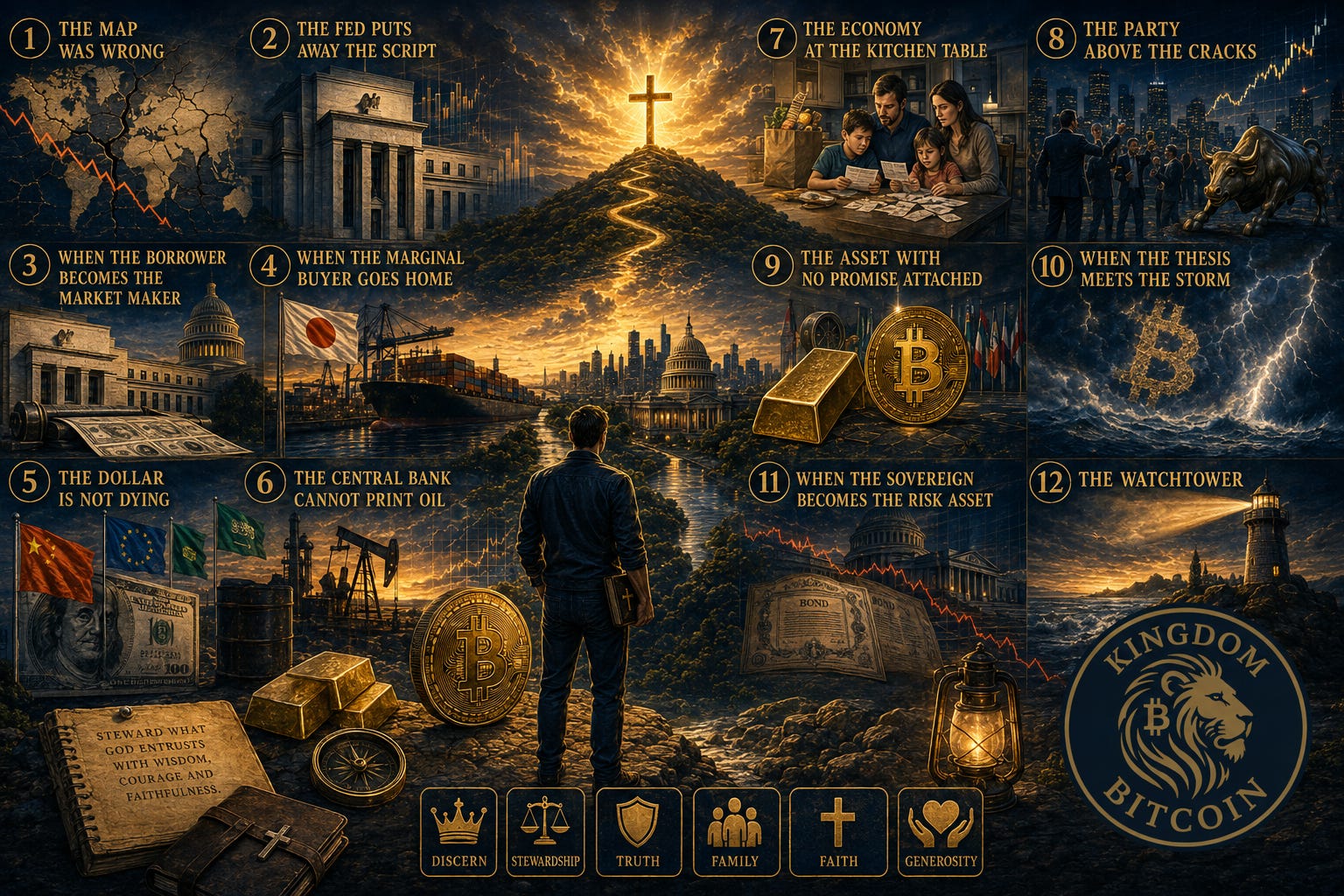
That is where I want to finish this journey through The Sovereign Squeeze. We have traveled from Washington to Tokyo, Beijing to Brussels, Hormuz to Wall Street, and eventually back to the kitchen table. We have examined central banks, sovereign debt, bond yields, currencies, energy, housing, artificial intelligence, credit, gold, and Bitcoin. Yet this series was never really about becoming better macro traders. It was about learning to see the architecture beneath the financial world so that changing conditions do not quietly become changing convictions.
The first lesson was humility. Nearly every comfortable assumption entering 2026 was challenged. The Federal Reserve did not follow the expected easing script, Europe tightened, Japan normalized faster, energy markets were disrupted by war, long-term sovereign yields surged, and yet equities remained remarkably resilient. The map was wrong because the terrain had changed. The men of Issachar taught us that discernment is not predicting everything correctly; it is understanding the season well enough to know how faithfully to respond.
Then we examined the Federal Reserve and discovered the limits of monetary power. Kevin Warsh represents a different institutional philosophy, placing greater emphasis on discipline, money, and allowing markets to live with less forward-guidance anesthesia. Yet even the most determined central banker encounters the same stubborn reality: interest rates cannot manufacture oil. Monetary policy can restrain demand, but supply shocks remind us that the financial world ultimately rests upon a physical one created by God.
Treasury revealed another pressure. America has crossed $40 trillion in federal debt while interest expense consumes an increasingly meaningful share of national resources. Alexander Hamilton understood that public credit is national power, while George Washington understood that borrowing today can become a burden placed upon posterity tomorrow. Debt is neither automatically evil nor magically harmless. The borrower may possess enormous political power, but arithmetic remains one constituent who never accepts campaign donations.
Japan then showed us why global finance is connected in ways most people never see. For decades, Japanese savers exported capital because domestic yields offered almost nothing. Now Japanese bonds offer meaningful returns again, and the marginal buyer of American duration has another choice. China taught a related lesson through gradual Treasury diversification and persistent gold accumulation, while Europe reminded us that one currency can conceal very different sovereign balance sheets beneath it. Capital does not swear lifetime allegiance to yesterday’s allocation.
War brought the physical economy crashing back into the conversation. Hormuz taught us that a tanker unable to pass through a strait can matter more to household inflation than a thousand monetary-policy speeches. Gasoline affects drivers, diesel affects freight, freight affects food, and energy eventually touches nearly everything civilization produces. The central bank cannot print oil, just as money cannot create the physical abundance it merely represents. Honest money should teach us respect for scarcity rather than the illusion that every constraint can be financed away.
Then we returned home. Ruth reminded us that God sees the household inside the statistic. A national unemployment number does not tell the story of the person who has submitted fifty applications without a response, just as a CPI category cannot fully explain the family whose insurance premium, mortgage payment, groceries, and childcare consume nearly everything coming through the door. Economic averages matter because policymakers need them. Families still have to live the individual data point.
Wall Street gave us perhaps the strangest contrast of the year. Sovereign yields reached extraordinary levels, geopolitical risk remained elevated, artificial-intelligence spending exploded, and credit markets continued behaving as though someone had misplaced the worry button. Daniel’s story of Belshazzar warned us that parties can continue above structural cracks. AI may genuinely transform civilization while some financing structures surrounding it still prove foolish; technological truth and financial excess can occupy the same room without introducing themselves.
Gold then forced intellectual honesty upon Bitcoiners. It behaved more like the hard-money thesis said Bitcoin should behave, in large part because its marginal buyers were central banks purchasing with patient, unleveraged reserves. Bitcoin’s marginal ownership had become increasingly financialized through ETFs, miners, leveraged traders, and treasury companies dependent upon capital markets. Gold had sovereign buyers. Bitcoin had financed buyers. When the storm came, the difference mattered.
That brought us to one of the most important conclusions of the series: Bitcoin’s monetary architecture did not fail, but its first institutional market structure failed the clean debasement-hedge test. When inflation intensified, Bitcoin fell with liquidity-sensitive assets while gold reached records. Then leverage was stripped away, miners sold, treasury companies faced pressure, ETF redemptions transmitted real selling, and the market painfully cleared itself. Conviction required us to say what happened rather than explain it away.
Yet that failure may ultimately teach us why Bitcoin remains so important. Twenty-one million did not change. There was no emergency issuance, sovereign refinancing calendar, interest bill, or committee deciding to create additional coins because conditions became uncomfortable. Price moved violently because human beings, leverage, financing structures, and liquidity moved violently. Bitcoin’s market price remained human while Bitcoin’s monetary rule remained stubbornly mechanical.
That distinction brought us finally to the sovereign itself. When the supposedly risk-free asset begins carrying greater fiscal uncertainty, the entire hierarchy of financial risk deserves another look. The thirty-year Treasury may tell us more about the next monetary era than the daily Bitcoin chart. If central banks tighten and long yields decline, monetary credibility may remain strong. If they tighten and long yields rise anyway, markets may be signaling that sovereign financing has become a larger force than central-bank discipline.
But the final lesson is not a trade. It is stewardship.
The Christian does not study these things so macroeconomics can become another idol with better vocabulary. We study because money shapes households, debt shapes freedom, inflation shapes time horizons, geopolitics shapes prices, and financial systems influence how confidently people can build beyond tomorrow. Understanding the environment helps us prepare, but our preparation should make us more generous, responsible, courageous, and useful rather than merely more afraid.
So what should we carry forward from these twelve stones? Build margin before ambition. Reduce leverage capable of making decisions for you. Understand the promises beneath the assets you own. Develop skills the world values, hold productive assets thoughtfully, preserve some wealth in forms not entirely dependent upon another party’s promise, teach your children how money works, understand custody, and remain generous enough to prove that money has not become your master.
Bitcoin belongs inside that framework, not above it. It is not the answer to every economic distortion, nor must the world collapse for its purpose to become obvious. Bitcoin is a financial tool built around scarcity, direct ownership, verifiable rules, and a monetary policy separated from sovereign discretion. Those qualities become more interesting as debts expand, trust diversifies, and financial promises become increasingly expensive to maintain.
We began by asking what is moving. We should end by remembering what does not.
Governments change. Central bankers change. Wars begin and end. Currencies rise and fall. Gold reprices. Bitcoin reprices. Markets alternate between wisdom and something resembling happy hour.
God remains. Jesus Christ remains. Truth remains. Our assignment remains.
The future does not require us to know every turn in advance. It requires us to become people capable of faithful action when the turn arrives. Stand on the watchtower, understand the times, keep honest scales, provide for your household, preserve margin, give generously, teach the next generation, and refuse to surrender peace to a world designed to keep refreshing the price.
The sovereign may be squeezed. The steward does not have to be.
Kingdom Principle 👑
Stewardship begins with understanding the world as it is while remaining anchored to the God who does not change.
The purpose of financial wisdom is not prediction, accumulation, or insulation from every hardship. It is greater faithfulness. We learn how debt, inflation, liquidity, energy, capital flows, gold, and Bitcoin interact so that we can make wiser decisions for our households, serve others more freely, and build across generations with our eyes open.
Bitcoin matters because honest rules, scarcity, ownership, and freedom from arbitrary monetary expansion matter. Yet even sound money cannot produce sound hearts. Our security is ultimately found not in the asset with the strongest balance sheet, but in Jesus Christ, whose Kingdom does not depend upon markets, governments, creditors, or currencies.
Prayer 🙏
Heavenly Father, thank You for giving us minds capable of learning, hands capable of building, and resources capable of being stewarded for purposes greater than ourselves. Give us discernment to understand changing economic conditions without becoming captive to them, courage to face uncomfortable truths, humility to revise our assumptions, and wisdom to prepare our households faithfully.
Teach us to keep honest scales, manage debt carefully, preserve margin, work diligently, give generously, educate our children, and use Bitcoin and every financial tool without turning them into idols. May the Holy Spirit sharpen our discernment, may our stewardship strengthen families and communities, and may Jesus Christ remain the unchanging foundation beneath everything we build.
Watch the world carefully. Steward what is in your hands faithfully. Trust God completely.
In Jesus’ name, Amen. 🙏📖🌍🧭⚖️🏠🥇₿🕊️👑