

In Washington, D.C., the Declaration sleeps in dim light.
It rests behind glass, protected from air, fingerprints, time, and forgetfulness. The room is quieter than most places in the capital. People who speak loudly in museums lower their voices there. Children press forward to see what their parents have told them is important, though many are still too young to understand why faded ink can make grown men quiet. Visitors move slowly past the old parchment, some reading the words carefully, others simply taking in the fact that they are standing near something that outlived a king.
The document is fragile now. The ink has aged. The parchment has dimmed. The signatures that once carried the risk of hanging as traitors now sit beneath protective glass, guarded by a nation that still lives under the claims those men made. They were not writing for tourists. They were not writing for monuments. They were not writing for schoolbooks, museums, or marble halls. They were writing because there are moments when truth must be placed into history even when the outcome is uncertain.
A father standing there with his son does not need a lecture on inheritance. He needs only to look from the parchment to the boy beside him and realize that the future is always closer than we think. The child may be bored. He may be hungry. He may be more interested in the gift shop than the words behind the glass. But one day he will live inside the country his father’s generation either strengthened or neglected. One day he will inherit not merely stories about America, but the consequences of what America became in the hands of those who came before him.
That is the hidden weight of ordinary life.
Most generations believe they are simply living in the present. They work, spend, save, argue, vote, pray, build, consume, raise children, check markets, read headlines, bury parents, and move through their days as though their choices belong only to them. They rarely stop long enough to consider that the present is always becoming someone else’s inheritance. The grocery receipt, the national debt, the family Bible, the bank account, the school curriculum, the church attendance, the monetary system, the bedtime prayer, the neglected repair, the hard conversation avoided, the truth spoken when silence would have been easier, all of it travels forward.
We stand between two dates.
Behind us is 1776, where men wrote words that outlived them. Before us is 2276, where Americans we will never meet will live inside the consequences of what we preserved, repaired, neglected, or surrendered. That distance can feel abstract until we remember that every century is eventually carried by households. A republic does not travel through time by speeches alone. It travels through fathers and mothers, pastors and teachers, business owners and builders, savers and givers, citizens and children. It travels through what people love enough to guard.
America began with a sacred claim: rights come from God, not government. That claim was not a decorative phrase added to make a political document sound noble. It was the foundation beneath the entire American experiment. If rights come from kings, kings may revoke them. If rights come from legislatures, legislatures may redefine them. If rights come from courts, courts may reinterpret them. But if rights come from God, then every earthly authority stands beneath a higher judgment.
That truth made America possible.
It also made America accountable.
The Declaration announced the claim. The Constitution gave it architecture. The Bill of Rights guarded the individual from the reach of power. Later generations tested the claim, betrayed it, appealed to it, corrected toward it, and died beneath its demands. The founding truth was larger than the Founders themselves. That is why it could judge them. Truth does not require perfect carriers to remain true. It simply requires faithful stewards willing to be corrected by it.
This book begins before Philadelphia because the American story did not invent freedom. It inherited an older truth. Moses stood before Pharaoh and carried a sentence that would trouble every empire after Egypt: “Let my people go.” Pharaoh believed the Hebrews belonged to him. Their labor served his economy. Their children strengthened his future. Their suffering was simply the cost of his power. God disagreed.
Every age produces new versions of Pharaoh’s mistake. Some rulers wear crowns. Some sit in offices. Some govern institutions. Some control money. Some speak in the language of efficiency, compassion, safety, progress, or emergency. The form changes, but the temptation remains. Fallen people keep reaching for authority over what belongs first to God.
That includes the measure of value itself.
Money may seem like a strange subject for a book about God, America, and inheritance. It is not. Money carries labor across time. It stores sacrifice. It enables generosity. It shapes households. It helps determine whether a father’s work today can bless his daughter tomorrow. If money becomes dishonest, the damage is not confined to markets. It enters kitchens, retirement accounts, small businesses, churches, and the quiet hopes of families trying to build something durable.
The Bible is not indifferent to this. Scripture speaks of honest weights, just balances, wages, debt, inheritance, greed, generosity, and the danger of trusting earthly treasure more than God. The Lord who cares about prayer also cares about the scale. The God who sees worship also sees measurement.
That is why Bitcoin appears in these pages, but not as the center of them. Jesus is the center. Bitcoin appears as a witness and a question. At its best, Bitcoin is not a rebellion. It is a repentance toward honest money. It asks whether the labor of ordinary families should be stored in something that can be diluted by the convenience of those in power. It asks whether a free people can rediscover a sound-money instinct the Founders understood through painful memory. It asks whether the scale can be made harder to bend.
But Bitcoin is not salvation. America is not salvation. The Founders are not salvation. The Constitution is not Scripture. No technology, nation, market, or institution can bear the weight that belongs to God alone. The order matters because disordered loves eventually become idols. America is a stewardship. Bitcoin is a tool. The Kingdom is eternal.
The images that follow in this book are simple.
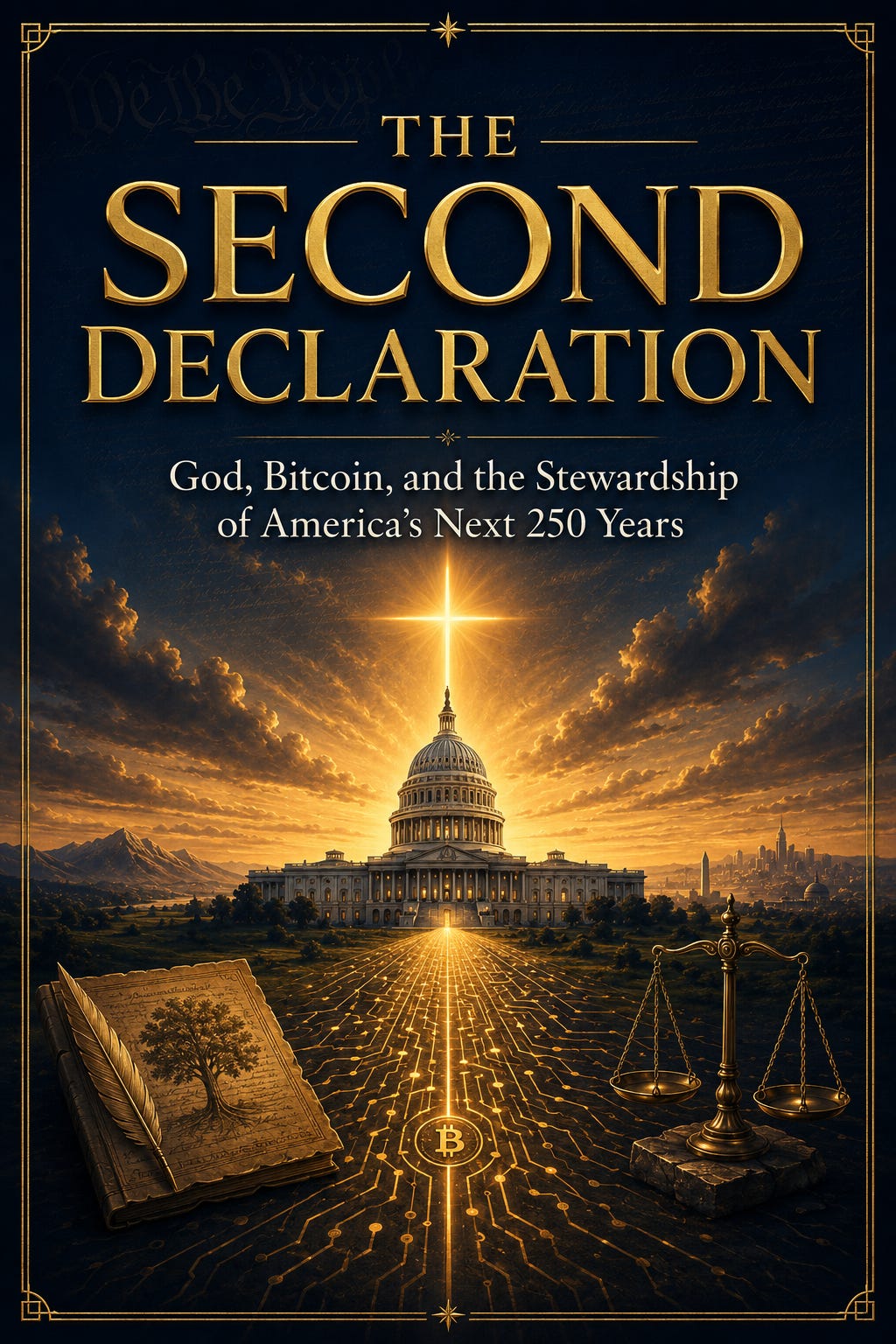
There is a parchment, because some words outlive the people who write them. There is a scale, because honest measurement is inseparable from justice. There is an inheritance, because everything received eventually becomes something passed forward, diminished, or lost.
The parchment is not only the Declaration behind glass. It is also the warning of Brutus, the architecture of the Constitution, the restraint of the Bill of Rights, the insight of Federalist 51, the monetary memory of Article I, Section 10, the Bitcoin whitepaper, and the quiet note a father leaves so his family is not left in confusion. The scale is not only an ancient balance in a marketplace. It is the measure of rights, power, money, labor, truth, and responsibility. The inheritance is not only wealth. It is faith, freedom, wisdom, honest money, disciplined households, and the courage to leave the future something better than our excuses.
The future will not know most of our names. It will know what we left.
That sentence should sober us. It should also strengthen us. We are not powerless. We are not merely spectators watching history happen to us. We are stewards living between the sacrifices of those who came before and the needs of those who will come after. We inherited blessings we did not earn. We will leave consequences we cannot fully control. Our task is faithfulness.
This book is not written as nostalgia. Nostalgia admires the past without accepting responsibility for the future. Nor is it written as outrage. Outrage is too small to build anything worthy of our children. This book is a summons: to remember God, to recover truth, to honor the Founders without worshiping them, to understand Bitcoin without idolizing it, to steward freedom without consuming it, and to think in grandchildren.
One day, Americans in 2276 may open what we sealed, read what we wrote, and live inside what we built. They may ask whether we understood the hour. They may ask whether we preserved honest money. They may ask whether we taught our children where rights come from. They may ask whether we repaired what was broken or simply handed them the bill. They may ask whether we remembered God.
They will not need our speeches.
They will have our inheritance.
We are the generation between the parchment we received and the future we are writing. Behind us are men and women who pledged lives, fortunes, prayers, labor, and sacred honor for people they would never meet. Before us are children who will inherit the systems we build, the debts we leave, the money we trust, the faith we teach, and the truths we refuse to surrender.
The question before us is simple.
What will we do with what we have been given?
Love you son. Dad