

No one will ask you to sign a parchment tomorrow.
No delegation will gather in Philadelphia to watch your name move across the page. No bell will ring above the city. No historian will pause to record the moment. The world will not stop because you decide to tell the truth about money, open the family Bible, repair the household plan, pray over your children, or ask whether the systems you trust are worthy of the future you hope to leave. Most of the decisions that shape history do not feel historic while they are being made. They feel ordinary, almost forgettable, until time reveals what they carried.
The next signature may begin at your table.
It may begin beside a bank statement, a grocery receipt, an insurance folder, a notebook, and a child’s drawing left near the edge of the counter. It may begin in the quiet after everyone else has gone to bed, when the house settles and the questions you avoided during the day return with unusual honesty. What are we building? What are we leaving? What have we trusted too easily? What have we postponed because the conversation felt too heavy? What will our children know because we had the courage to teach them?
That is where the second declaration becomes real.
Not first in Washington. Not first in markets. Not first in speeches, campaigns, platforms, or public arguments. It begins in households that refuse to drift. It begins when a father decides that love must become instruction, when a mother refuses to let fear govern the future, when a husband and wife sit together long enough to make confusion less likely for those who depend on them. It begins when a family understands that stewardship is not a mood. It is a way of ordering life under God.
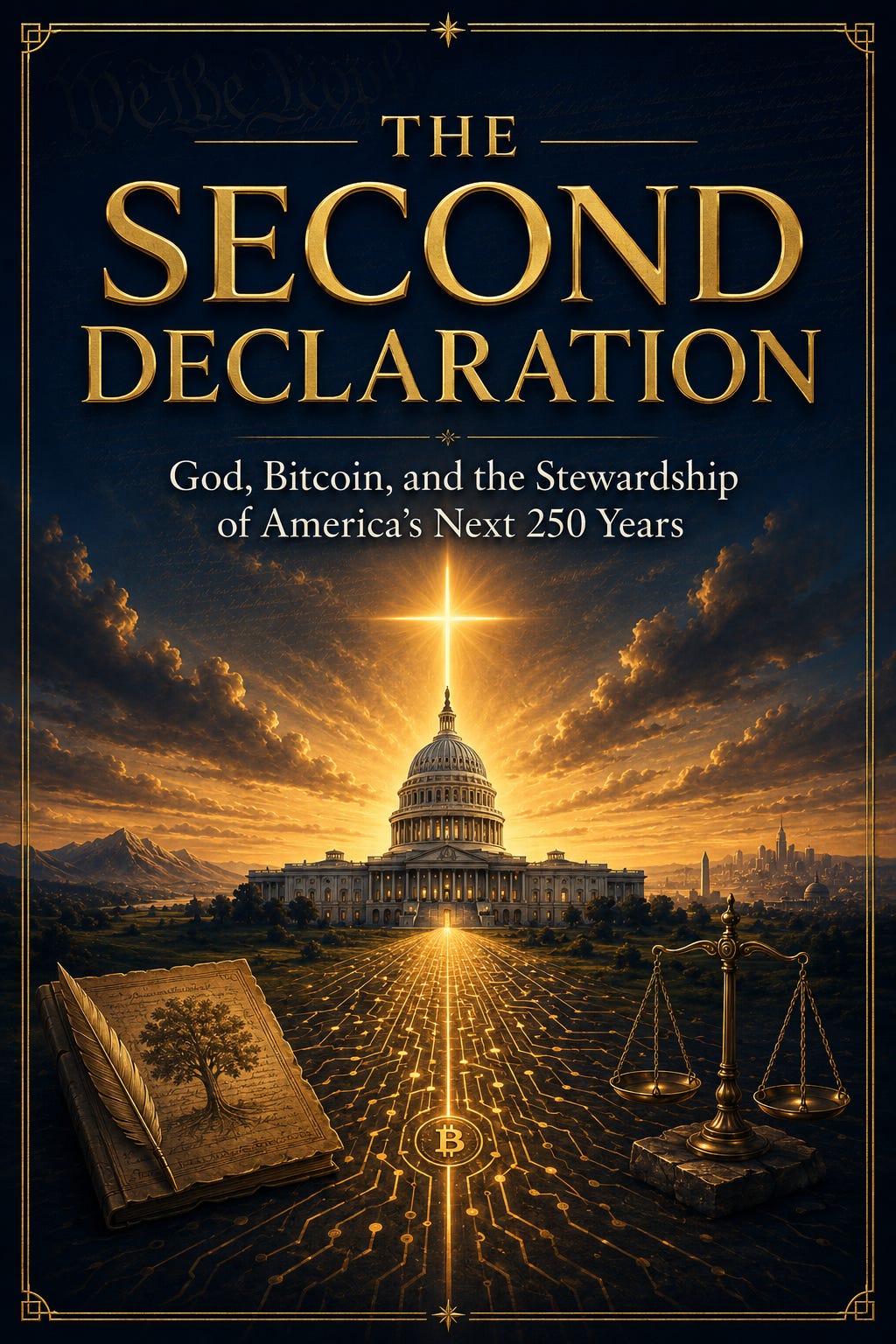
America’s first Declaration was written with parchment and ink. It announced that rights come from God and that earthly power must answer to a higher authority. The second declaration will not replace the first. It will return to its source. It will say again, in the language of our own lives, that government is not God, money is not salvation, technology is not wisdom, and freedom is not permission to live without truth.
That declaration will be lived before it is ever spoken.
It will be lived when we treat money as moral rather than merely mathematical. It will be lived when we ask whether our savings preserve labor honestly, whether our debts burden those who follow us, whether our budgets reveal faithfulness or avoidance. It will be lived when bitcoin, if we hold it, is ordered under stewardship rather than pride. It will be lived when we remember that bitcoin may witness to honest measurement, but Jesus alone is worthy of ultimate trust.
It will be lived when we honor the Founders without worshiping them. They were imperfect stewards of truths larger than themselves. Their greatness was not that they possessed perfect virtue, but that they placed into the American bloodstream a truth strong enough to judge even their own failures. We honor them best not by pretending they were flawless, nor by discarding the inheritance because the first stewards were flawed, but by carrying the truth forward with greater faithfulness than we received it.
It will be lived when we refuse the false choices of our age. Freedom without truth becomes appetite. Control without liberty becomes bondage. Greed with patriotic language is still greed. State power dressed in moral concern still becomes dangerous when it asks people to look first to government rather than God, family, church, work, and neighbor. A free people must be formed by virtue, restrained by truth, protected by honest scales, and humble enough to remember that no earthly system can bear the weight of God.
This is not fear. It is faithfulness.
Fear hoards because it believes scarcity is ultimate. Faithfulness prepares because it believes God is sovereign. Fear grasps for control. Faithfulness accepts responsibility. Fear sees the future as a threat. Faithfulness sees the future as a field entrusted by God for cultivation, courage, and love.
The work ahead will often feel small. Most faithful work does. Nehemiah’s wall was rebuilt stone by stone. Joseph filled storehouses while abundance still made preparation seem unnecessary. Madison studied failed republics before helping frame a Constitution strong enough to outlive the emotion of revolution. Parents build inheritance through habits so quiet that children may not recognize them until years later, when they discover that what felt ordinary was actually formation.
Open the Bible with them. Tell them where rights come from. Teach them why truth matters. Show them that money should serve stewardship, not appetite. Let them see you pray for the country without worshiping it. Let them hear you speak of the future with sobriety rather than despair. Let them inherit a faith that is more than language, a freedom that is more than preference, and a household ordered enough to bless those who come after you.
One day, none of us will be here to explain what we meant. We will not be able to clarify our intentions, defend our compromises, or revise the record of our lives. Those who follow us will inherit what we preserved and what we neglected. They will live with our courage or our cowardice, our wisdom or our confusion, our restraint or our appetite, our prayers or our silence.
That thought should not crush us. It should call us upward.
The generation of 1776 did not know how the story would end. Neither do we. They wrote, prayed, argued, built, fought, repented imperfectly, and sent something forward. We have received it for our appointed season, not forever, but long enough to decide whether we will be consumers of inheritance or stewards of it.
The second declaration will not be signed in one dramatic moment. It will be written over time in households that decide truth is worth carrying forward. It will be written in systems repaired, debts confronted, children discipled, money measured honestly, freedom ordered under God, and courage practiced when applause is absent. It will be written when ordinary people refuse to hand the future a lie.
The future will not need us to have been perfect.
It will need us to have been faithful.
So let the work begin where lasting renewal so often begins: at the table, beside the Bible, near the receipts, in the prayers whispered over sleeping children, in the decisions no one applauds, and in the truths we refuse to surrender. The Founders wrote the first Declaration with parchment and ink. The second will be written with stewardship.
And God will read every line.