

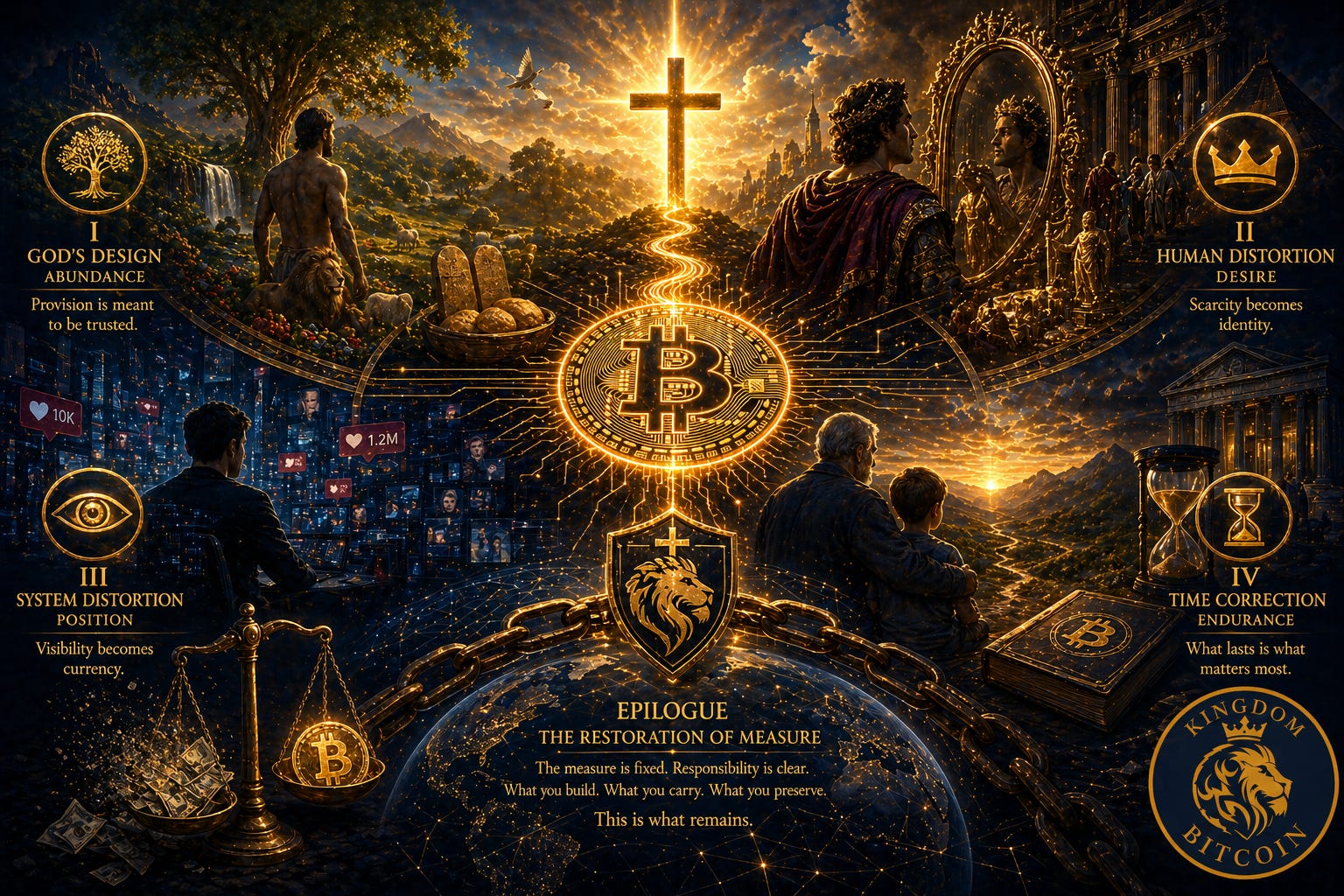
What actually endures across generations
There is a difference between what is rare and what endures.
Rarity can be constructed. It can be marketed, positioned, and, given enough time, often replicated. Endurance cannot. It is not assigned. It is revealed. It is tested not by attention, but by time. And time has a way of exposing what was never built to last.
This is the horizon most people rarely consider. Not because it is inaccessible, but because it demands a different posture. It requires patience in a world that rewards immediacy, discipline in a culture that prizes convenience, and a willingness to build for outcomes that may never be personally realized. Most decisions made today will not survive a single generation. Not because they are inherently wrong, but because they were never designed to endure. They were designed to optimize for the present, and what is optimized for the present rarely survives the future.
As technology advances, this tension becomes more pronounced. Each wave of innovation expands what can be created, distributed, and replicated. Artificial intelligence accelerates production. Software reduces friction. Ideas that once required years of effort can now be produced in moments. The natural result is abundance, not just of goods, but of information, expression, and access.
But as abundance increases, value does not disappear. It shifts. It migrates away from what is easily produced and toward what cannot be replicated at speed. This pattern has repeated across every era of technological advancement. When something becomes abundant and cheap, something else becomes scarce and valuable.
Today, that shift is accelerating.
Generic knowledge becomes abundant. Distinction becomes scarce. Content becomes infinite. Attention becomes limited. Replication becomes effortless. Authenticity becomes harder to discern. In such an environment, what rises in value is not what is most visible, but what is most difficult to reproduce.
Trust, wisdom, and covenant becomes scarce. Time itself becomes scarce, not in quantity, but in how it is invested and what it is used to build.
These are not assets in the traditional sense, yet they are the foundation of everything that endures. They cannot be scaled quickly. They cannot be manufactured on demand. They must be cultivated, protected, and, in many cases, carried forward across generations.
Scripture speaks directly into this longer horizon. Proverbs teaches that a good person leaves an inheritance to their children’s children. This is not merely a statement about accumulation. It is a statement about continuity. About responsibility that extends beyond a single lifetime. The inheritance described is not simply financial. It is relational, spiritual, and structural. It includes faith, wisdom, discipline, and the systems that support them.
Jesus sharpens this further when He instructs not to store up treasures on earth, where they can decay or be taken, but to build toward what cannot be destroyed. He does not discourage building. He redefines where permanence exists. The call is not to withdraw from the world, but to engage it with clarity about what actually lasts.
This is where distortion often enters. Some interpret abundance as a sign of favor. Others reject it entirely, equating scarcity with virtue. Both positions miss the point. Scripture does not measure righteousness through material outcomes. Abraham was entrusted with abundance. Job experienced both loss and restoration. The pattern is not material. It is relational. God is not building portfolios. He is forming stewards. And stewardship is measured not by what is gained, but by what is faithfully carried forward.
A 400-year perspective clarifies this in a way few other frameworks can. It filters out what is temporary. It reduces the influence of noise. It forces decisions to be measured not by immediate return, but by long-term integrity. It asks not what works now, but what will still matter when the systems surrounding it have changed.
Against this backdrop, the question of money becomes unavoidable. If value is to be carried across generations, it must be preserved within a system that does not erode with time. It must be measured by something that does not quietly shift. Otherwise, what is intended as inheritance becomes diminished, not through neglect, but through instability in the measure itself.
Any system that claims durability must be examined carefully. History is filled with assets that appeared permanent until they were not. Empires fall. Currencies weaken. Technologies become obsolete. Even the most dominant systems eventually face pressures they were not designed to withstand. The question is not whether something works today. It is whether it can endure the forces of time, power, and change.
Bitcoin enters at this exact point of tension. Not as a promise, but as a structure.
It addresses the layer most systems ignore, which is the measure itself. Every asset, every form of wealth, every inheritance is ultimately expressed through a unit of account. If that unit expands, contracts, or shifts unpredictably, then what is being preserved is not stable. It is slowly diluted.
Bitcoin introduces a fixed reference point. Its supply does not expand in response to pressure. Its issuance does not accelerate in response to demand. Its rules do not change based on who participates or who influences it. It remains what it is, independent of external conditions.
This does not make it perfect. It does not eliminate volatility or remove uncertainty. But it introduces something that becomes increasingly important over long time horizons.
It introduces honesty.
Even when considering emerging technological threats, such as advances in quantum computing, the relevant question is not whether challenges will arise, but whether the system can adapt without compromising its core properties. Bitcoin’s open and decentralized nature allows for evolution at the edges while preserving its foundational rules. It is not static, but it is anchored. And that distinction matters.
Bitcoin is not the inheritance. It is a tool within it. Faith, family, and wisdom remain the foundation. But without an honest measure, even well-built structures can erode over time. Bitcoin does not replace what endures. It supports it by preserving value in a form that resists silent dilution.
And over time, that matters more than most realize.
Because what endures is not what is rare in a moment. It is what remains faithful across time. It is what can be carried without distortion, transferred without loss of integrity, and trusted without constant adjustment. It is what continues to serve long after the conditions in which it was created have changed.
This is the horizon most people never reach. Not because it is hidden, but because it requires a different kind of commitment. It requires building for outcomes that extend beyond personal gain, beyond immediate recognition, and beyond the systems that dominate the present.
And yet, this is precisely the kind of stewardship Scripture calls for. To build in a way that outlives us. To carry in a way that strengthens those who follow. To measure in a way that does not shift when everything else does.
Because in the end, the question is not what we gained. It is what we preserved.
Kingdom Principles
What endures is revealed over time, not assigned in the moment
Stewardship is measured across generations, not immediate outcomes
True inheritance includes faith, wisdom, and structure
Honest measure is essential to preserving long-term value
Prayer 🙏✝️🔥
Heavenly Father,
Give us vision beyond our own lifetime. Teach us to build with faithfulness, not urgency, and to steward what You have entrusted to us with wisdom and care.
Help us to see clearly what endures and to invest in what truly matters. Strengthen our commitment to faith, family, and truth. Guard us from being shaped by what is temporary, and anchor us in what is lasting.
May our lives reflect Your design, building something that carries forward with integrity for generations to come.
In Jesus’ name, Amen. 🙏✝️🔥
Once again I am overwhelmed of your knowledge. Love Dad