

Why more has never been enough
Abundance has a way of revealing what scarcity never could.
When resources are limited, desire is naturally constrained by necessity. People pursue what they need because they must. There is a clarity to it. Survival sharpens focus. But when abundance arrives, when constraints loosen and options multiply, something less predictable begins to surface. Not contentment, as many would assume, but appetite. Not satisfaction, but expansion. The belief is that more will quiet the longing. In reality, more often than not, it gives it room to grow.
The question is not whether abundance changes desire. It is whether it has already changed yours.
History provides a revealing lens into this pattern. In the late nineteenth and early twentieth centuries, as industrial wealth surged across the United States, a new class of individuals emerged with access to extraordinary financial resources. For the first time, the challenge was no longer how to build wealth, but how to distinguish oneself within it. Money, once the objective, became the baseline.
Joseph Duveen understood this dynamic with unusual clarity. Europe possessed something America could not manufacture quickly, which was centuries of accumulated culture. Old Master paintings, sculptures, and artifacts shaped by time itself carried a form of scarcity that wealth alone could not reproduce. America, by contrast, had capital but lacked historical depth. Duveen saw the opportunity immediately. He did not sell art as decoration. He sold it as identity.
Ownership became a signal. Not simply of taste, but of permanence, access, and status. The rarer the piece, the stronger the signal. Wealthy individuals began to compete not for more money, but for what money could not easily create. Scarcity, once something to overcome, became something to acquire.
The pattern did not stop there. It expanded into the fabric of society. The Gilded Age produced not just wealth, but a new form of competition. The Vanderbilts and their contemporaries did not simply build businesses. They constructed lives designed to be seen. Yachts became larger. Estates more elaborate. Titles were pursued with increasing intensity. Scarcity was no longer merely discovered. It was engineered. Social systems formed around perception, where the appearance of rarity could carry as much weight as rarity itself.
Abundance had not eliminated desire. It had refined it.
That refinement continues today, though it appears in different forms. Professional sports franchises, luxury brands, rare real estate, exclusive memberships, all operate within the same underlying structure. The value is not solely in the asset itself, but in its limited availability and the identity it confers. In a world where many things can be replicated, copied, or scaled, what cannot be reproduced becomes the focal point of attention.
Yet beneath this pattern lies a deeper tension, one that Scripture addresses with clarity that has not diminished over time. Ecclesiastes states plainly that whoever loves money never has enough, and whoever loves wealth is never satisfied. This is not an argument against wealth. It is a diagnosis of the human condition.
Scripture does not condemn abundance. Abraham was wealthy. David governed a kingdom marked by prosperity. The issue has never been possession. It has always been attachment. Wealth can serve as a tool for stewardship, or it can become a substitute for trust. The difference is not found in what is held, but in what is worshiped.
The danger is not that we have too much. The danger is that we begin to believe what we have is who we are.
This is brought into sharp focus in the encounter between Jesus and the rich young ruler. The man approaches with confidence, having followed the commandments and achieved what many would consider success. Yet he asks a question that reveals a deeper unease. Something is still missing. When Jesus invites him to release what he has, not as punishment but as freedom, the response is immediate and telling. He walks away.
He does not walk away because he lacks discipline. He walks away because he has found his identity.
Abundance had not freed him. It had bound him.
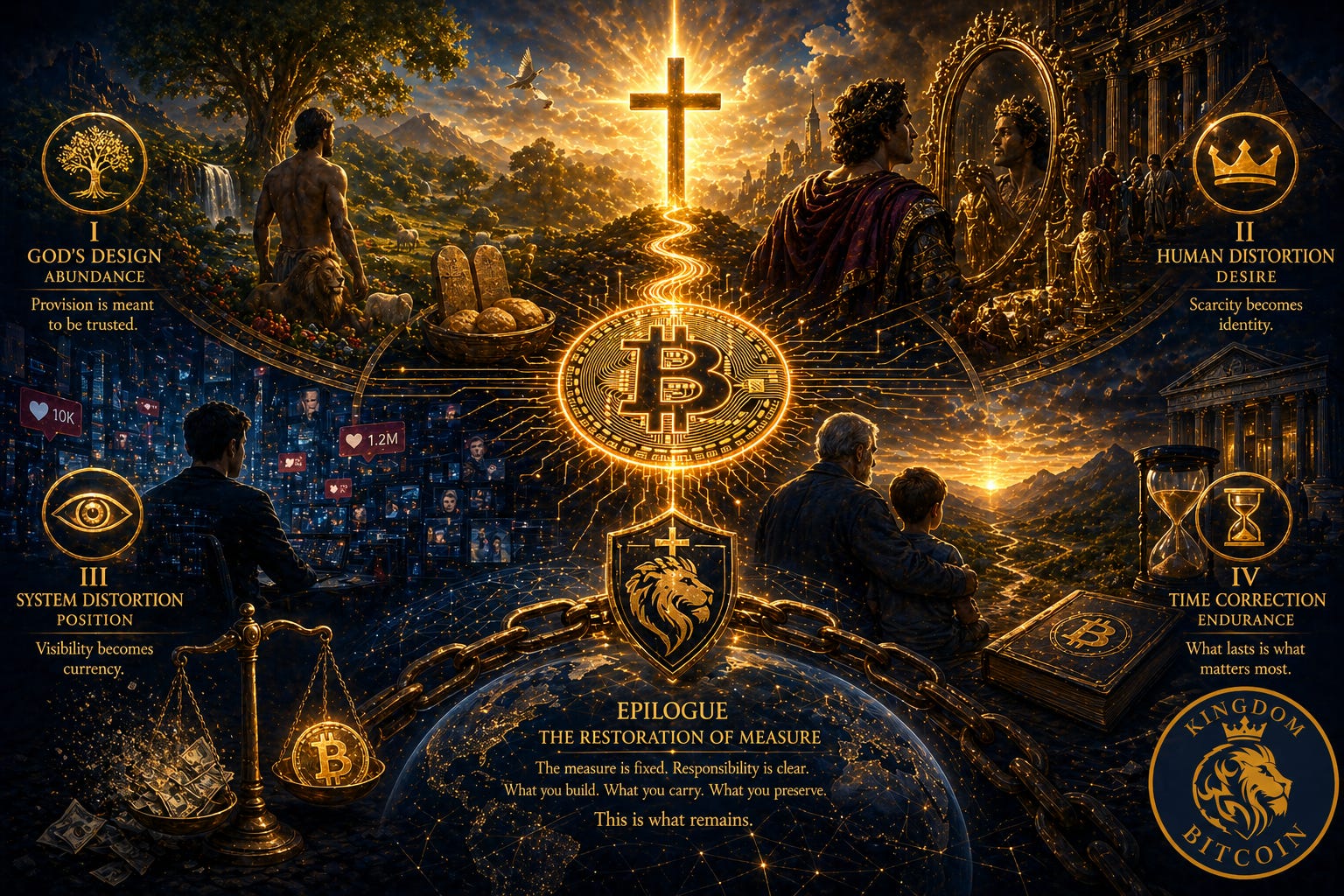
This is the paradox. Scarcity, once feared, becomes desirable. Abundance, once pursued, becomes insufficient. Identity begins to form around what is owned, what is displayed, and what others can see. Scarcity becomes identity. Status replaces security.
This is where the modern system begins to show its limits. Much of what is perceived as scarce is, in reality, constructed. It is curated, positioned, and maintained through perception. It signals value, but it does not necessarily preserve it. It can be expanded, adjusted, and, at times, manipulated.
And this is where a different kind of scarcity begins to stand apart.
Bitcoin does not participate in this system. It does not rely on perception, access, or visibility to establish its value. It does not require positioning or promotion. It simply operates according to rules that do not change.
Its scarcity is not engineered. It is enforced.
There is no authority that can alter its supply. No mechanism that allows for quiet expansion. No structure through which influence can reshape its foundation. It exists outside the performative scarcity that defines so much of the modern world.
In that sense, it removes the performance.
It does not ask who is watching. It asks whether something is true.
This does not mean people will not attempt to use it the way they use everything else. The human heart has a way of turning even truth into a signal. But the system itself does not require it. It does not reward visibility. It does not depend on attention. It does not elevate status.
It simply measures.
And when something measures honestly, everything around it begins to shift. The assets that rely on perception become easier to recognize. The systems that depend on manipulation become harder to sustain. What remains is not what appears valuable, but what endures.
Abundance fills the world. It multiplies options, expands access, and accelerates desire. But it does not answer the deeper question of what we trust, what we worship, and what we build our lives upon.
That question remains.
It is answered not by what we accumulate, but by what we refuse to compromise.
Because in the end, the issue is not whether we live in a world of abundance.
It is whether we can live within it without losing sight of what is true.
Kingdom Principles
Abundance reveals the condition of the heart more than it resolves it
Wealth is a tool; identity must never be built upon it
What appears scarce is not always what is valuable
Truth, not perception, is the foundation of lasting value
Prayer 🙏✝️🔥
Heavenly Father,
Search our hearts and reveal what we are truly pursuing. In a world filled with abundance, help us not to confuse what is available with what is valuable.
Guard us from placing our identity in what we own or what others see. Teach us to find our security in You alone. Where desire has grown beyond what is healthy, bring alignment. Where abundance has distracted us, bring clarity.
Lead us back to what is true, lasting, and rooted in You.
In Jesus’ name, Amen. 🙏✝️🔥