

Series Thesis | The Rules of The New Money
Every civilization eventually reaches moments when its institutions must confront realities they were never designed to govern. The printing press challenged the Church. The automobile reshaped cities. The Internet transformed communication. Today, bitcoin and digital assets are forcing America to reconsider some of the most fundamental questions about money, property, privacy, sovereignty, and the role of government itself. This series is not about politics, nor is it intended to be a collection of legislative updates that will soon become outdated. It is an exploration of something much deeper: how a free society governs an entirely new monetary architecture while preserving the principles that allow human flourishing. As Washington debates the future of digital assets through legislation like the GENIUS Act and the CLARITY Act, we will step back from the headlines to examine the larger story through the lenses of Scripture, history, the American Founding, and biblical stewardship. Because the most important question is not simply whether America will regulate digital assets. It is whether we can build rules worthy of the monetary transformation now unfolding before us.
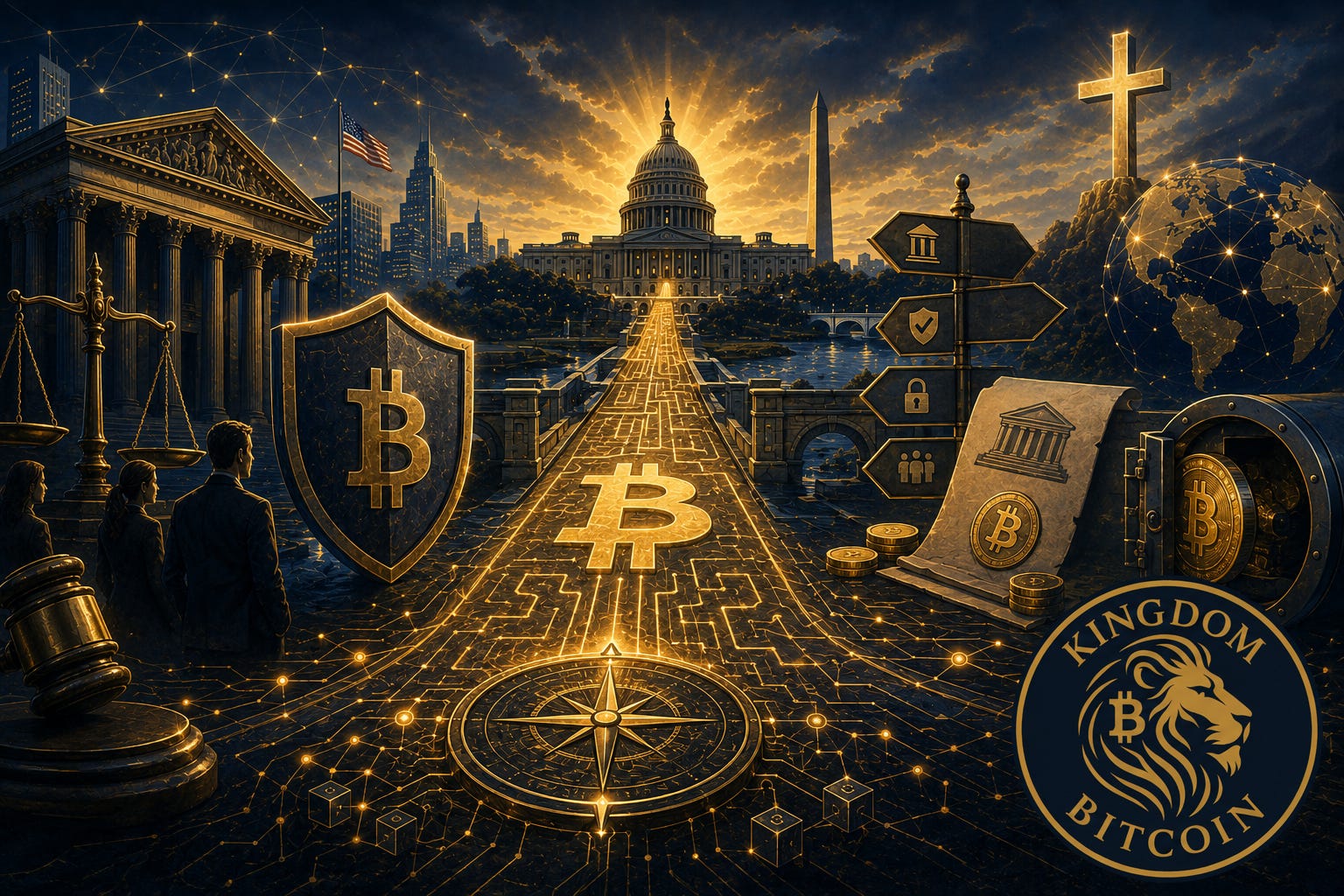
Somewhere in the world, another bitcoin block is added to the ledger. No one votes. No legislature convenes. No central banker approves its issuance. No executive signs an order authorizing its creation.
The network simply continues, almost indifferent to the debates unfolding thousands of miles away inside Washington, D.C., where committees hold hearings, regulators draft guidance, attorneys argue jurisdiction, and elected officials struggle to determine which laws written during the twentieth century should govern a monetary network born in the twenty-first. Every ten minutes, bitcoin quietly reminds the world that mathematics does not campaign for office.
For much of the past fifteen years, people have described bitcoin as existing outside the law. I have never found that description particularly helpful. Bitcoin did not emerge because it rejected order. It emerged because it challenged assumptions. The American legal system was built upon a financial world where every meaningful asset had an issuer, a chief executive officer, a board of directors, a headquarters, a transfer agent, or someone capable of receiving a subpoena and changing the rules. Bitcoin arrived with none of those things. There was no company to regulate, no founder capable of rewriting monetary policy, no treasury deciding when additional supply should be created, and no office where regulators could knock on the front door. The law did not fail because it lacked intelligence. It struggled because it encountered something structurally different from anything it had governed before.
Jesus once taught that no one pours new wine into old wineskins. His point was never that the old wineskins were bad. They had faithfully served their purpose. The problem was that a genuinely new reality could not simply be forced into containers designed for another season. Otherwise, both would be damaged. Bitcoin is not the Gospel, nor is blockchain the Kingdom of God. But Christ’s teaching reveals an enduring principle. Sometimes history presents us with realities that expose the limitations of inherited frameworks. Wisdom is not found in rejecting everything old or blindly embracing everything new. Wisdom asks whether the framework still explains the world standing before us.
That tension has defined nearly every American conversation about digital assets. FinCEN viewed bitcoin through the lens of money transmission and financial surveillance. The IRS classified it as property. The Commodity Futures Trading Commission recognized it as a commodity. The Securities and Exchange Commission evaluated many digital assets through securities law. Individual states created licensing regimes of their own while Congress debated comprehensive legislation that rarely seemed capable of keeping pace with the technology itself. None of these institutions acted irrationally. Each simply interpreted bitcoin through the authority already entrusted to it. The result was not lawlessness. It was overlapping regulation without a unified architecture.
The story reminds me of another moment in American history.
By 1783, the colonies had won their independence. The Revolutionary War was over. The impossible had happened. Yet beneath the celebration sat an uncomfortable truth. The Articles of Confederation, which had served the young nation during wartime, proved too weak to sustain the republic during peace. Commerce suffered. National coordination faltered. The architecture that secured liberty could not adequately preserve it. The Founders did not abandon freedom because the Articles proved insufficient. They gathered in Philadelphia and built a Constitution capable of carrying the nation into its next chapter.
America now faces a different constitutional moment.
The question is no longer whether digital assets should exist. They already do. The question is whether our legal architecture can evolve without sacrificing either innovation or accountability. Honest markets require rules. Fraud should be prosecuted. Theft deserves justice. Consumers deserve protection. Yet regulation must first understand what it seeks to govern. Bitcoin does not fit neatly inside categories built for corporations because bitcoin is not a corporation. It does not fit neatly inside categories built for issuers because bitcoin has no issuer. It asks lawmakers to think less like managers supervising a company and more like constitutional architects designing durable principles for something no single person controls.
Isaiah records the Lord saying, “See, I am doing a new thing! Now it springs up; do you not perceive it?” The invitation was never to worship novelty. Scripture consistently warns against chasing whatever is fashionable. Rather, God’s people are called to possess discernment, recognizing when familiar assumptions no longer fully explain what is unfolding before them. That is where America finds itself today. Bitcoin did not arrive too late for the law. The law arrived too late to pretend Bitcoin fit neatly inside the old categories.
The next question, therefore, is not whether regulation should exist. It is who possesses the rightful authority to write it.
Kingdom Principle 👑
Godly stewardship begins with discernment before judgment.
Throughout Scripture, the Lord repeatedly calls His people to understand before they act, to seek wisdom before exercising authority, and to distinguish carefully between what appears familiar and what is genuinely new. Faithful stewardship does not fear truth. It patiently examines it through the lens of God’s unchanging character. As followers of Christ, we should neither reject innovation because it is unfamiliar nor embrace it because it is exciting. We are called to test everything, hold fast to what is good, and build every conclusion upon the eternal foundation of Jesus Christ.
Prayer 🙏
Heavenly Father, give us hearts that pursue wisdom above opinion and discernment above fear. Help us see the world through Your truth rather than through headlines, politics, or passing narratives. As technology, finance, and culture continue to change, keep our hearts anchored to the One foundation that never changes—Jesus Christ.
Teach us to become faithful stewards of every opportunity You place before us. Give our leaders wisdom, our institutions integrity, and Your people courage to pursue truth wherever it leads. May we never confuse temporary systems with Your eternal Kingdom, and may our lives always point others toward the Cornerstone that cannot be shaken.
In Jesus’ name, Amen. 🙏📖⚖️₿🏛️🕊️👑
Arrived on time. This will take a bit for my brain to process and glean what God is telling me.