

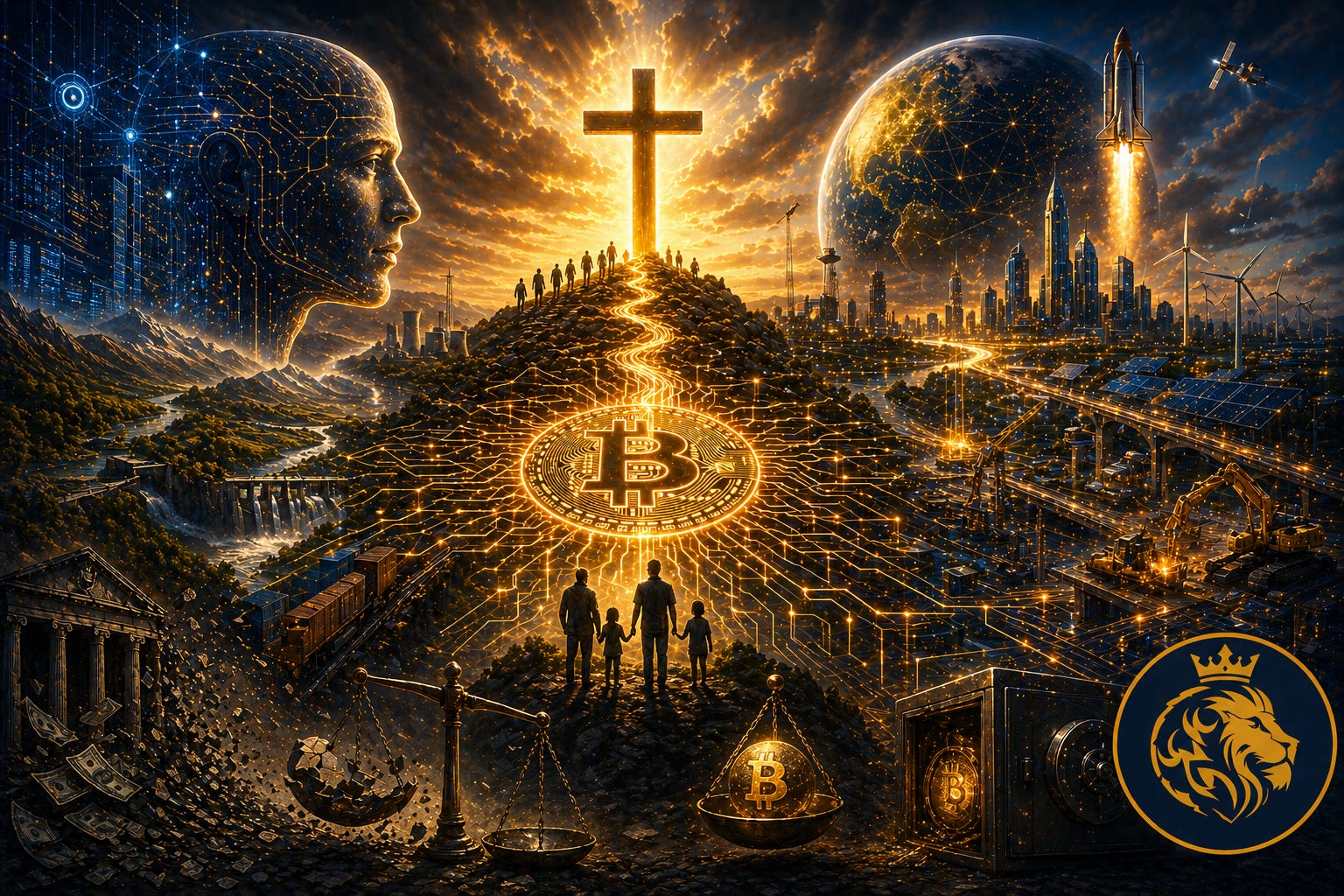
Every system rests on an assumption.
Not the kind that is debated in public, but the kind that is quietly accepted. The kind that becomes so embedded in daily life that it disappears from view. We question outcomes. We debate policies. We analyze markets. But rarely do we stop to examine the thing that measures all of it.
Money.
It is the most used system in the world, and the least questioned.
Chamath Palihapitiya’s 2025 Annual Letter framework walks with precision through the visible layers. He identifies where value is shifting, how power is reorganizing, and why the systems that once felt stable are beginning to fracture. He highlights the movement away from software abstraction toward physical control. He sees the importance of energy, infrastructure, and long-term positioning in a world that is becoming less predictable.
There is a layer beneath all of it. The system that measures value itself.
Because once you begin to follow his thinking to its natural conclusion, a deeper tension emerges. It is not simply that systems are changing. It is that the future those systems once relied on is becoming harder to trust. The idea of terminal value, the assumption that long-term cash flows can be projected, discounted, and relied upon, is weakening. Moats that once felt permanent are now temporary. Competitive advantages erode faster. Time horizons compress.
The future is no longer trusted in the way it once was. When the future becomes uncertain, capital responds. It moves. Away from what is projected and toward what is present. Away from models and toward materials. Away from promises and toward things that can be seen, touched, and held. This is why capital is rotating into what are being called “real assets.” Energy. Commodities. Infrastructure. Things that do not depend on distant assumptions to justify their value.
This shift is logical. In my opinion, it is incomplete.
While capital is moving toward what feels more real, it is still being measured by a system that is not fixed. Today, that system is fiat money, currency issued by governments and expanded at will, untethered from any hard constraint. The unit of account does not hold its form. It grows, it shifts, it adjusts based on policy decisions rather than production. The denominator itself is moving. And as long as that remains true, even the most tangible assets are being evaluated through a lens that distorts their meaning over time. Prices rise, but not always because value is being created. Often, it is because the measure itself is being diluted.
This is the omission. Not in analysis, but in foundation.
Chamath asks the right question at the surface. What creates value? Where is value going? How should capital be positioned in response? These are essential questions. They guide decisions. They shape strategy. They influence outcomes.
However, there is a prior question that must be asked. What measures value?
Because without a stable measure, value itself becomes difficult to define. Prices move, but they do not always communicate truth. Assets appreciate, but it is not always clear whether they are increasing in real terms or simply being repriced against a weakening unit. Gains are recorded, but their meaning becomes ambiguous when the standard itself is in flux.
Scripture addresses this with a clarity that transcends time. “The Lord detests dishonest scales, but accurate weights find favor with him.” — Proverbs 11:1 (NIV)
This is not a metaphor. It is instruction.
Scripture does not treat measurement as a minor detail. It treats it as a matter of righteousness.
From the earliest books of the Bible, God establishes that honest weights and measures are not simply about commerce. They are about justice. Leviticus 19:35–36 commands, “Do not use dishonest standards when measuring length, weight or quantity. Use honest scales and honest weights.” This is repeated, reinforced, and never softened. Because when the measure is corrupted, the outcome is no longer fair, even if the process appears orderly.
God is not indifferent to systems.
He is a God of order, of truth, of alignment. “For God is not a God of confusion but of peace.” — 1 Corinthians 14:33 (NIV). When the system used to measure value becomes unstable, confusion follows. People work and feel behind. They save and watch it erode. They plan and find the goalposts moving. Not because they failed, but because the measure itself did not hold.
This is where the conversation moves beyond economics and into stewardship.
Money is not just a tool. It is a mirror. It reflects what a society values, how it allocates time, and whether it rewards patience or punishes it. When the measure is honest, stewardship becomes possible. When the measure is distorted, even discipline can feel futile.
Jesus Himself spoke directly to this principle. “Whoever can be trusted with very little can also be trusted with much.” — Luke 16:10 (NIV). Trust begins with what is measured. If the foundation is unstable, trust erodes. If the foundation is true, trust can compound.
This is why the question of money is not secondary. It is foundational. Because what we measure determines how we live.
A dishonest measure does not just distort prices. It distorts lives.
The Founding Fathers understood this principle deeply. Their debates around money were not merely economic. They were philosophical and moral. They recognized the danger of debased currency, of systems where the unit could be expanded at will, where value could be altered without direct consent. Sound money was not simply a preference. It was a safeguard. A way to ensure that the measure itself remained consistent, so that everything built upon it could remain stable.
That concern has not disappeared. It has simply been normalized.
Bitcoin reintroduces that question in its simplest form. What if the measure did not change? What if the unit used to store and transfer value was fixed? What if the rules governing that system were transparent, verifiable, and immune to manipulation?
This is not an abstract idea. It is a functional reality.
A supply capped at twenty-one million. A network that operates without central authority. A system that does not rely on future cash flows to justify its existence. It does not promise returns. It does not project earnings. It does not depend on narratives about what might happen.
It simply is. In a world where the future feels increasingly uncertain, that simplicity becomes powerful.
Because when projections weaken, when models fail, when assumptions about growth and stability begin to break down, the focus shifts. Not to what might be, but to what is. Not to what can be forecast, but to what can be known.
When the future becomes uncertain, truth becomes the only asset left.
Bitcoin does not eliminate uncertainty. It does not solve every problem. But it removes one layer of distortion. It restores the measure. It provides a reference point that does not shift with policy, sentiment, or circumstance.
And in doing so, it completes the framework. Artificial intelligence accelerates. Physical infrastructure grounds. Bitcoin measures.
Three layers, each necessary, each connected. Chamath reveals the movement of systems. Bitcoin reveals the foundation beneath them.
And once that foundation is seen, it becomes difficult to look at the world the same way again.
Kingdom Principles
Money is not neutral; it shapes behavior and reflects truth or distortion
Honest measure is foundational to justice and stewardship
When uncertainty rises, truth becomes more valuable
What we measure determines how we live
Prayer 🙏✝️🔥
Heavenly Father,
You are a God of truth and perfect measure. Open our eyes to see clearly the systems we live within and the foundations they are built upon.
Give us wisdom to discern what is real, what is lasting, and what is aligned with You. Help us to steward faithfully, not just reacting to change, but understanding it.
Guide us toward truth in every decision, and anchor us in what does not shift. Let our lives reflect Your order, Your clarity, and Your purpose.
In Jesus’ name, Amen. 🙏✝️🔥