

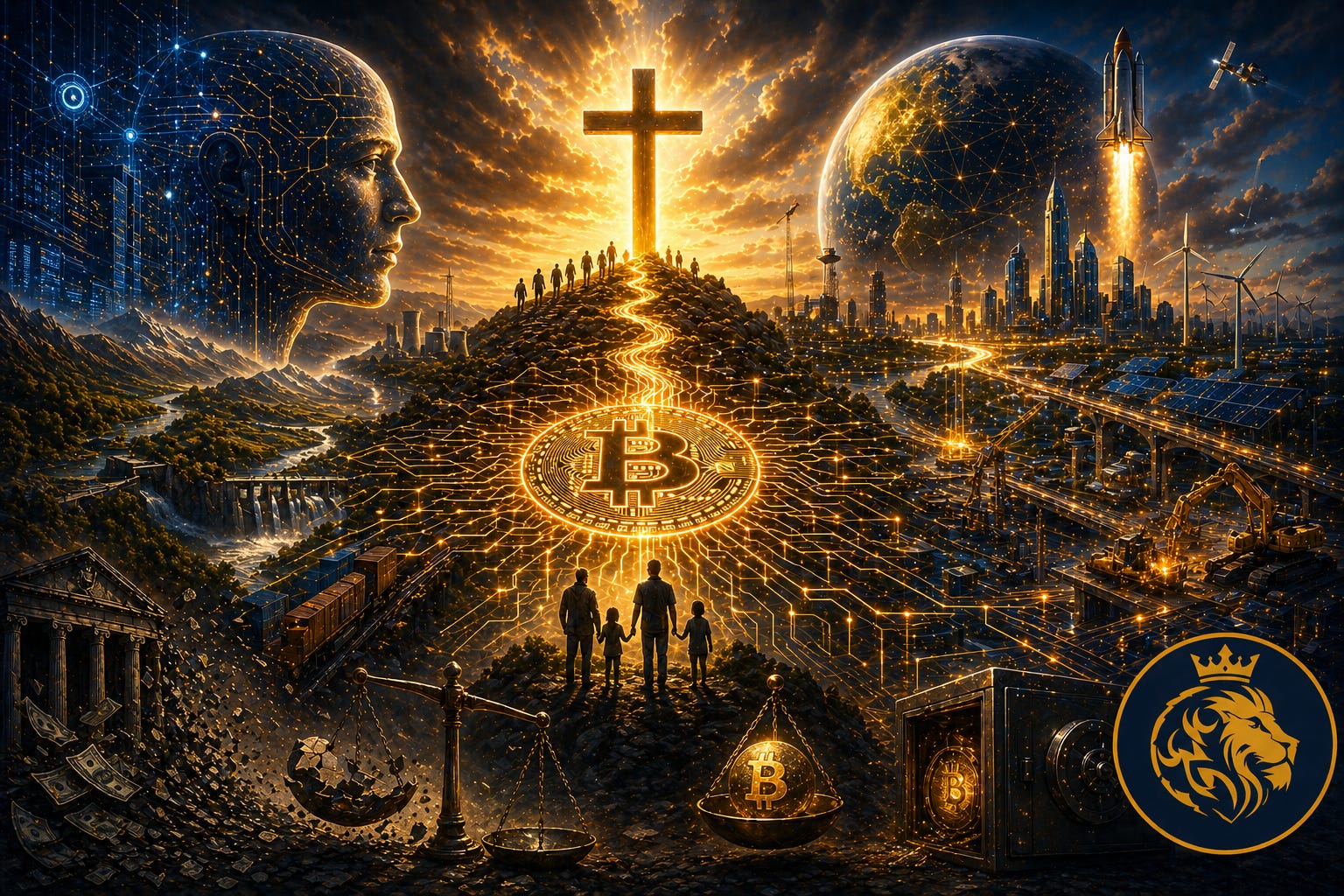
For years, the world believed the future would be built in software.
Code was king. Platforms scaled infinitely. Capital chased what could grow without friction, without weight, without the constraints that had defined industry for centuries. The great companies of the last era did not require steel or land or raw materials. They required engineers, data, and distribution.
Bits, not atoms. It felt like an escape from the physical world. However, reality has a way of reasserting itself.
Chamath Palihapitiya’s 2025 Annual Letter framework points to a shift that is now impossible to ignore. The next phase of global power is not being built on software alone. It is being anchored in something far more fundamental. Energy. Minerals. Infrastructure. The assets that do not scale infinitely, but determine whether anything else can scale at all.
This is not a reversal. It is a rebalancing.
Software was never the foundation. It was leverage on top of a foundation that already existed. And as the world moves deeper into artificial intelligence, that distinction becomes critical. Intelligence at scale is not just a function of code. It is a function of compute. Compute is a function of energy. And energy is a function of physical systems that must be built, maintained, and secured.
Without energy, intelligence stops.
This is the layer that is now coming back into focus. Data centers are no longer abstract concepts. They are massive physical installations, drawing enormous amounts of power. Supply chains for semiconductors are no longer background considerations. They are strategic priorities. Rare earth minerals, once overlooked, are now central to national security conversations.
The world is rediscovering something it thought it had moved beyond. Power is physical. Physical systems require control.
This is where the geopolitical landscape begins to shift. What once felt like a globally integrated system is increasingly organizing into spheres of influence. The United States and China have emerged as the defining poles of this new structure. Not just economically, but technologically and industrially. Nations are being forced to make choices, not always explicitly, but through alignment of trade, policy, and infrastructure.
This is not simply competition. It is architecture.
The Founding Fathers understood that sovereignty required more than ideals. George Washington warned of entanglements not because he rejected engagement, but because he understood the cost of dependence. A nation that cannot sustain itself, that relies too heavily on external systems for its core functions, ultimately forfeits a degree of its freedom.
That principle is returning.
Industrial policy, once dismissed as inefficient or outdated, is reemerging as a central strategy. Governments are funding energy production, semiconductor manufacturing, and critical infrastructure with a long-term perspective that markets alone rarely sustain. The time horizon is extending. The focus is shifting from immediate return to enduring capability.
Scripture offers a parallel that is as practical as it is prophetic. In Genesis 41, Joseph interprets a dream that reveals both abundance and famine. His response is not reactive. It is strategic. He stores grain during the years of plenty, building reserves that will sustain nations when scarcity arrives.
Preparation is not fear. It is wisdom.
The world is entering a phase where that kind of thinking is no longer optional. Systems that appeared efficient in times of stability are now being tested under pressure. Supply chains that were optimized for cost are being reexamined for resilience. Energy systems that were taken for granted are being reevaluated for security.
And beneath all of it, a deeper question is emerging. What holds value in a world where physical control matters again?
This is where Chamath’s analysis is both accurate and incomplete. He identifies where value is moving. Toward the assets that underpin everything else. But as with the previous layer, the question is not only where value resides. It is how that value is measured, transferred, and preserved across time.
Because energy, for all its importance, does not store itself. It must be converted. Priced. Carried forward. Historically, that process has been mediated by systems that introduce distortion. Systems where the unit of account shifts, where value can be expanded or contracted, where the measurement itself is not fixed.
This is where the final layer begins to reveal itself. Bitcoin does not produce energy. It does not mine minerals. It does not build infrastructure. Bitcoin does something just as important. It monetizes energy.
It provides a way to take the output of physical systems and translate it into a form that can be stored without degradation, without dilution, without dependence on a central authority. It connects the physical world to a digital network that preserves value with a consistency that traditional systems have struggled to maintain.
Energy powers the world. Bitcoin prices it across time. That is not a slogan. It is a structural shift.
When energy can be monetized directly, when it can be captured and stored in a system that does not change its rules, the incentives begin to align differently. Stranded energy becomes valuable. Excess production becomes an asset rather than a loss. The economics of infrastructure begin to shift, not just in theory, but in practice.
And this is where the framework completes itself. Artificial intelligence accelerates what is possible. Physical infrastructure determines what is sustainable. Bitcoin anchors what is true.
Three layers. Each essential. Each incomplete without the others. The world is not just reorganizing around technology. It is reorganizing around reality. In that reordering, the systems that endure will not be the ones that move the fastest.
They will be the ones that hold their form.
Kingdom Principles
True power is grounded in what is real, not what is abstract
Preparation is an act of wisdom, not fear
Sovereignty requires stewardship of physical and spiritual resources
What endures must be anchored in truth
Prayer 🙏✝️🔥
Heavenly Father,
You are the source of all wisdom and provision. As the world shifts and systems are rebuilt, give us clarity to understand what is real and what truly sustains.
Teach us to prepare with wisdom, to steward what You have entrusted to us, and to build in ways that honor Your design. Help us to see beyond what is temporary and align with what is lasting.
Guide us as we navigate these changes, and anchor us in truth so that we may lead with confidence and purpose.
In Jesus’ name, Amen. 🙏✝️🔥