

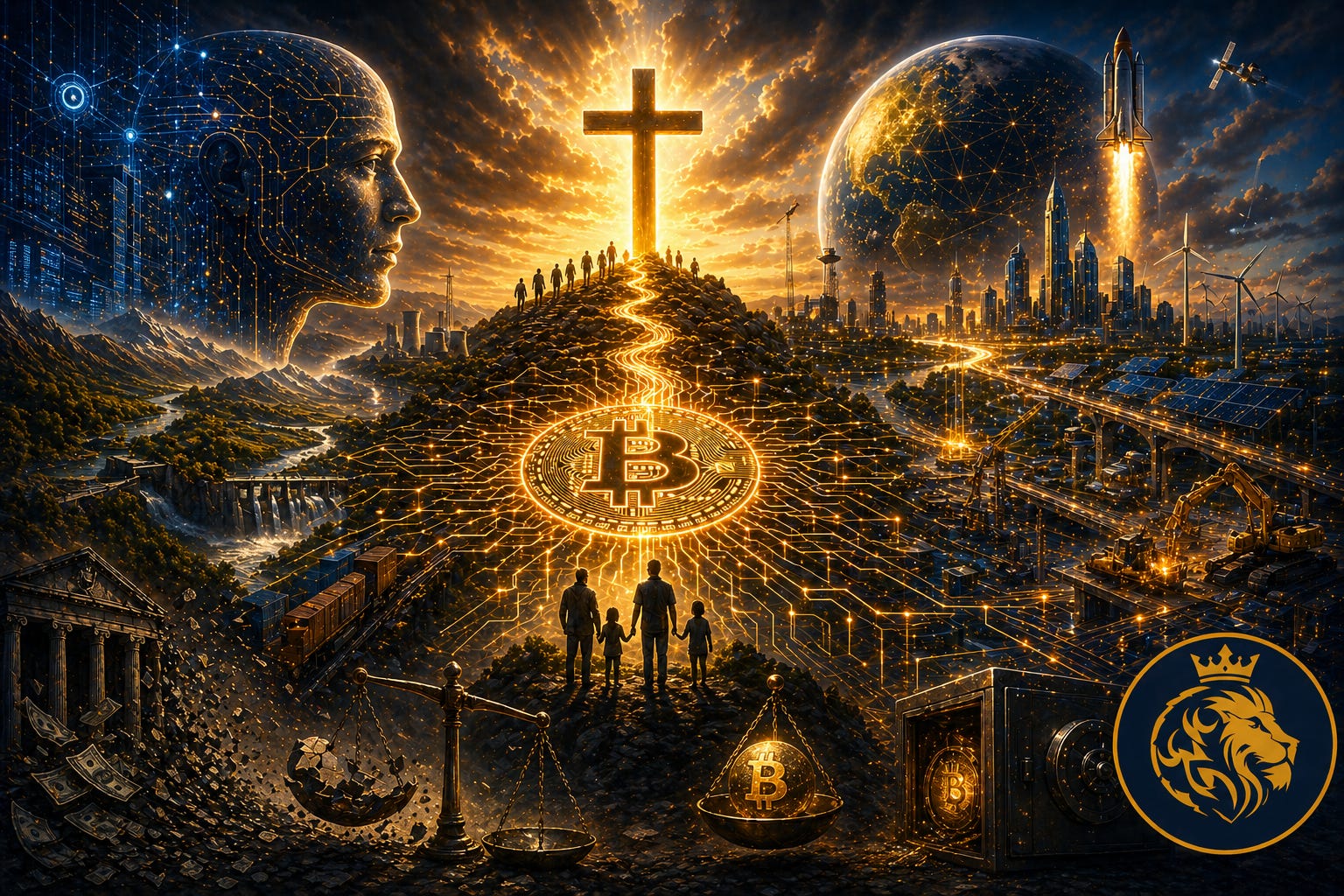
There is a moment in every technological age when humanity begins to whisper the same quiet thought.
This might be it.
Not just progress. Not just advancement. Something greater. Something approaching omniscience. The kind of power that feels less like invention and more like revelation. We saw it when electricity first lit entire cities. We saw it when voices traveled across wires. We saw it again when the internet placed the world’s information into the palm of a hand.
And now, we are seeing it with artificial intelligence.
But there is a pattern here that is easy to miss when you are standing inside the moment. What feels like transcendence is often acceleration. What appears to be understanding is often prediction. And what is marketed as intelligence is, at its core, something far more mechanical.
Chamath Palihapitiya, founder of Social Capital, early executive at Facebook, and one of the more thoughtful voices in modern capital markets through the All-In Podcast, recently offered a framework that feels remarkably aligned with the moment we are living through. His annual letter does not chase headlines. It diagnoses structure. It speaks to the reordering of systems beneath the surface, where artificial intelligence, energy, and capital are beginning to reshape the foundations of global power.
His insight is both clear and necessary.
We are not witnessing intelligence in the way it is being marketed. We are witnessing acceleration. Systems that can predict with increasing precision, compress time between input and output, and simulate understanding at scale. As he frames it, these models are not thinking. They are extending pattern recognition further into the future than ever before.
That distinction matters.
Because when something becomes difficult to explain, the human instinct is to elevate it. To assign it language that suggests awareness, intention, even wisdom. Entire markets begin to move around that assumption. Capital flows. Narratives expand. And what is, at its core, an extraordinary computational breakthrough begins to take on attributes it does not possess.
This is not new.
Each generation has mistaken its greatest invention for something closer to omniscience. Electricity. The internet. Now artificial intelligence. The pattern repeats, not because humanity lacks intelligence, but because it lacks restraint in how it interprets its own creations.
Scripture anticipated this tendency long before we had the words to describe it. “Come, let us build ourselves a city… so that we may make a name for ourselves.” — Genesis 11:4 (NIV). The Tower of Babel was not built out of ignorance. It was built out of ambition. Out of a desire to reach beyond what was given, to collapse the distance between man and God through human effort alone.
Technology has always carried that tension.
It expands what is possible. It accelerates what can be done. But it does not answer the deeper question of why it should be done, or what it ultimately serves. That is where confusion begins to take root. Not in the capability itself, but in the interpretation of it.
What we are witnessing today is not the arrival of intelligence in the way it is being described. It is the rapid scaling of computation, fueled by energy, data, and capital. It is the compression of time between input and output. It is the ability to simulate understanding at a level that feels, at times, indistinguishable from the real thing.
Remember, simulation is not truth. Prediction is not knowing. Speed is not wisdom.
The distinction is not academic. It is foundational. Because systems built on prediction require constant updating. They evolve, adapt, and improve, but they remain dependent on inputs. They are only as reliable as the data they consume and the frameworks they are trained on. This is why trust has become the real bottleneck. Not capability. Not scale. Trust.
Trust is not granted easily. It is earned through consistency. Through transparency. Through something that holds its form over time. This is where the deeper layer begins to emerge.
While the world races to build systems that can predict the future, very few are asking what anchors the present. What serves as the reference point in a world of accelerating outputs. What remains constant when everything else is adapting.
This is not a new question. It is an old one.
The kind that our Founding Fathers wrestled with when they considered the dangers of concentrated power. The kind that shaped early debates around sound money, where stability was not a convenience, but a requirement for a functioning republic. A system cannot remain free if its foundations are constantly shifting beneath it.
The same principle applies here.
If intelligence is being scaled at an unprecedented rate, then the systems that measure, store, and transfer value must be equally grounded in truth. Otherwise, we create a world where capability expands faster than clarity. Where outputs increase, but understanding diminishes. Where we can generate answers at scale, but lose sight of what is real.
This is the tension of the current moment. AI represents acceleration. Acceleration without anchoring leads to distortion. This is where bitcoin quietly enters the conversation.
Not as a competitor to intelligence, but as a complement to it. Not as a system that predicts, but as one that verifies. A fixed supply. Transparent rules. A network that does not adapt to opinion or adjust to narrative. It simply operates, block by block, holding its form in a world that is constantly reshaping itself.
If AI is the engine pushing humanity forward, bitcoin is the reference point that ensures we know where we are.
One expands possibility. The other preserves truth. In a world that is beginning to confuse the two, that distinction will become increasingly important.
Because the question is no longer whether we can build systems that feel intelligent. The question is whether we will build a world that remains aligned with what is true.
Kingdom Principles
What feels powerful is not always what is true
Acceleration without anchoring leads to distortion
Trust is built on consistency, not capability
Truth must underlie every system that shapes humanity
Prayer 🙏✝️🔥
Heavenly Father,
In a world moving faster than ever, ground us in what is true. Give us discernment to see clearly, wisdom to understand deeply, and humility to recognize the limits of what we build.
Help us not to confuse creation with Creator, or capability with purpose. Anchor us in Your truth so that as the world accelerates, we remain steady.
Guide our thoughts, our work, and our decisions. Let everything we engage with reflect Your order, Your clarity, and Your design.
In Jesus’ name, Amen. 🙏✝️🔥