

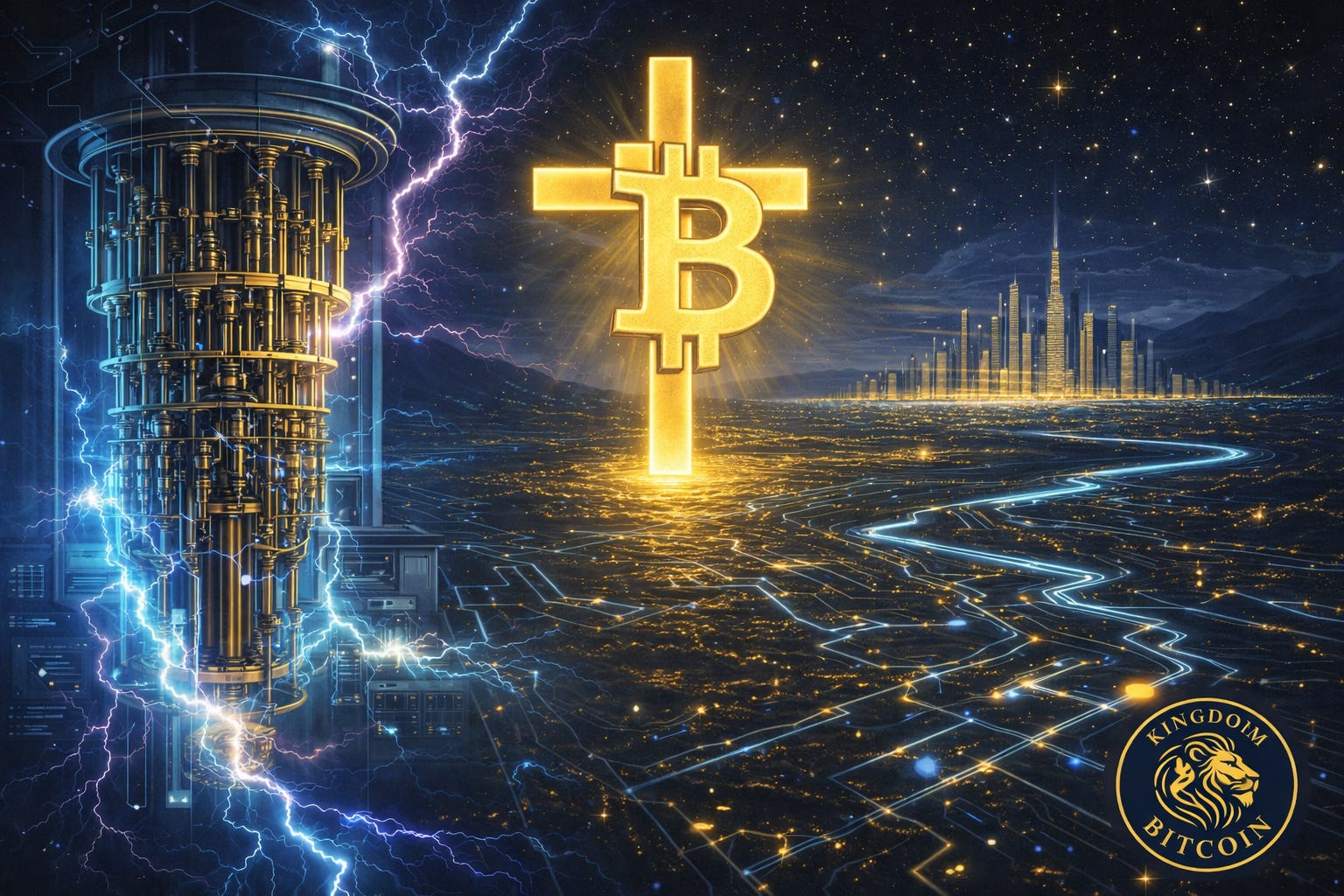
This series examines the collision between quantum computing and Bitcoin, revealing what happens when truth is tested at its deepest level. Over a 300–400 year horizon, the question is not which system survives, but which system is built on truth that can endure.
What Breaks, What Holds, and Why Truth Still Wins
Eighteen months ago, quantum computing was a future problem.
Today, it is a strategic race.
And for the first time, Bitcoin is being pulled directly into the conversation.
There is a shift happening beneath the surface of the world that most people can feel, but few can explain. Quantum computing has quietly moved from theoretical curiosity to strategic priority. Papers are being published. Timelines are tightening. And for the first time, the conversation is no longer about if, but when.
Scripture anticipated this kind of moment long before we could name it.
“Many will go here and there to increase knowledge.” — Daniel 12:4 (NIV)
We are living inside that acceleration now. Knowledge is compounding. Capabilities are expanding. And systems built in one era are beginning to be tested by another.
Bitcoin is one of those systems.
And the truth is simple, even if the headlines are not. The threat is real. But most people are being taught it wrong.
Bitcoin has two layers most people never think about. One layer records truth. The ledger. Immutable, ordered, verifiable. The second layer proves ownership. The signatures that allow someone to say, with finality, this is mine.
Quantum computing does not attack the ledger. It does not rewrite history. It does not undo the chain. What it targets is the moment ownership is revealed. The cryptographic signatures that prove control over an asset.
Let’s slow that down, because this is where clarity replaces fear.
Cryptography is simply the practice of securing information using mathematics. It is the reason you can send a message, store value, or prove ownership in a digital world without trusting a central authority. In Bitcoin, cryptography acts like a lock and key system.
It is like placing a lock on a glass box. Everyone can see what is inside. But only the one with the key can open it.
Because once you see it clearly, the fear begins to fall away. The narrative that Bitcoin can simply be “broken overnight” dissolves under even modest understanding. Mining is not the primary risk. The blockchain itself is not unraveling. What is under pressure is a specific form of cryptography that secures transactions once a public key becomes visible, meaning the moment you reveal your “lock” to prove ownership, the system briefly exposes the mechanism that secures it.
This distinction changes everything.
And yet, the urgency is not imaginary. Recent research has materially compressed the theoretical resources required to break elliptic curve cryptography. Estimates that once felt distant are now within a horizon that serious institutions are preparing for. The models suggest that under certain assumptions, key derivation could occur within minutes.
That deserves explanation.
Elliptic curve cryptography is the mathematical system Bitcoin uses to generate private and public keys. Think of it as a one-way function. It is very easy to go from a private key to a public key, but extraordinarily difficult to go the other direction. That asymmetry is what secures Bitcoin today.
Quantum computing changes the nature of that difficulty.
“Derivation” in this context means working backwards. Taking a known public key and mathematically deriving the private key that controls the funds. In classical computing, this would take longer than the age of the universe. Under certain quantum assumptions, that time compresses dramatically.
Bitcoin is not breaking.
Complacency is.
The deeper issue is not technology. It is understanding.
“For God is not a God of disorder but of peace.” — 1 Corinthians 14:33 (NIV)
Confusion is not a sign of complexity. It is often a sign of misinterpretation. And right now, there is more confusion than clarity in how this topic is being discussed.
Three ideas dominate the conversation, and all three are wrong.
The first is that quantum breaks Bitcoin overnight. It does not. Even in aggressive scenarios, there are layers of exposure, not a single point of failure. The second is that mining is at risk. It is not the primary concern. Hashing functions, which are mathematical processes that take any input and convert it into a fixed, irreversible output, degrade far more slowly under quantum assumptions than signature schemes, which are the specific cryptographic proofs used to authorize and sign transactions. The third is that your bitcoin can simply disappear. It cannot. Risk emerges at specific moments, under specific conditions, not universally across the system.
This is not chaos. It is structure under pressure.
Satoshi understood this instinctively. Systems built on weak foundations do not fail gradually. They fail when tested.
And structure reveals truth.
“What has been will be again… there is nothing new under the sun.” — Ecclesiastes 1:9 (NIV)
Every generation believes its challenges are unprecedented. But the pattern is familiar. New tools emerge. Old assumptions are tested. And systems built on weak foundations begin to fracture, while those grounded in truth adapt and endure.
Bitcoin is entering that phase now. Not as a victim, but as a participant in a larger refinement.
Because the real question is not whether quantum computing will test Bitcoin. It will. The real question is whether we understand Bitcoin well enough to respond with clarity instead of fear.
This is not a moment for panic. It is a moment for precision. A moment to separate what is actually at risk from what is not. A moment to recognize that a system designed for truth will inevitably be tested, not avoided.
And in that testing, something deeper is revealed. Not just about Bitcoin. About us. Because systems do not fail first. Understanding does. And when understanding matures, fear loses its grip.
Quantum does not expose Bitcoin’s weakness.
It exposes whether we ever understood it.
And in the end, that has always been the greater risk.
Kingdom Principles
• Clarity over confusion
• Truth over fear
• Understanding over reaction
Prayer
Heavenly Father,
You are the Author of truth and the source of all wisdom.
In a world where knowledge is increasing and systems are being tested, anchor us in clarity. Guard us from fear that comes from misunderstanding, and lead us into discernment that reflects Your order and not the noise around us.
Teach us to see clearly what is real and what is not. Strengthen us to respond with wisdom, not reaction. Help us steward what You have entrusted to us with understanding, patience, and conviction.
May we walk in truth even as the world shifts, trusting that what is built on Your foundation will endure every test.
In Jesus’ name, Amen. 🙏⚔️✨