

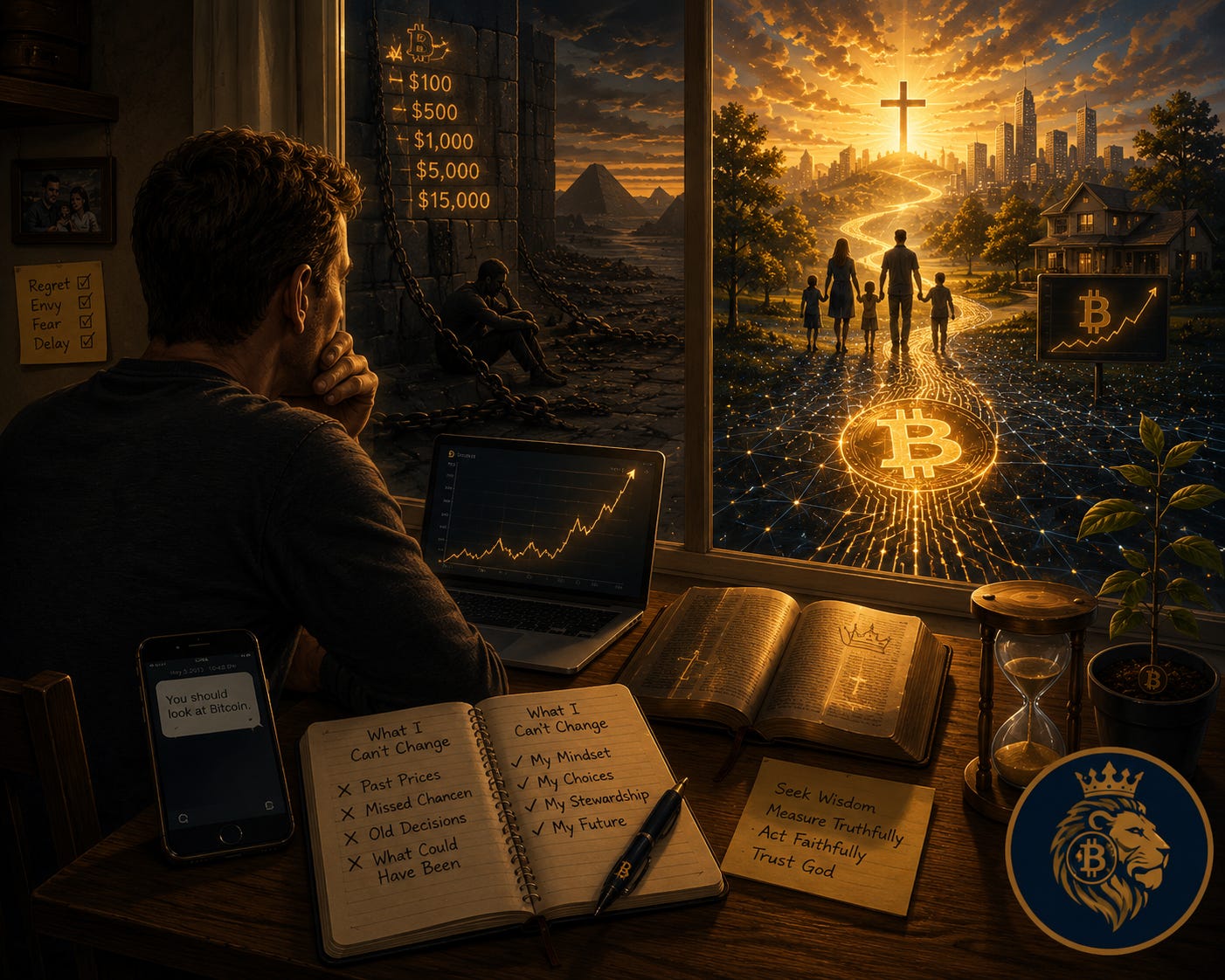
A man sits alone at his kitchen table long after the house has gone quiet. The only light comes from his phone and the small blue glow of a laptop. He is scrolling through an old text thread with a friend, the kind of conversation people revisit only when they are looking for evidence against themselves.
There it is. A message from years ago. “You should look at bitcoin.”
He remembers the price. Maybe it was five hundred dollars. Maybe five thousand. Maybe fifteen. The exact number no longer matters because regret has already rounded it down into something impossibly cheap. He remembers hesitating, laughing, researching for twenty minutes, then deciding he would wait for a better entry.
Now the chart glows like an accusation.
He is no longer studying price. He is imagining an alternate life. The house paid off. The college accounts funded. More freedom from work. More generosity. More room to breathe. Regret has turned one old decision into an entire biography he never lived.
That is what regret does. It edits the past until the choice we failed to make looks obvious, painless, and guaranteed.
The Israelites did something similar after leaving Egypt. Once the wilderness became difficult, they remembered the food but forgot the chains. They remembered the pots of meat and ignored the bricks, the whips, and the graves of children Pharaoh had claimed. Memory became selective because hardship made bondage look simpler than freedom.
Ecclesiastes warns us not to ask why former days were better, because the question is rarely born from wisdom. It is usually born from frustration with the present. Regret keeps asking what life might have been. Stewardship asks what faithfulness requires now.
Bitcoin creates this tension more powerfully than almost any asset in modern history because its past prices look almost fictional. A dollar. A hundred dollars. A thousand. Each old number becomes an anchor, and every new price feels expensive compared with a moment that no longer exists.
Anchoring bias is simply the mind’s refusal to release its first reference point. Someone who first saw bitcoin at one thousand dollars may feel foolish buying at ten thousand. Someone who discovered it at ten thousand may feel late at sixty thousand. The number changes. The emotion does not.
But wisdom does not ask whether yesterday’s price will return. Wisdom asks whether today’s value is being measured truthfully.
The hundred-dollar bitcoin is gone. So is the five-cent gallon of gasoline. So is the five-thousand-dollar house in the neighborhood that later transformed. History does not give us the comfort of acting at yesterday’s price. The Founders could not return to peaceful dependence upon Britain once the truth of their moment had become clear. They had to judge the world in front of them.
The same is true for us.
The question is not what bitcoin cost when you first ignored it. The question is what your money is becoming while you continue to wait.
There is another bias hiding beneath the regret. People want to own a whole unit. One house. One gold coin. One bitcoin. When one bitcoin feels out of reach, they often move toward cheaper-looking tokens because owning a million of something feels more satisfying than owning a fraction of something stronger.
But a million units of nonsense do not become valuable because the app gives you more zeroes to admire.
One bitcoin contains one hundred million sats. You do not need to own a whole bitcoin to participate in scarce money any more than you need to own an entire gold mine to own gold. The whole-coin obsession is psychological, not monetary. Scarcity does not become less meaningful because your ownership begins in fractions.
Isaiah tells us not to dwell on former things because God is doing something new. Paul writes of forgetting what lies behind and pressing toward what is ahead. Neither passage promises financial gain. Both confront the paralysis of living backward.
The man at the table closes the old text thread.
The past has told him everything it can.
Regret is a terrible financial advisor because it always invests in a market that no longer exists. You cannot steward yesterday. You can only repent, learn, and act today.
Now he must decide whether the current price is truly the obstacle, or whether regret has become an excuse for remaining unprepared.
Kingdom Principle 👑
You cannot steward yesterday. You can only act faithfully with what God has placed before you today.
Regret keeps the heart anchored to opportunities that no longer exist. Faithful stewardship learns from the past without living inside it. God calls us to seek wisdom, examine the present honestly, and move forward without allowing shame, envy, or missed timing to govern our decisions.
Prayer 🙏
Heavenly Father, thank You for being the God of new beginnings and present grace. Forgive us for the times we have allowed regret to become an excuse for fear, paralysis, or bitterness.
Give us wisdom to learn from the past without becoming imprisoned by it. Help us measure value truthfully, make patient decisions, and steward our money without greed, panic, or comparison. Teach us to press forward with humility, courage, and trust in You.
May every decision we make honor Jesus, strengthen our households, and create an inheritance of truth and faithfulness for those who follow us.
In Jesus’ name, Amen. 🙏📖₿⏳🌱🕊️👑
Thank you so much for that message it truly ministered to me!