

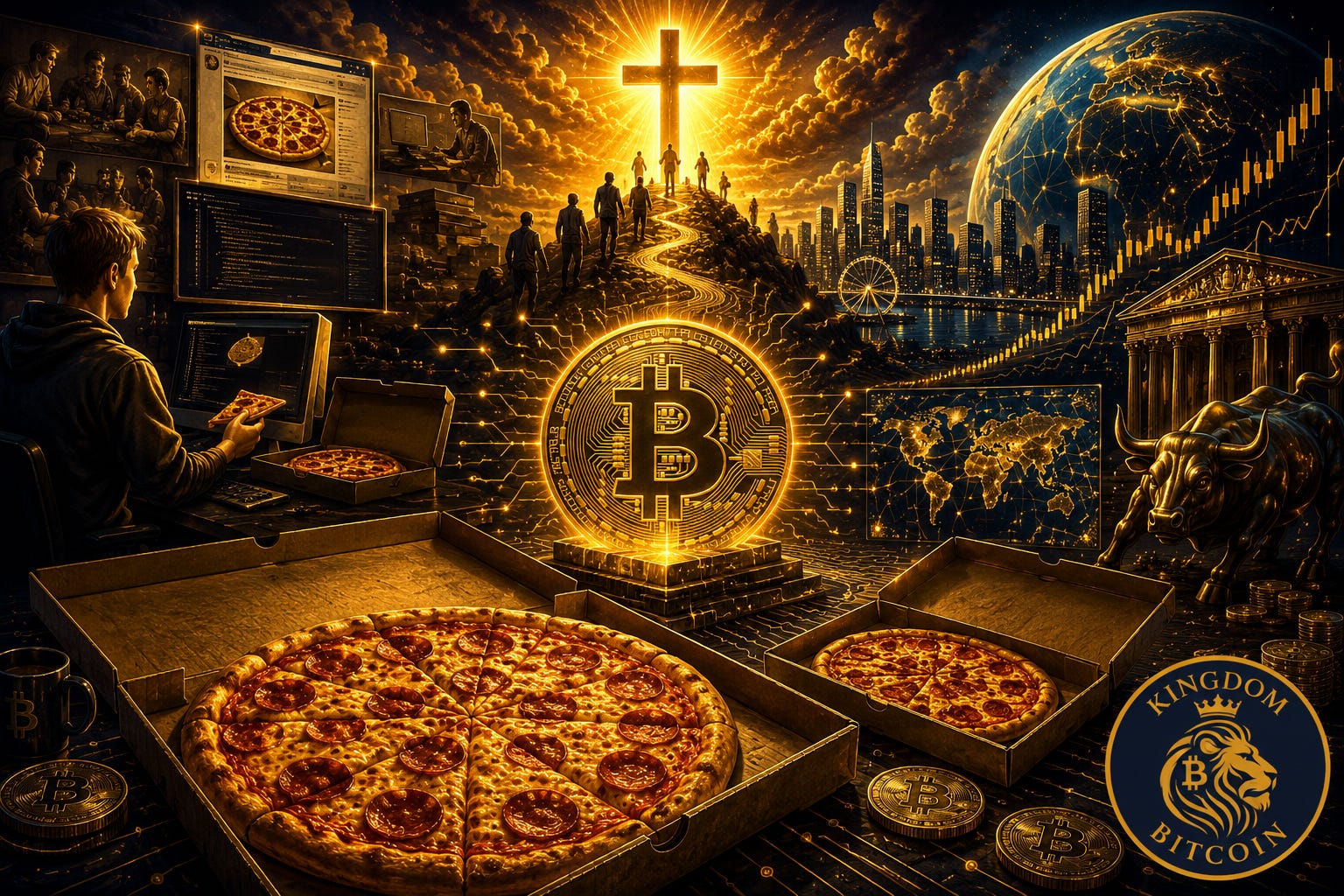
On May 22, 2010, a programmer named Laszlo Hanyecz traded 10,000 bitcoin for two Papa John’s pizzas.
At the time, almost nobody noticed.
No television coverage.
No institutional investors.
No Wall Street analysts.
No ETF commercials.
No nation-state treasury discussions.
Just two pizzas, an internet forum, and a strange digital currency most of the world considered worthless. Sixteen years later, the transaction increasingly reads less like internet trivia and more like monetary prophecy.
With bitcoin trading near $78,000 and having reached an all-time high above $126,000 in October last year, those same 10,000 bitcoin briefly represented about $1.26 billion in value.
Which means Laszlo may have purchased the most famous meal in financial history. Happy Bitcoin Pizza Day.
Every year around this time, headlines perform the same predictable ritual. The world laughs about “the most expensive pizza ever purchased,” usually accompanied by jokes about pepperoni worth hundreds of millions of dollars. But I increasingly believe most people fundamentally misunderstand what actually happened that day.
Laszlo did not fail. The transaction succeeded brilliantly.
Before Pizza Day, bitcoin was theory.
After Pizza Day, bitcoin became money.
For the first time in history, a decentralized digital asset secured by cryptography moved from abstract technological experiment into real-world economic exchange. Laszlo was not trying to become famous. He was simply trying to prove bitcoin could function as money in the real world.
And in that sense, the trade worked perfectly. The world laughed because the world did not yet understand what was being measured.
Every transformative technology looks ridiculous before it looks inevitable.
America itself once looked improbable to the dominant empires of the world. The internet looked unserious in its earliest days. Electricity looked unnecessary to societies already organized around older systems. Conviction often appears irrational to people benefiting from the current order because existing systems naturally defend themselves against replacement.
Bitcoin was no different.
Yet while the world mocked internet money and pizza memes, something far more important was unfolding quietly underneath the surface.
Two monetary systems had begun diverging in real time.
Over the same sixteen years bitcoin’s supply only increased by its prescribed amount via mining rewards every 10 minutes while the monetary system surrounding it expanded relentlessly. In 2010, U.S. national debt stood around $13.5 trillion. Today it approaches $40 trillion. M2 money supply expanded from roughly $8.5 trillion in 2010 to more than $21 trillion at its peak following years of quantitative easing, pandemic stimulus, emergency lending programs, and monetary intervention.
That is not normal historical behavior. That is monetary transformation.
Meanwhile, the purchasing power of the dollar quietly eroded year after year. The same pizza Laszlo purchased for approximately $41 in 2010 would now cost roughly $62 simply from inflation alone.
That distinction matters enormously because Pizza Day is not merely a story about bitcoin appreciation. It is a story about what happens when a fixed system collides with an expandable one. The pizza did not become more valuable. The measuring stick changed.
This may be one of the most important yet least understood ideas in all of finance. Most people still measure bitcoin exclusively in dollars without stopping to ask what is happening to the dollar itself over time. A scarce asset priced against an expandable currency will eventually reveal the properties of both systems simultaneously.
One preserves scarcity.
The other absorbs expansion.
And perhaps this is where Pizza Day becomes strangely biblical.
Scripture repeatedly ties faithfulness to stewardship across time. Proverbs warns against dishonest weights and measures because civilizations eventually become reflections of the systems they normalize. The issue was never merely economics. It was moral architecture. A society incapable of preserving honest measure eventually distorts incentives, savings, stewardship, and ultimately truth itself.
The Bible also repeatedly contrasts short-term appetite against long-term inheritance. Esau traded his birthright for immediate hunger because the present moment felt more urgent than generational blessing. Civilization still behaves this way constantly. We prioritize short-term convenience while weakening the systems meant to preserve value across generations.
Bitcoin increasingly challenges that mentality directly.
Every bitcoin held across sixteen years required conviction against ridicule, volatility, exchange collapses, political hostility, media attacks, and repeated declarations of failure. The market eventually rewards conviction when conviction aligns with truth.
And perhaps that is the deeper lesson hidden inside Pizza Day. The real story was never about a man accidentally spending a fortune on pizza.
The real story was that sixteen years ago, one programmer demonstrated that an alternative monetary system could exist outside traditional financial architecture entirely. Most people dismissed it because transformational moments rarely appear transformational while they are happening.
They usually look small.
Strange.
Almost laughable.
Until enough time passes for the divergence to become impossible to ignore.
The Founding Fathers understood this principle deeply. Durable systems are rarely built around immediate gratification. They are constructed around long-term stewardship capable of surviving generations. Bitcoin increasingly resembles that kind of long-duration architecture.
And sixteen years later, Pizza Day may still be teaching civilization one profoundly uncomfortable lesson:
Scarcity matters. Conviction matters. Honest measure matters. Especially when everything else keeps expanding. Because in the end, the pizzas were never the story. The measure was.
Kingdom Principles 👑
Honest measurement shapes civilizations over time
Conviction often appears irrational before truth becomes obvious
Scarcity matters more inside expanding monetary systems
Stewardship requires thinking beyond immediate gratification
Durable systems are built for generations, not short-term cycles
Bitcoin’s fixed supply contrasts sharply against perpetual monetary expansion
Prayer 🙏✝️🔥
Lord,
Teach us wisdom as we navigate changing financial systems, technologies, and incentives in the modern world.
Help us value truth, stewardship, honesty, and integrity above fear, greed, or short-term thinking. Give us conviction to recognize what is lasting even when the world misunderstands it initially.
May we build lives, families, and systems rooted in faithful stewardship across generations. And may we always remember that true wealth is not merely what we accumulate, but what we preserve, protect, and pass forward wisely.
In Jesus’ name, Amen. 🙏✝️🔥