

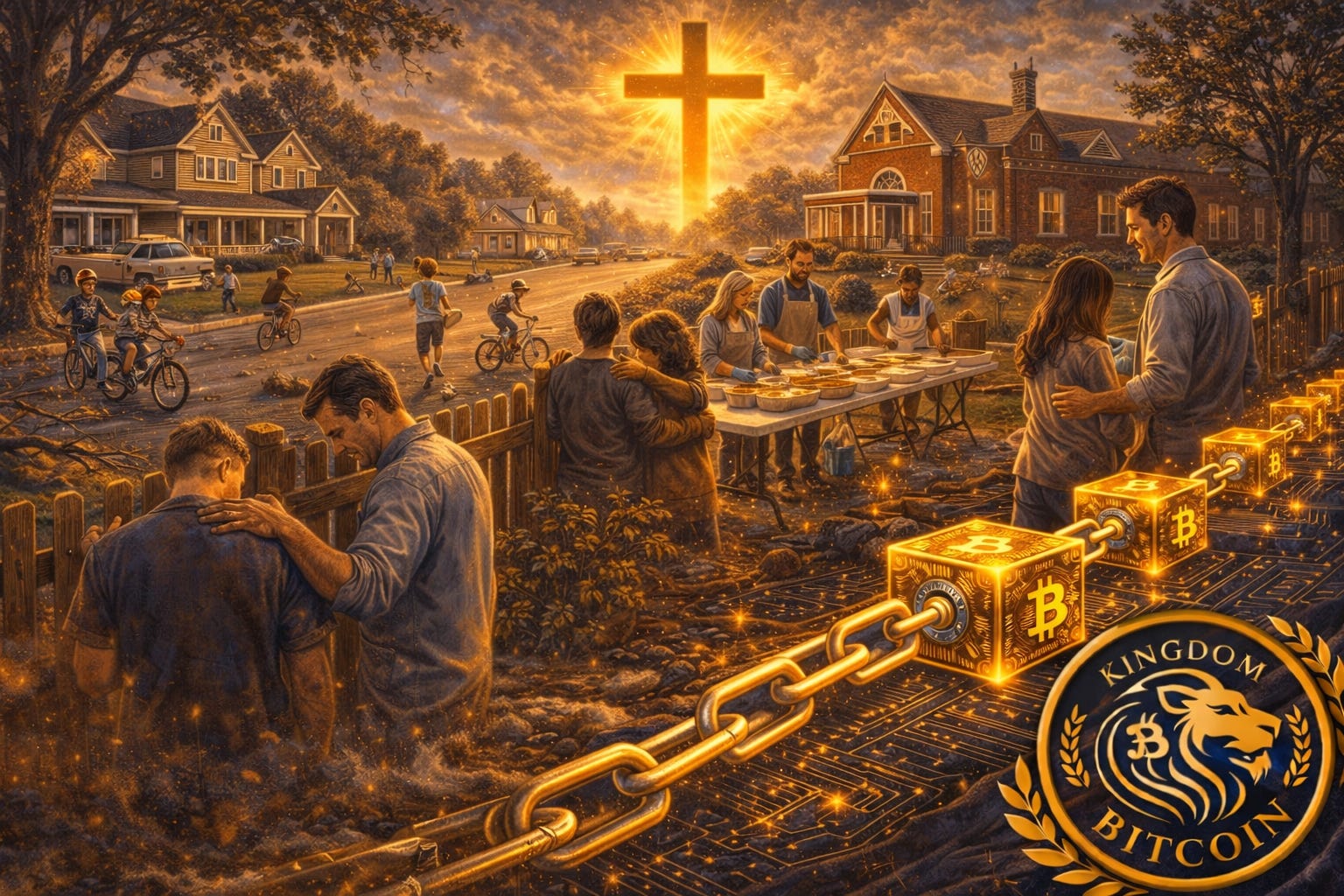
On a typical Saturday morning somewhere in America, neighbors are helping one another repair a fence after a storm. A church group is preparing meals for families in need. Children ride their bikes down quiet streets while parents talk across driveways.
None of it will appear on the evening news. And yet scenes like this unfold thousands of times every day across the country.
If you believed everything the modern information ecosystem tells you, you would conclude that the United States is tearing itself apart.
Every day the headlines reinforce the same message. America is divided. Communities are fractured. Citizens no longer trust one another. But when researchers ask Americans a much simpler question, a very different story begins to emerge.
They ask people not about the country they see on television. They ask about the neighborhood they actually live in. And the answers change almost immediately.
Outrage is now one of the most profitable products in the information economy.
Algorithms reward conflict because conflict captures attention. Attention keeps people on their screens. And time on screens generates advertising revenue.
So the loudest voices slowly become the entire story. But reality is far less dramatic than the narrative.
Researchers with the organization More in Common, led by Tim Dixon, conducted a series of nationwide surveys asking Americans how they viewed the state of the country and how they viewed their own communities.
The contrast was striking.
When Americans described the nation as a whole, many used words like divided, chaotic, and dangerous. But when those same Americans described their own towns, neighborhoods, and communities, the language changed almost completely.
Their communities were friendly. Their neighbors were trustworthy. Their streets felt safe. The country, people believed, was fractured. Their own communities, however, were functioning surprisingly well.
This gap between national perception and local experience reveals something important about the modern information environment. Most Americans do not experience division in their daily lives. They experience it through screens and what they are being served.
The Founding Fathers never expected Americans to agree on everything. In fact, they assumed disagreement would be constant. Their goal was not to eliminate conflict but to design institutions capable of managing it.
In his farewell address, George Washington warned about the dangers of political factions. He understood that factions would arise naturally in a free society. But he cautioned that when political rivalry transforms fellow citizens into enemies, the health of the republic begins to erode.
Washington was not warning against debate. Debate is essential to democracy. He was warning against the loss of civic friendship.
For many years that civic friendship still existed in American public life.
Consider the remarkable relationship between Supreme Court Justices Antonin Scalia and Ruth Bader Ginsburg. On the bench they represented opposite judicial philosophies and often issued sharply conflicting opinions on some of the most consequential legal questions in the country.
Yet outside the courtroom they were genuine friends. They attended the opera together. Their families vacationed together. They shared meals and laughter despite profound intellectual disagreements.
They understood something modern political culture often forgets. Disagreement does not require hatred. You can fiercely debate ideas while still honoring the dignity of the person across the table.
The pace of modern life, however, increasingly works against that kind of depth.
Smartphones have transformed how we consume information. News now arrives in a constant stream of alerts, headlines, and algorithmically curated feeds. Complex issues that once required long articles and thoughtful debate are now compressed into memes, short clips, and emotionally charged soundbites.
The speed of information has increased dramatically. The depth of reflection has often decreased.
The Founders built a republic that required thoughtful citizens. The modern digital environment often rewards reactive ones. And yet beneath the noise, the deeper character of the country remains intact.

My wife, Denise Gitsham, addresses this challenge directly in her book Politics for People Who Hate Politics. After more than two decades working at the highest levels of government, Denise has seen firsthand how the modern political environment often rewards outrage rather than wisdom. Yet her conclusion is not that citizens should withdraw from public life. It is the opposite.
She argues that the answer to a broken political culture is not disengagement, but a different kind of engagement.
Christians, she writes, must bring something countercultural into the public square: integrity, discernment, and the courage to stand firmly for truth while still loving those with whom they disagree. Politics practiced in this way does not inflame division. It elevates the conversation and restores dignity to civic life.
In other words, the problem in American politics is not disagreement. The problem is the loss of character in how we disagree. Americans are not rejecting politics. They are rejecting political theater.
A healthy republic requires citizens who are willing to disagree without forgetting that they still belong to the same nation.
The research from Tim Dixon and the team at More in Common points in the same direction. Beneath the algorithmic noise, there remains a wide foundation of shared civic values that still binds the country together.
This insight matters not only for politics but also for the systems that allow societies to function.
In many ways bitcoin reflects the same principle.
The Bitcoin network does not require its participants to share political beliefs, cultural identities, or national loyalties. It operates through a simple set of transparent rules that anyone in the world can verify. No central authority decides who may participate. No committee quietly adjusts the supply.
People who disagree about almost everything else can still cooperate inside the system.
The Founders understood the importance of this kind of neutral architecture. The American Constitution was designed to allow citizens with profoundly different convictions to live under a shared framework of rules. It did not eliminate disagreement. It made peaceful cooperation possible despite disagreement.
Bitcoin applies a similar insight to money.
In a world where trust in institutions is increasingly fragile, systems governed by open rules become more valuable. The bitcoin ledger does not ask who you voted for, what church you attend, or which ideology you hold. It simply records truth in a way that anyone can verify.
Free societies require more than shared opinions. They require shared systems that people can trust even when they disagree. That insight is not entirely new in American history.
That insight is not entirely new in American history.
In 1776, a group of founders signed a declaration asserting that free people could govern themselves through shared principles rather than imposed authority.
More than two centuries later, in 2009, another quiet innovation introduced a system where individuals across the world could cooperate through transparent rules rather than centralized control.
Both moments reflected the same enduring insight. Human cooperation flourishes when trust is anchored in principles rather than personalities.
Scripture has long recognized that societies flourish when people learn to live together despite their differences.
“Behold, how good and pleasant it is when brothers dwell in unity.”
- Psalm 133:1
Unity in Scripture does not mean uniformity. It means learning to inhabit the same covenant community while honoring the dignity of those around us.
A healthy nation is not one without disagreement. It is one where disagreement does not destroy the covenant that binds its people together. But when we step away from the spectacle and look honestly at the communities around us, a quieter truth emerges.
Neighbors still help one another during storms. Communities still rally around families in crisis. Churches still feed the hungry. Volunteers still rebuild homes after disasters.
The foundation of the country remains stronger than the spectacle suggests.
As the United States approaches the celebration of its 250th year of independence, it is worth remembering that the American experiment has always been both fragile and resilient. The Founders were attempting something unprecedented. They were building a nation not around tribes, bloodlines, or ancient borders, but around ideas. Liberty. Responsibility. Self government.
Those ideas have been tested again and again over the past two and a half centuries.
Yet the republic endures because ordinary citizens continue to practice the quiet virtues that sustain free societies. They raise families, serve neighbors, volunteer in churches, build businesses, and show up for their communities.
Free societies do not survive because citizens agree on everything. They survive because citizens remember that they belong to the same story.
More than a century and a half ago, Abraham Lincoln described what holds the American people together as the “mystic chords of memory” stretching across the nation, connecting citizens through shared history and shared hope.
Those chords have not disappeared. They have simply been drowned out by the noise. If we choose to listen more carefully, we may rediscover something that the algorithms cannot measure and the headlines cannot manufacture.
The American story is not finished. The foundation is still there.
And the next chapter will not be written by the loudest voices on our screens, but by the quiet millions of citizens who still believe that a free people can live, work, and build together.
The American story has never been written by algorithms.
Prayer 🙏
Dear Lord,
In a world filled with noise, help us seek truth.
Guard our hearts from division, slander, and the temptation to see our neighbors as enemies. Teach us to listen with humility and to pursue wisdom rather than outrage. Strengthen the foundations of our communities, our families, and our nation.
And remind us that real renewal begins not through conflict, but through faithful people who quietly serve, build, and love their neighbors.
In Jesus’ name, Amen. 🙏
Very articulately expressed wisdom!