

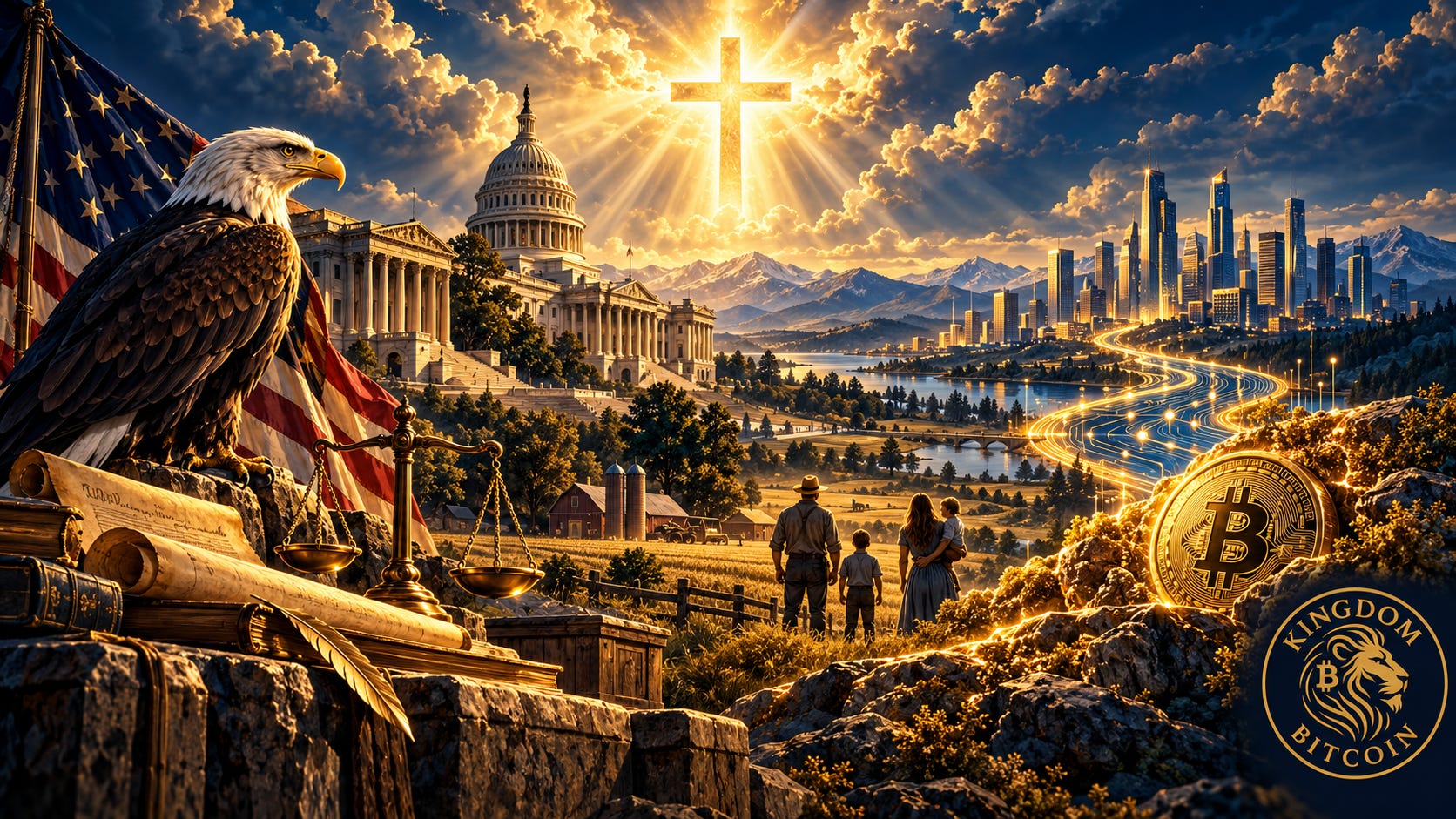
America’s 250th anniversary is more than a birthday. It is an audit of what one generation received, preserved, and is preparing to hand forward. This four-part Kingdom Bitcoin series returns to four foundations of the American experiment: God-given rights, constrained power, economic freedom, and honest money. Before constitutions, capitalism, or Bitcoin, we must begin with the question beneath them: who stands above the state?
Pharaoh possessed the throne, the army, the law, and the power to punish resistance. Then he ordered the Hebrew midwives, Shiphrah and Puah, to kill newborn sons. Exodus says they “feared God and did not do what the king of Egypt had told them to do.” Pharaoh had political authority, but he did not have ultimate authority. The midwives understood something every free nation must remember: a command does not become righteous merely because a ruler issued it.
That is where the Christian case for human dignity begins. It does not begin with citizenship, wealth, race, ability, productivity, or government recognition. It begins in Genesis, where humanity is created in the image of God. The state does not grant personhood; it encounters a person whom God already made. Jesus reveals the depth of that value by giving His life for sinners, while the Holy Spirit forms people capable of using freedom for service rather than self-worship. Christian liberty is freedom to tell the truth, love our neighbor, accept responsibility, and live beneath God’s authority.
Before America had a Constitution, it had a claim about who stood above government. The Declaration appealed to “the Laws of Nature and of Nature’s God,” declared that people are “endowed by their Creator” with unalienable rights, appealed to “the Supreme Judge of the world,” and concluded with reliance upon “divine Providence.” Its hierarchy is striking: Creator, human person, unalienable rights, government, consent of the governed. Government comes fourth, not first. It exists to secure rights it did not create. The Declaration’s first political limit was theological: the state is not God.
That does not mean America was established as a church-state, nor did every Founder hold identical Christian beliefs. The Constitution later prohibited religious tests for federal office, and the First Amendment protected religious exercise while restraining federal establishment. Yet the founding culture was not spiritually empty. A study of political literature from 1760 to 1805 found that roughly one-third of its citations were biblical. The Constitution was not copied from Scripture, but biblical language, moral assumptions, and ideas about human nature permeated the world in which it was formed.
George Washington and John Adams understood that parchment alone could not preserve liberty. Washington called religion and morality pillars of human happiness and necessary supports of popular government. Adams wrote that statesmen might plan for liberty, but religion and morality establish the principles on which freedom securely stands. They recognized that government cannot manufacture faith and self-government requires self-governed people. The Founders did not expect parchment to produce virtue. They expected a moral people to carry the parchment.
America did not live its declared principles perfectly. The nation proclaimed that all men were created equal while tolerating slavery, a contradiction patriotism cannot excuse. Yet the Declaration provided the ruler by which the country could be measured and corrected. At Gettysburg, Abraham Lincoln described America as conceived in liberty and dedicated to equality, and called for a new birth of freedom under God. In his Second Inaugural, he noted that North and South read the same Bible and prayed to the same God. The Declaration announced a truth America had not yet fully lived. Lincoln called the nation back to its own ruler.
That calling cannot be sustained by memory alone. In 2007, 78 percent of American adults identified as Christian; by 2023 and 2024, that share had fallen to 62 percent. Christianity remains dominant, but its inheritance can no longer be assumed. Faith is not transmitted through monuments, presidential quotations, or a flag in the sanctuary. It is transmitted through discipleship, worship, Scripture, prayer, family, and lives transformed by Jesus Christ. Christian inheritance does not survive through nostalgia. It survives through teaching and practice. Pew Research Center
That begins in the household. Do our children know why the Declaration places the Creator before government? Do they understand that rights carry duties, liberty requires character, and religious freedom protects conviction without making every belief equally true? Are they learning America only as a collection of grievances, or as an inheritance to correct where wrong and steward where right? A country forgets its foundations one family at a time. It can remember them the same way.
Bitcoin enters this first essay because it does not create human rights and should never become a theological system. It does raise a related question about ownership: can digital property exist without depending entirely upon an intermediary granting permission? The Declaration asks whether rights predate government. Bitcoin asks whether ownership can be verified before institutional approval. Those are different questions, but they share an instinct. Some things are too important to depend entirely upon the favor of whoever currently holds power.
America was not founded on the belief that government makes people free. It was founded on the belief that people already possess dignity and rights government must respect. Jesus stands above every political document, and the freedom He gives reaches deeper than any republic can promise. Yet earthly liberty remains a profound stewardship. If rights come from above government, the next question is how government can be prevented from reaching above its proper place. That was the assignment of 1787 and every future generation.
Kingdom Principle 👑
Human freedom is safest when government remembers that it did not create the human person.
Government can recognize rights, secure rights, defend rights, and violate rights. It cannot author the dignity from which those rights arise. The Christian understanding of freedom begins with a person made by God, known by God, and accountable to God before that person ever encounters a ballot box, courtroom, tax code, or government office.
That order protects both liberty and responsibility. Rights are not permission to live without obligation. They create space in which we can worship, build, serve, speak truth, raise families, love our neighbors, and answer the call God has placed upon our lives.
Bitcoin offers a smaller architectural reminder. Ownership becomes more durable when it can be verified rather than merely granted by an intermediary. But Bitcoin remains beneath the greater truth. A protocol can help protect property. Only God can tell us why the person holding it possesses value in the first place.
Prayer 🙏
Heavenly Father, thank You for creating every human being in Your image and for giving dignity that no ruler, institution, majority, or government can rightfully erase. Thank You for the men and women who understood that political authority must remain beneath a higher moral authority. Help America remember that liberty is not self-created and that rights detached from truth eventually lose both their meaning and their protection.
Lord Jesus, keep us from turning patriotism into idolatry or using Your name merely to bless our political preferences. Teach us to love truth, defend human dignity, serve our neighbors, protect religious liberty, and use freedom for purposes worthy of the sacrifice that preserved it. Raise churches that disciple rather than merely comment, parents who teach rather than assume, and citizens whose character is strong enough to carry self-government.
Holy Spirit, renew the American household. Help us pass forward faith, wisdom, courage, historical memory, and a clear understanding of where our freedom comes from. Keep every government, market, technology, currency, and ambition in its proper place beneath God. As America begins its next 250 years, make us faithful stewards of the inheritance placed in our hands.
The future belongs to You. The stewardship belongs to us. In Jesus’ name, Amen. 🙏📖🇺🇸🗽🏛️✝️🏠₿🕊️👑