

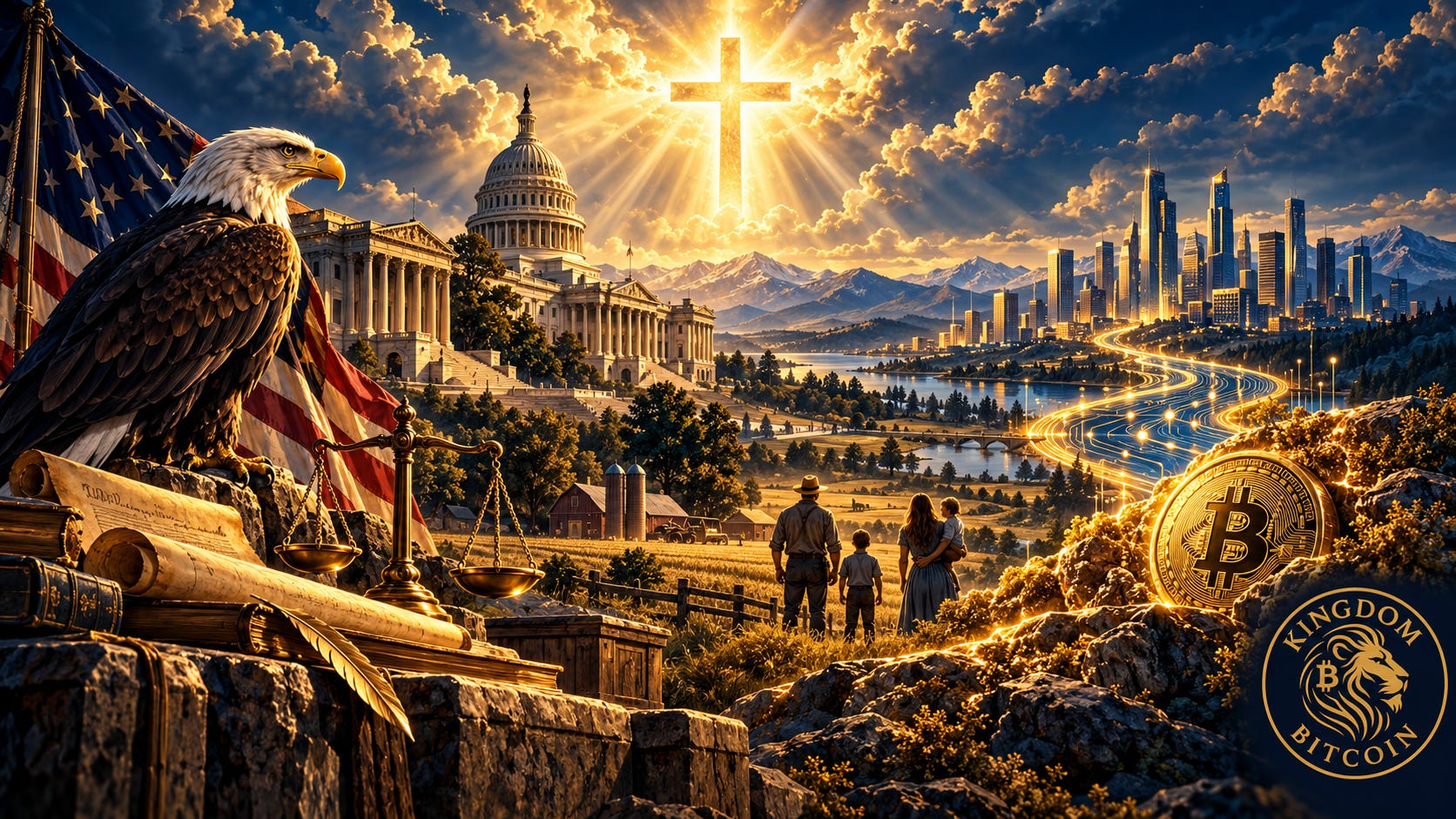
American history is also a story of things built. Farms became towns, savings became investment, and ideas became institutions that outlived their founders. The first two articles established that rights come from God and power must be constrained because human beings are not angels. The next question is what free people create when law protects the room in which talent can work.
Exodus 31 gives us one of Scripture’s most beautiful pictures of craftsmanship. God tells Moses that He has filled Bezalel with the Spirit of God, with wisdom, understanding, knowledge, and every skill needed for the work ahead. Building was not beneath spiritual life. Craftsmanship could become a calling, and excellence an act of obedience. Before finance, there was a man equipped by God to make something useful and beautiful.
Jesus’ Parable of the Talents carries that stewardship principle further. The master entrusts resources, expects action, and eventually asks what each servant did with what he received. The lesson is Kingdom accountability, but the logic is unmistakable. Gifts are meant to be cultivated rather than buried by fear. Capitalism gives that cultivation room by protecting private property, voluntary exchange, contracts, competition, investment, and the right to try. It is the freedom to put talent to work without requiring government to decide what that talent may become.
The Constitution quietly built that freedom into America’s architecture. Congress received authority over commerce, bankruptcy, borrowing, and intellectual property, while the Patent and Copyright Clause empowered it to promote progress by protecting authors and inventors. That provision created a lawful path through which useful ideas could become valuable. In 1790, George Washington signed the first United States patent, and Thomas Jefferson served on the Patent Board. By June 2024, the nation had issued its twelve-millionth utility patent. America gave inventors a reason to keep inventing.
Benjamin Franklin embodied that builder’s instinct. He was a printer, publisher, scientist, inventor, postmaster, diplomat, and founder of civic institutions including a lending library and volunteer fire company. Franklin did not separate enterprise from public usefulness. His success created room for experiments, service, and institutions that strengthened his community. He reminds us that capitalism at its best is useful creation that widens possibility for others.
Alexander Hamilton understood the same principle. His reports on public credit, a national bank, the mint, and manufacturing sought to turn independence into productive capacity. He knew savings could become capital, capital could finance enterprise, and credible institutions could help a young republic build beyond subsistence. Hamilton was not arguing that government should direct every economic choice. He was building architecture through which private ambition and national strength could reinforce one another.
Abraham Lincoln carried the freedom to build into a nation at war. The Homestead Act offered settlers a route toward property ownership through residence and cultivation, while the destruction of slavery restored the economic truth that free enterprise requires free people. Lincoln was also the only United States president ever awarded a patent, which feels appropriately American. Theodore Roosevelt later added another insight. Competition must remain open enough for the next builder to enter the arena. Antitrust, properly used, protects capitalism from hardening into privilege.
Ronald Reagan gave this tradition its most memorable modern image. His shining city had free ports humming with commerce and creativity, with doors open to people carrying the will and heart to build a life there. Reagan did not ask America to apologize for prosperity. He asked America to remember the principles that produced it. Limited government, religious liberty, enterprise, and confidence in ordinary citizens belonged to one national character.
The results are not merely rhetorical. Real United States GDP grew from about $1.19 trillion in 1929 to nearly $23.94 trillion in 2025, measured in chained 2017 dollars. In 2025, American venture investors deployed roughly $320 billion across more than 15,000 deals. Statistics cannot capture every failure, but they reveal something enormous. American freedom created a system through which millions could attempt useful things nobody in government had thought to authorize.
That is why I reject democratic socialism as a competing vision for America. It shifts economic authority away from owners, workers, customers, investors, and entrepreneurs and toward political institutions that cannot possess the local knowledge distributed across millions of decisions. The American Dream is not a promise that everyone finishes in the same place. It is the freedom to begin somewhere and build toward somewhere better. Compassion should help people regain agency, not make permanent dependency the organizing principle of national life.
Bitcoin belongs in this builder’s republic because it emerged through open-source software rather than a chartered corporation or government program. Anyone could inspect the design, challenge it, run a node, build a wallet, mine, create a company, or walk away. No licensing board decided who was important enough to participate. Bitcoin extends the capitalist question into digitally native property: what happens when ownership, exchange, and settlement occur on an open network governed by transparent rules? The answer is still being built. Permissionless innovation matters because nobody knows which outsider carries the next important idea. bitcoin.org
The household is where this inheritance becomes practical. Teach children to make something, sell something, save before consuming, understand ownership, serve a customer, and recover from honest failure. The most important capitalist lesson may not be how to own stocks. It may be how to create something another human being genuinely values. Free people can build extraordinary things, but every contract, wage, price, debt, and inheritance still depends upon the integrity of the measure beneath it. That is where the final article must go next.
Kingdom Principle 👑
Freedom reaches its highest economic purpose when talent becomes service, savings become productive capital, and prosperity creates more opportunity for others.
Capitalism gives people room to cultivate what God has placed in their hands. It rewards those who solve problems, serve customers, accept risk, create value, and build something other people freely choose to use. It also permits failure, which matters because a nation that makes honest failure unforgivable will eventually produce fewer courageous attempts.
Capital should not merely circulate among people who already possess it. At its best, it becomes fuel for the next builder, employee, invention, household, and community. Prosperity finds greater purpose when it expands someone else’s opportunity rather than merely enlarging our own comfort.
Bitcoin adds another open field for experimentation, ownership, and enterprise. Yet neither capitalism nor Bitcoin can govern the heart of the builder. The Holy Spirit must still shape ambition into service, prosperity into generosity, and freedom into faithful stewardship.
Prayer 🙏
Heavenly Father, thank You for creating human beings with imagination, skill, intelligence, courage, and the desire to build. Thank You for Bezalel and for the reminder that craftsmanship can be a calling filled with Your Spirit. Bless the entrepreneurs, workers, inventors, investors, farmers, tradespeople, scientists, engineers, and builders who use their gifts to create something useful for others.
Lord Jesus, protect us from burying what You have entrusted to us through fear, complacency, entitlement, or dependence. Give employers integrity, workers diligence, investors wisdom, and customers discernment. Help government protect the field without attempting to control every play, and preserve an America where the next builder can begin without first needing political permission.
Holy Spirit, govern our ambition. Keep prosperity from becoming pride, profit from becoming an idol, and success from making us forget the people who helped us build. Teach our children to create rather than merely consume, serve rather than merely demand, and understand that freedom carries the responsibility to cultivate what God has placed within them.
May our talents become service, our capital become possibility, and our freedom become a blessing to generations still to come. In Jesus’ name, Amen. 🙏📖🇺🇸🛠️🏗️💡💼📈₿🕊️👑