

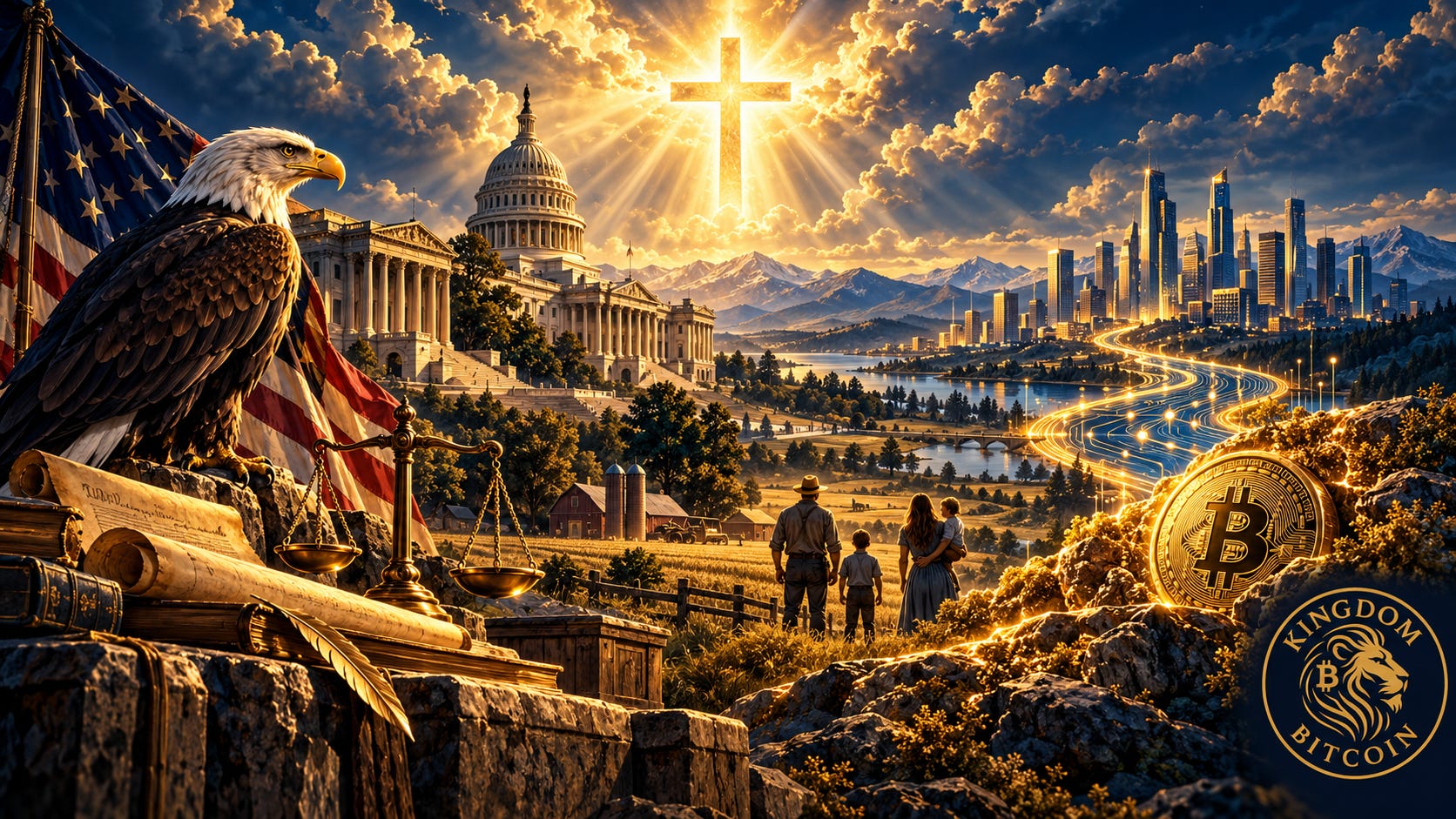
America’s history is an audit of what one generation received, preserved, and will hand forward. This four-part Kingdom Bitcoin series returns to four foundations: God-given rights, constrained power, economic freedom, and honest money. The question is whether we still understand our inheritance.
Israel asked Samuel for a king like the nations around it. God permitted the request, but Samuel warned what concentrated authority would eventually do. “He will take,” Samuel said, then repeated it over sons, daughters, fields, vineyards, servants, and flocks. The king would not begin by announcing tyranny. He would begin by claiming that more of life belonged under his direction. First Samuel 8 is not an argument for anarchy. It is a warning that rulers remain human even when their titles become impressive.
Romans 13 recognizes legitimate government entrusted with preserving order and punishing wrongdoing. Scripture gives us neither worship of government nor contempt for it. It gives us government beneath God, leadership beneath truth, and power beneath accountability. Jeremiah says the human heart is deceitful, and Romans reminds us that all have sinned. That includes citizens, judges, presidents, and the person writing the political advertisement. Good intentions do not repeal fallen human nature.
America learned quickly that liberty without structure could become fragile. Under the Articles of Confederation, Congress could request money but could not collect it, regulate interstate commerce, or compel states to honor national obligations. Independence had been won, but its machinery remained inadequate. By 1787, Washington, Madison, Hamilton, Franklin, and the delegates were not abandoning the Revolution. They were asking how to build a government strong enough to function without becoming strong enough to dominate.
The Constitution answered through architecture. Legislative, executive, and judicial authority were separated. Congress was divided into two chambers with different terms. Power was shared between the federal government and the states, judges received institutional independence, and amendments provided a lawful path for correction. None of those structures guaranteed wisdom. They were designed to make ambition and abuse harder to concentrate.
James Madison gave the clearest explanation in Federalist No. 51. Government must first control the governed, he wrote, and then be obliged to control itself. “Ambition must be made to counteract ambition.” His conclusion did not flatter political leaders: “If men were angels, no government would be necessary.” The Constitution did not assume the best people would always govern us. It was designed because eventually they would not.
George Washington then gave the architecture a living example. After leading the Continental Army, he resigned his military commission and returned power to civilian authority. After two presidential terms, he stepped away again, decades before the Constitution imposed a term limit. He had enough stature to remain and enough discipline to leave. America began with a leader powerful enough to hold power and principled enough to surrender it. Restraint became part of the precedent. Mount Vernon
George Mason shows that disagreement can strengthen durable systems. He refused to sign because the Constitution lacked a bill of rights. His objections helped intensify the demand for protections that became the first ten amendments. Article VI had already prohibited religious tests for federal office, and the First Amendment later protected religious exercise while restraining federal establishment. The Founders believed faith could form the citizen without allowing the state to own the conscience. Dissent was not disloyalty, and unity was not forced unanimity. Constitution Center
Bitcoin enters this article because it confronts a similar problem elsewhere. A Constitution governs political authority, while Bitcoin governs a monetary network, so the analogy should not be stretched until it breaks. Yet Bitcoin also refuses to place every lever in one pair of hands. Developers may propose software, miners may propose blocks, nodes enforce the rules they choose to run, and users and markets determine which implementations gain economic life. No participant receives unilateral authority because that participant is wealthy, technical, famous, or loud.
That architecture does not eliminate trust. It reduces the amount of perfect trust the system requires from one actor. Full nodes can examine whether blocks obey the rules, and proposed changes must gain voluntary adoption rather than arriving by executive decree from Bitcoin headquarters, a building that thankfully remains impossible to locate. The Constitution assumes sinners. Bitcoin assumes adversaries. Neither waits for angels.
Our information environment pushes in the opposite direction. The Constitution was built for disagreement, but social media monetizes our inability to disagree well. Eighty-one percent of Americans say social media has made people more politically divided. The medium rewards speed, outrage, certainty, and performance, while constitutional government requires patience, memory, compromise, and the ability to distinguish an opponent from an enemy. The loudest edges are not necessarily the country, but the algorithm rarely sends moderation to the top of the feed.
Architecture belongs in the household too. Marriage benefits from shared financial visibility, consequential decisions deserve accountability, estate plans require more than one person understanding the map, and children need boundaries before they need unlimited choice. Wise limits are not enemies of freedom. They are often what keep freedom from collapsing under impulse, secrecy, or pride. The Holy Spirit produces self-control because self-government eventually begins inside the self.
Good architecture does not make people good. It limits the damage when they are not, creates space for correction, and preserves responsibility when personalities fail. Power should be divided not because every leader is corrupt, but because no leader is God. The Constitution created room for freedom to survive. The next American achievement was learning what free people could wisely and responsibly build inside that room.
Kingdom Principle 👑
Because human beings are not angels, power must be bounded, divided, examined, and made accountable.
Christianity does not ask us to assume that every ruler is evil. It asks us never to forget that every ruler is human. Government is necessary, but authority without limits becomes dangerous because fallen people can eventually bend even good institutions toward pride, self-interest, and control. Wise architecture preserves the ability to govern while refusing to make government absolute.
The Constitution built checks around political ambition. Bitcoin builds verification around monetary claims. Neither system can create virtue, and neither should ever be confused with Scripture. Yet both demonstrate that durable freedom should not depend upon one person, office, company, or institution remaining permanently righteous.
The same principle belongs in the household. Shared knowledge, accountability, recovery plans, and wise boundaries protect trust rather than insult it. The Holy Spirit produces self-control because the first government we must learn to exercise is government over ourselves. Freedom becomes durable when responsibility is built into the architecture carrying it.
Prayer 🙏
Heavenly Father, thank You for the wisdom woven into America’s constitutional design and for the men who understood that authority must be capable of governing while remaining accountable. Give our presidents, legislators, judges, governors, and public servants humility about the limits of their offices. Protect us from political idolatry and from the temptation to defend concentrated power merely because our preferred side temporarily controls it.
Lord Jesus, teach our leaders the model of authority You gave us. You did not lord power over others, but served, sacrificed, told the truth, and remained obedient to the Father. Strengthen religious liberty, preserve lawful disagreement, and make our institutions worthy of the trust citizens place within them. Give us courage to dissent when conscience requires it and humility to remember that disagreement does not make another American our enemy.
Holy Spirit, form in us the self-control that self-government requires. Bring patience into our politics, wisdom into our households, accountability into our institutions, and restraint into every place where power is exercised. As America begins its next 250 years, help us preserve a government strong enough to protect liberty and limited enough not to consume it.
The future belongs to You. The stewardship belongs to us. In Jesus’ name, Amen. 🙏📖🇺🇸🏛️⚖️🛡️🏠₿🕊️👑