

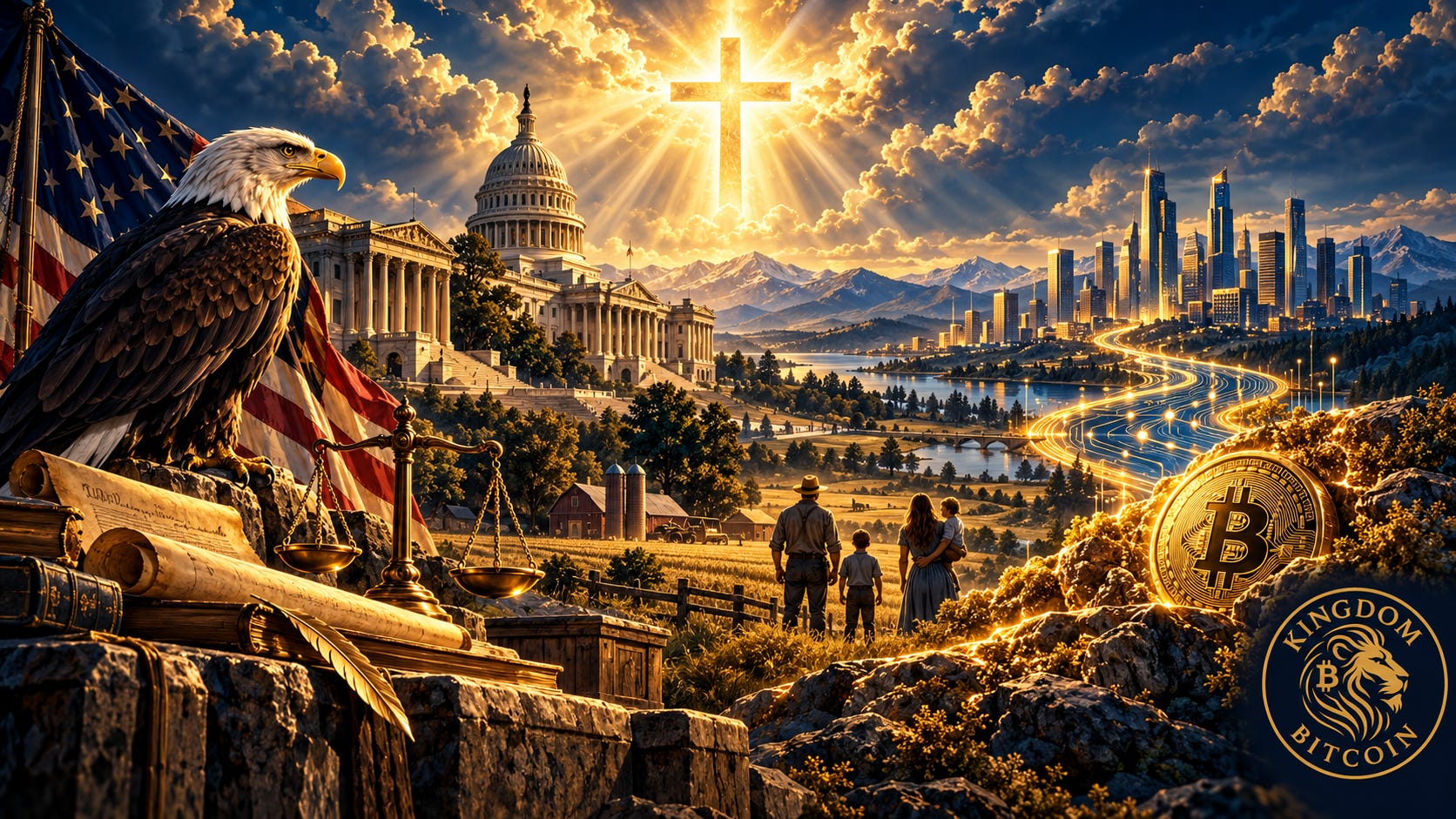
Amos watched merchants grow impatient with worship. They asked when the Sabbath would end so they could resume selling grain, then reduced the measure, raised the price, and cheated with dishonest scales. The sin was not merely personal greed. The measuring system had been bent against ordinary people. God cared because when the ruler becomes dishonest, everyone measured against it eventually pays dearly.
Money is not merely something we spend. It measures labor, stores time, prices obligations, and carries today’s work into tomorrow. A paycheck represents hours of human life that cannot be earned twice. Savings preserve that life for future needs and generations not yet born. Before asking what Bitcoin is worth, inspect the ruler being used to measure it. A bent ruler cannot correct another bent ruler.
Alexander Hamilton understood that political independence without financial credibility remained fragile. His 1790 report argued that honoring obligations was essential to American prosperity. The following year, his report on a mint shaped the architecture Congress formalized through the Coinage Act of 1792. America needed debts organized, promises honored, and money people could trust. Washington later called public credit a source of strength while warning against passing posterity burdens the present generation should bear.
The monetary architecture kept changing. The Federal Reserve Act of 1913 followed banking panics, especially the crisis of 1907, and created a central bank intended to provide stability and an elastic currency. The Fed was not created to expand control. It responded to weaknesses in the banking system. Yet every new capacity concentrates discretion somewhere, and monetary discretion is among the most consequential powers a nation can create.
In 1933, amid bank failures and the Great Depression, Franklin Roosevelt suspended domestic gold convertibility and expanded federal control over monetary gold. In 1944, delegates from forty-four nations created Bretton Woods, centering global finance on the dollar while fixing official conversion to gold at thirty-five dollars per ounce. In 1971, Richard Nixon ended that convertibility as inflation and pressure on gold reserves intensified. The external constraint disappeared. The dollar rested upon institutions, productive capacity, military power, and confidence. Those are formidable supports, but none is an external monetary anchor.
The financial crisis of 2008 exposed another weakness. Highly leveraged institutions had built promises upon poorly understood assets. When trust evaporated, government and the Federal Reserve intervened to prevent a deeper collapse. The interventions may have stabilized the system, but necessity did not erase questions. Who absorbs losses when private risk becomes public danger? What incentives remain when institutions expect rescue before accountability?
Bitcoin asked whether digital value could move without a financial institution permanently in the middle. Its supply follows a visible schedule, issuance declines predictably, ownership can be verified, and no central administrator can announce a larger maximum supply. Bitcoin replaces gold convertibility with protocol constraint. That does not make it perfect, stable in price, or capable of solving federal deficits. It gives citizens access to an asset whose monetary rules government cannot casually rewrite.
The need for restraint is harder to ignore. The Congressional Budget Office projects a federal deficit of roughly $1.9 trillion in 2026, with debt held by the public equal to 101 percent of GDP. Under current law, debt is projected to reach 120 percent of GDP by 2036 and 175 percent by 2056. Net interest costs are projected to reach 6.9 percent of GDP by 2056, exceeding projected spending on Social Security or Medicare individually. Arithmetic has never registered to vote, but it still counts. Debt can finance a future, but eventually the future receives the invoice.
Ronald Reagan understood optimism and accountability. In his Farewell Address, he celebrated the shining city while admitting the deficit remained one of his regrets. He warned that American memory had begun to erode. A nation unable to remember how its systems were built may not recognize when they bend. That is the question at the heart of my soon to be published book The Second Declaration: what moral and monetary architecture are we preparing for 2276?
That horizon brings monetary history back to the household. A family must decide how much debt it can carry, whether savings preserve purchasing power, what children will inherit, and who can access assets if a parent dies. Good stewardship builds margin before ambition and understanding before complexity. It holds productive assets thoughtfully, avoids leverage capable of making decisions for the family, and preserves some value outside another party’s promise. Bitcoin can be part of that structure. It is not the structure by itself.
The purpose of sound money is not to make us richer on paper. It is to make honest stewardship easier across time. Money should help a father’s labor reach his children, allow a widow’s savings to retain meaning, and give a builder confidence that today’s sacrifice can matter tomorrow. Yet the straightest monetary ruler cannot straighten the human heart. Jesus warned that we cannot serve both God and money. The Holy Spirit must form contentment, generosity, courage, patience, and wisdom in the person holding the asset.
This series began with the Creator above government, moved to power restrained by constitutional architecture, and then considered what free people can build when talent can work. It ends with the measure beneath all of it. Political freedom, economic freedom, and generational stewardship become harder to sustain when money becomes difficult to interpret. Bitcoin does not need America to fail in order for Bitcoin to matter. America’s future will be stronger if it remembers that honest promises, honest measures, and stewardship belong together. The next chapter begins with what we choose to preserve now.
Kingdom Principle 👑
A nation stewards the future by keeping honest measures, honoring its promises, restraining present appetites, and refusing to make posterity pay for every comfort of the present.
Money is moral architecture because it connects work performed today with promises made about tomorrow. When a government borrows, a family saves, a company invests, or a parent prepares an inheritance, each is making a claim across time. Honest stewardship requires that those promises be understood, measured truthfully, and carried responsibly. A nation cannot continually consume the future while calling the arrangement compassion.
Bitcoin belongs in this conversation as a tool of monetary restraint. It cannot balance the federal budget, form wise leaders, make households disciplined, or remove human greed. It can offer rules that are visible, supply that is constrained, ownership that can be verified, and value that does not exist as another institution’s debt. Those characteristics become more important as sovereign promises grow larger and more expensive to maintain.
But Bitcoin must remain beneath stewardship. Money must remain beneath truth. Technology must remain beneath wisdom, and the self must remain beneath God. Honest money matters because people, families, work, inheritance, and freedom matter. Jesus Christ remains the only foundation strong enough to define what all of it is ultimately for.
Prayer 🙏
Heavenly Father, give America leaders with the courage to tell the truth about debt, deficits, interest, and the obligations we are passing forward. Teach those entrusted with public finances to cherish public credit, honor promises, restrain unnecessary appetites, and think beyond the next election. Help us remember that every dollar borrowed today eventually becomes a claim upon someone’s labor tomorrow.
Lord Jesus, bring wisdom into our households. Teach us to build margin, avoid destructive leverage, save patiently, give generously, prepare inheritances thoughtfully, and speak honestly with our spouses and children about money. Keep Bitcoin, gold, stocks, property, and every financial asset in their proper place as tools of stewardship rather than objects of worship.
Holy Spirit, restore honest measures in our homes, institutions, markets, and nation. Give us the humility to correct what is bent, the courage to preserve what is true, and the patience to build for people we may never meet. As America prepares for the centuries ahead, help us remember that the future belongs to God and the stewardship has been entrusted to us.
The future belongs to Him.
The stewardship belongs to us.
The next 250 years begin now.
In Jesus’ name, Amen. 🙏📖⚖️🇺🇸🏛️💵🏠₿🕊️👑