

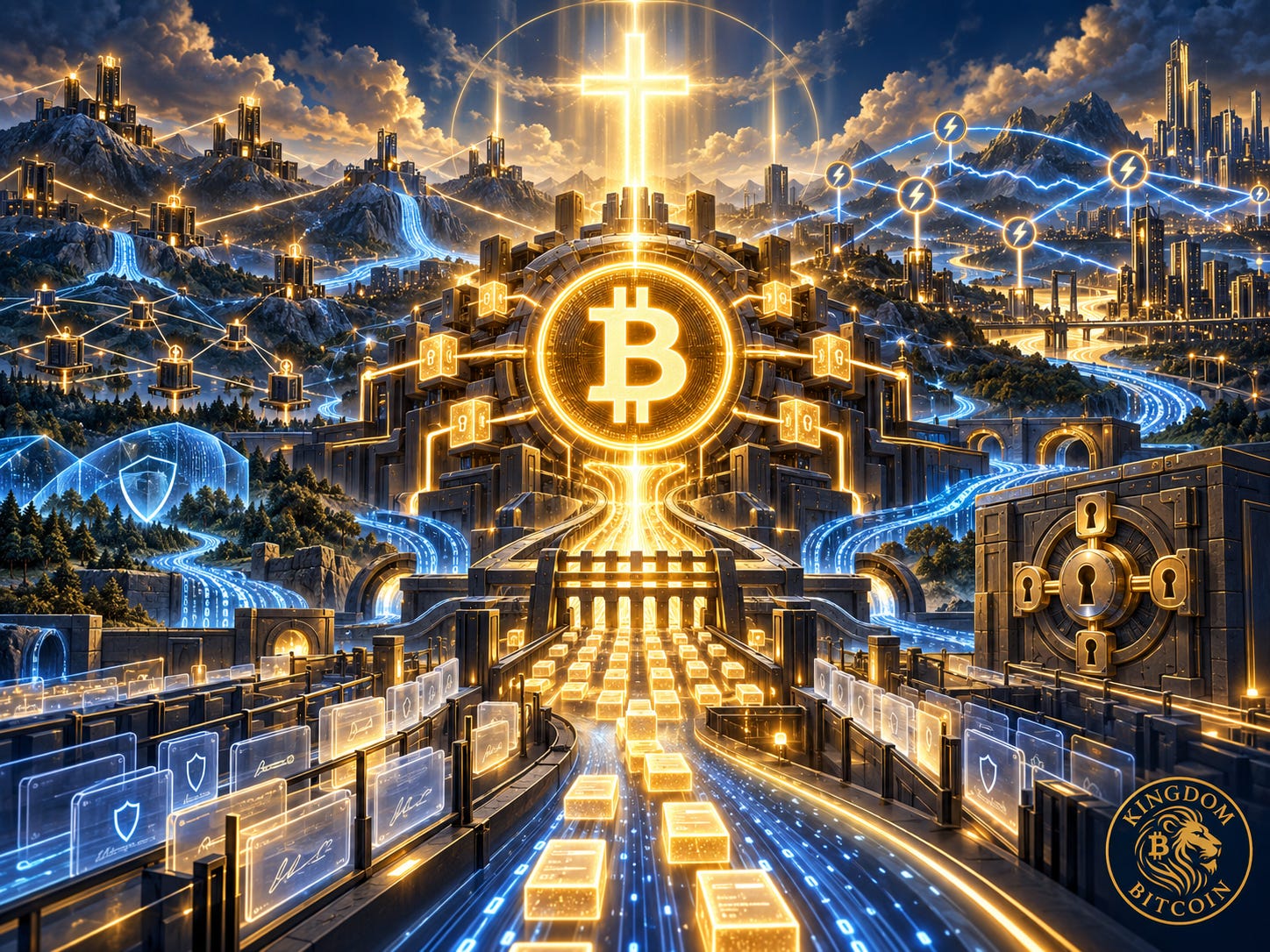
King Josiah inherited a temple that still stood, but it was no longer in the condition it was meant to be. The structure had endured, yet parts of it needed repair. In 2 Kings 22, Josiah orders the craftsmen to restore what had deteriorated, saying, “Let them repair the temple wherever it is found to be in need of repair.” Then something remarkable happens. During the restoration, Hilkiah the priest discovers the Book of the Law, and suddenly the work becomes about more than repairing stone. They are fixing the structure while rediscovering the standard that gave the structure meaning in the first place.
Bitcoin has changed since Satoshi released the software in 2009. Bugs have been fixed, code has improved, wallets have become better, and the protocol has gained new capabilities. Yet some things are supposed to remain extraordinarily difficult to change, particularly the monetary rules that give Bitcoin its credibility. Repair is not reinvention. Improvement is not permission to redesign the foundation every time someone arrives with a clever idea and a GitHub account.
One of Bitcoin’s most important historical upgrades was Segregated Witness, better known as SegWit, which activated in 2017 after years of debate over scaling. Before SegWit, the signatures proving that transactions were authorized were woven directly into transaction data in a way that created technical limitations, including something called transaction malleability. SegWit reorganized how that signature information was handled, helping fix that problem while also allowing blocks to carry transaction data more efficiently. It did not increase Bitcoin’s supply or rewrite the monetary policy. It improved the plumbing.
That change also helped unlock something larger. Lightning, which allows smaller payments to move above Bitcoin’s base layer, became far more practical once transaction malleability was addressed. SegWit also created cleaner pathways for future script upgrades. A repair in one part of the architecture created room for builders to construct something above it. That is often what good infrastructure looks like. The best improvement is not always the one people notice immediately.
Then came Taproot, activated in 2021, together with Schnorr signatures and new scripting capabilities. Taproot made certain complex Bitcoin transactions more efficient and, in cooperative cases, allowed them to look more like ordinary transactions onchain. That can improve privacy because observers may learn less about the conditions that could have governed a transaction when those alternative conditions were never used. Schnorr signatures also provide cleaner mathematical foundations for combining signatures from multiple participants. The details are technical, but the practical idea is simple: Bitcoin became better at handling sophisticated ownership without requiring every sophisticated arrangement to announce itself publicly.
Again, the supply did not change. Twenty-one million did not become twenty-two. Proof of work did not disappear. The network improved its capabilities while attempting to preserve the principles people had already chosen to trust.
That brings us to one of Bitcoin’s most important philosophical debates: ossification. The word sounds like something your doctor warns you about after fifty, but in Bitcoin it means the protocol gradually becoming harder to change. Some Bitcoiners believe that is exactly what sound money should eventually do. If people are storing decades of work and potentially generational wealth inside a monetary system, predictability becomes extraordinarily valuable.
Others worry that ossifying too early could lock in weaknesses that future engineers might otherwise improve. Privacy can improve. Custody can become safer. Scaling technology can mature. Security threats can change. A system that refuses every future improvement simply because change introduces risk can eventually make immobility its own risk.
Both instincts deserve respect.
James Madison and the American Founders wrestled with a similar tension while designing the Constitution. They wanted a governing framework durable enough to resist temporary passions, yet they included a process for amendment. Madison himself introduced amendments in 1789 that helped produce the Bill of Rights. The Founders did not believe an enduring system had to remain untouched forever. They believed change should be possible, but difficult enough that the foundational architecture could not be rewritten casually.
Bitcoin is not the Constitution, and developers are not Founding Fathers. But the structural question is wonderfully similar: what must remain stable, and what should remain improvable?
For a household holding bitcoin, this matters more than it may appear. Different wallet address formats you encounter today often reflect different generations of Bitcoin technology. An older wallet may use legacy addresses, while newer wallets may support SegWit or Taproot. Updating wallet software or hardware firmware is not necessarily changing Bitcoin’s monetary rules. Often it simply enables better use of capabilities the network already supports.
This is why the statement “Bitcoin can never change” is not quite right.
A better statement is that Bitcoin should be extremely difficult to change where trust depends upon stability, while remaining capable of careful improvement where improvement strengthens the system without compromising the foundation.
Scripture offers a useful standard here. Proverbs 24:3 says, “By wisdom a house is built, and through understanding it is established.” Wisdom is not obsessed with novelty. Neither is wisdom frightened by every repair.
Josiah restored what was broken and rediscovered what must not be forgotten. That may be exactly the posture Bitcoin needs for the decades ahead. Preserve the foundation. Repair what needs repair. And never confuse cleverness with wisdom.
Kingdom Principle 👑
Wisdom preserves what must remain true while improving what can be made stronger.
God does not call us to worship permanence for its own sake, nor does He call us to chase every new idea simply because it is new. Scripture repeatedly holds truth and renewal together. The foundation matters precisely because future generations will build upon it.
Bitcoin should be approached with the same humility. Its monetary credibility depends upon rules that are extraordinarily resistant to manipulation, while its technological usefulness may continue benefiting from careful improvement. Stewardship means knowing the difference.
Prayer 🙏
Heavenly Father, give us wisdom to preserve what is true and courage to repair what is broken. Protect us from pride that worships novelty and fear that mistakes every change for danger. Teach the builders, developers, users, and families working with Bitcoin to value wisdom above cleverness and long-term integrity above short-term excitement.
Holy Spirit, help us build on foundations that can withstand time. Keep Jesus Christ as the standard above every technology, protocol, market, and institution. May the tools we improve serve truth, freedom, households, and generations without ever becoming substitutes for the One upon whom our lives are ultimately built. In Jesus’ name, Amen. 🙏📖🏛️🔨₿🔐⚙️🕊️👑