

There is a new kind of bitcoin buyer in town.
It does not live on Crypto Twitter.
It lives inside brokerage accounts.
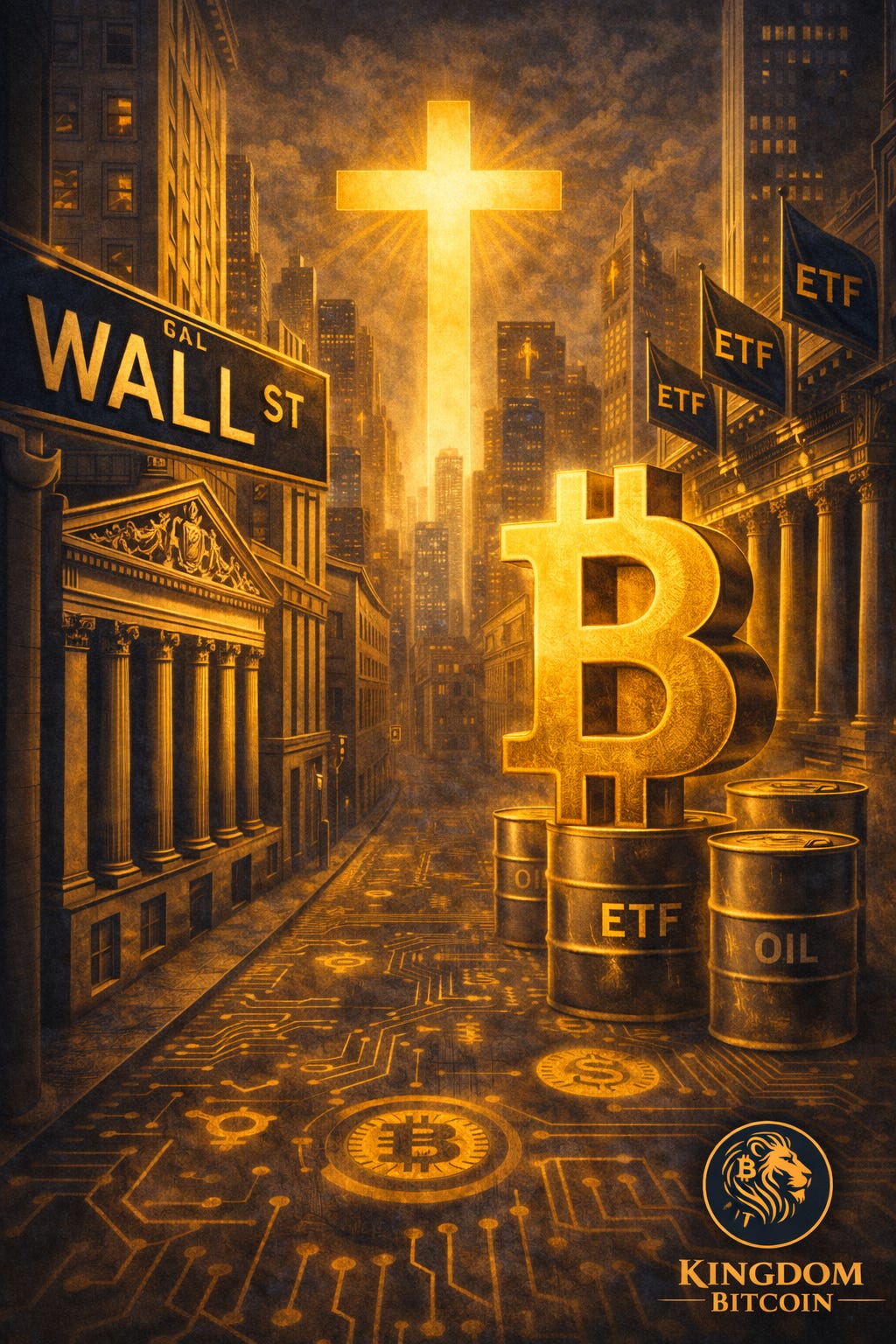
A spot bitcoin ETF is an exchange traded fund. In plain terms, it is a financial wrapper that trades like a stock while the fund itself holds bitcoin on behalf of investors. Money flows into the fund, shares are issued, and bitcoin is acquired and custodied at the fund level.
That structure matters.
ETFs are designed for scale, repeatability, and ease. They fit neatly inside retirement accounts, advisory portfolios, and institutional mandates. This is not about excitement. It is about plumbing.
And the shift is visible.
In a short period of time, spot bitcoin ETFs grew from holding roughly 1.1 million bitcoin to more than 1.3 million bitcoin. BlackRock’s IBIT reached approximately $70 billion in assets in just 341 trading days, the fastest ETF in history to reach that level.
This is not hype.
This is infrastructure.
Order at scale.
“Let all things be done decently and in order.”
- 1 Corinthians 14:40
But here is the critical distinction that must not be blurred. Buying a bitcoin ETF is not the same as owning bitcoin. When you buy an ETF, you own shares in a fund. The fund owns the bitcoin.
The keys are held by a custodian.
You hold a ticker symbol.
That difference is not academic. It is foundational.
ETFs provide exposure. They provide access. They provide convenience. For many people, that is a meaningful first step. Especially inside retirement accounts where direct ownership may not yet be practical.
But exposure is not possession. And Scripture has language for this.
“They serve as a copy and shadow of the heavenly things.”
- Hebrews 8:5
An ETF mirrors bitcoin’s price, but it is not bitcoin itself. It moves with the asset, but it cannot be withdrawn, transferred, or self-custodied by the investor. It is a representation, not the reality.
Kingdom stewardship requires clarity here. Convenience has a cost. So does control. Luke reminds us that wisdom begins with foresight.
“Suppose one of you wants to build a tower. Won’t you first sit down and count the cost?” - Luke 14:28
Counting the cost is not only about fees or performance. It is about responsibility. Who holds the keys. Who controls the asset. Who bears the risk when systems strain.
Self-custody is not for everyone. But it is the difference between holding an asset and holding a claim on an asset.
One is ownership.
The other is permission.
The ETF era marks a major milestone. Bitcoin has become a default allocation inside institutional portfolios. That matters. It validates bitcoin as an enduring asset, not a passing trade.
But it also creates a subtle danger.
Do not confuse access with ownership.
Do not mistake ease for stewardship.
Use the rails if they serve you.
Just know where they end.
Bitcoin invites responsibility. ETFs invite participation. Both have a place. Only one places the weight of stewardship directly in your hands.
In this new era, the question is no longer whether institutions will buy bitcoin. They already are.
The question is whether individuals, families, and the Church will learn the difference between touching the asset and truly holding it.
Not with hype.
With wisdom.
Not as a shortcut.
But as a long obedience in the same direction.
Prayer 🙏📈🕊️
Father God, Thank You for being a God of order, wisdom, and truth.
As new systems make bitcoin easier to access, give us discernment to understand what we truly own and what we do not. Help us embrace helpful tools without confusing a mirror for the real thing.
Teach us to count the cost with humility. To steward convenience without surrendering responsibility. To choose wisdom over hype and faithfulness over ease.
May institutions build with foresight.
May families grow in understanding.
May Your people hold what is true with steady hands and clean hearts.
In Jesus’ name, Amen. 🙏✝️🔥