

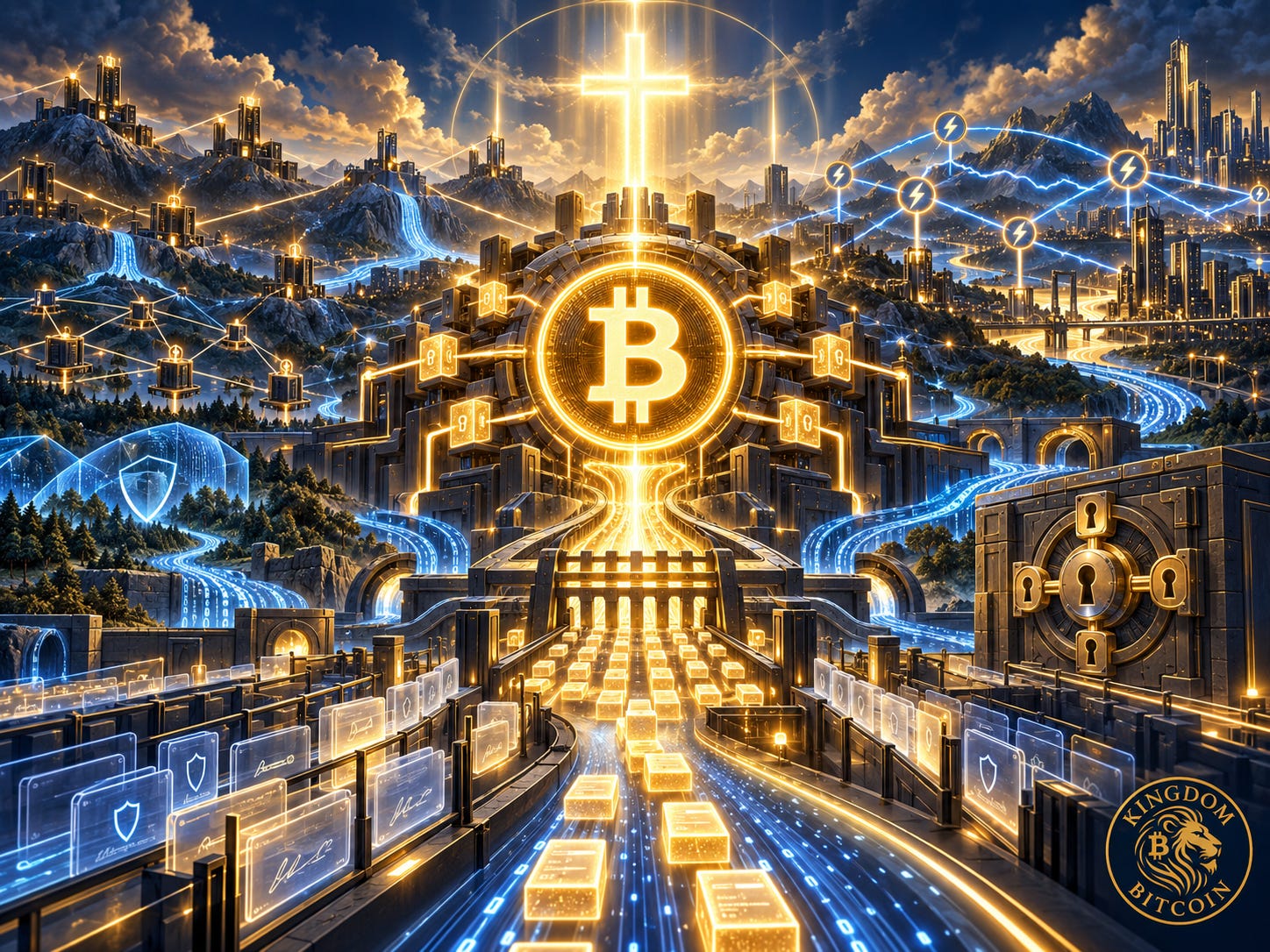
Exodus 39 is one of those chapters that can look like a construction report until you slow down and realize what is actually happening. Craftsmen have spent months making sacred objects, each piece entrusted to different hands. Then everything is brought together and presented to Moses for inspection. Scripture says, “The Israelites had done all the work just as the Lord had commanded Moses. Moses inspected the work and saw that they had done it just as the Lord had commanded. So Moses blessed them.” Different craftsmen and different components finally become one integrated architecture.
That is how I now think about Bitcoin after spending this series inside its engine room. Bitcoin is often reduced to a price chart, a digital coin, or a nine-page white paper. But its resilience does not come from one magical invention. It comes from many components reinforcing one another, each solving a different problem while helping preserve the whole. The deeper I go into the plumbing, the more remarkable the design appears.
A wallet begins by identifying spendable pieces of bitcoin, called UTXOs, and selecting what will fund a payment. The transaction is signed so the network can verify that the spender has authority, then broadcast to nodes that independently check whether the rules have been followed. Valid transactions wait in local mempools until miners choose among them, with scarce blockspace creating a market where urgency has a price. Miners perform proof of work to propose the next block, while nodes remain the referees of whether that block actually follows Bitcoin’s consensus rules.
Even mining, which sounds wonderfully decentralized from ten thousand feet, becomes more nuanced when you look closer. Pools coordinate hashing power so individual miners can receive steadier income, yet pool operators have historically had influence over which transactions enter candidate blocks. Decentralization is rarely one switch marked ON or OFF. It is an architecture that must be examined layer by layer.
Then Bitcoin begins building above itself. Lightning allows smaller, frequent payments to move through channels without requiring every coffee or family transfer to compete for permanent base-layer settlement. Silent Payments try to improve financial privacy without making Bitcoin’s public ledger disappear. BIPs give people a formal way to propose improvements without creating a Bitcoin CEO, while debates around covenants ask whether carefully designed future spending constraints could make custody safer. Fedimint explores another frontier by experimenting with where trust can live between full self-custody and traditional institutions.
When these pieces are viewed together, one of Bitcoin’s most repeated descriptions starts to look incomplete. Bitcoin is often called “trustless.” I understand what people mean, but I prefer something more precise: Bitcoin is trust-minimized and verification-maximized. We still trust software, hardware, our own competence, and sometimes other people. What Bitcoin repeatedly asks is whether a claim can be verified instead of merely believed.
That question should resonate deeply with Christians. Scripture never asks us to become gullible. Paul tells the Thessalonians, “Test everything; hold fast what is good.” Faith in God is not blind faith in every institution, technology, leader, or financial promise placed in front of us. Jesus Christ is worthy of ultimate trust because He is truth, while human systems should be tested because human beings remain human.
For households, technical understanding is not nerd trivia. It is part of stewardship. Can you explain what happens when you send bitcoin, why fees exist, and why Lightning is different from the base layer? Do you understand what your wallet may reveal publicly, who can participate in changing Bitcoin, and where the trust in your custody arrangement sits? Can you explain those things to your spouse or child without requiring them to become a cryptographer?
If the answer is yes, then we have accomplished something meaningful. Freedom is fragile when it depends on tools nobody understands. Responsibility becomes stronger when the architecture beneath ownership can be inspected, questioned, and verified. Bitcoin’s greatest contribution may not be eliminating trust at all. It may be forcing us to become more honest about where trust already lives.
That brings me back to Exodus 39. Moses did not bless the work because one craftsman had invented everything. He blessed it because many people had faithfully completed their assignments and the pieces came together as intended. Bitcoin is not a tabernacle, and technology is not revelation, but craftsmanship still matters. Good architecture requires details that work together.
That is also why Kingdom Bitcoin must keep its hierarchy clear. God comes first, truth follows from Him, stewardship flows from that truth, and technology remains beneath it. Bitcoin is an extraordinary tool for honest measurement, ownership, settlement, and freedom, but it cannot tell us what humanity is for. It cannot forgive sin, heal the brokenhearted, or replace Jesus Christ. The engine room matters because understanding the machinery makes us better stewards, but the engine is never the destination.
Kingdom Principle 👑
Freedom becomes durable when responsibility is supported by architecture people can understand and verify.
Bitcoin’s strength is not that it eliminates every form of trust. It is that it repeatedly moves us from blind dependence toward the ability to inspect, verify, and choose where trust belongs. That is a much more mature definition of freedom because freedom without understanding eventually becomes dependence wearing a better outfit.
For the Christian, the hierarchy must remain clear. God → Truth → Stewardship → Technology. Technology belongs beneath stewardship because tools cannot tell us why we exist, whom we should love, what is righteous, or how wealth should be used. Bitcoin can help straighten the ruler. Only God can tell us what is ultimately worth measuring.
Prayer 🙏
Heavenly Father, thank You for the creativity You have placed within humanity and for the developers, miners, researchers, wallet builders, security engineers, open-source contributors, and countless builders whose work allows us to understand and improve these systems. Give them humility alongside intelligence, wisdom alongside capability, and the courage to pursue truth rather than novelty for its own sake. Help families learn enough to steward technology confidently without allowing complexity to intimidate them or convenience to make them careless.
Holy Spirit, keep our hearts rightly ordered. Let technology remain beneath stewardship, money beneath truth, and every human ambition beneath Jesus Christ. Teach us to test what we build, hold fast to what is good, reject what is harmful, and use every tool entrusted to us in service of people, households, freedom, generosity, and generations we may never meet.
The future belongs to Him. The stewardship belongs to us. In Jesus’ name, Amen. 🙏📖⚙️₿🔑🧱🏠🕊️👑