

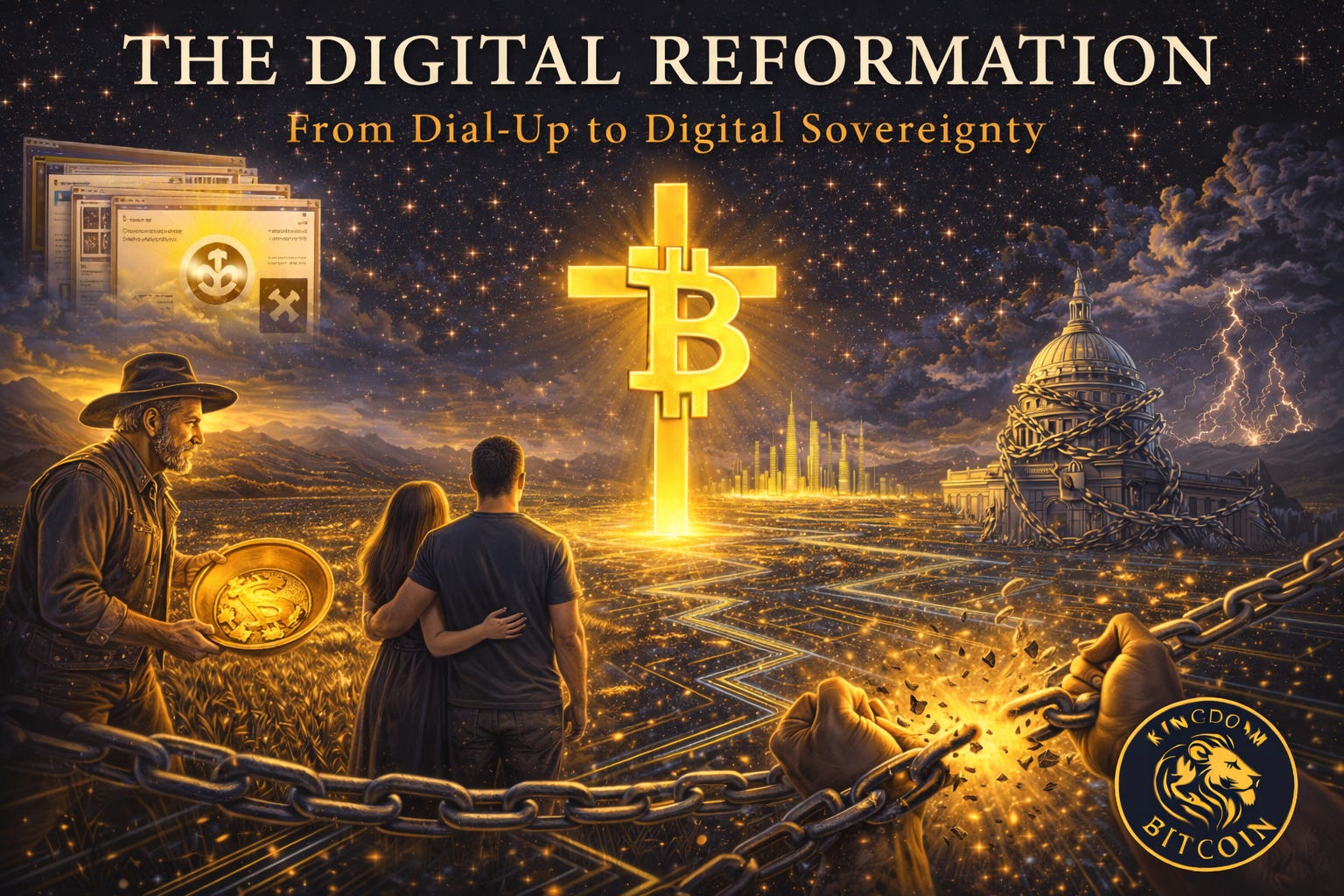
When truth existed, but the world had not yet learned to see
It began not with a headline, but with a sound.
A thin, mechanical tone stretched across a quiet room, followed by a scatter of clicks and static. The connection hesitated, negotiated, resisted. Then came the pause. A long, uncertain pause. On the screen, a small cursor blinked with indifferent patience, as if waiting for someone to understand what it already knew.
For most people in the early 1990s, this was the internet. My initial interaction was in spring 1994 in the basement computer lab of LaFortune student center at the University of Notre Dame.
It was not yet an experience. It was an abstraction. A system that functioned without meaning much to those outside the narrow corridors of research institutions and government labs. Engineers could traverse it. Academics could exchange information across it. But to the broader world, it felt distant, inaccessible, almost unnecessary.
And so it was dismissed. Not loudly. Not with opposition. But with something more final. Indifference.
The truth is, the internet did not arrive in 1995. It had been forming quietly for decades. Protocols had been written. Networks had been connected. Ideas had been proven. What had not yet been achieved was something far more difficult than invention.
Recognition.
There are moments in history where something becomes real long before it becomes visible. Where the substance is already present, but the world has not yet developed the capacity to perceive it. In those moments, progress appears stalled, not because nothing is happening, but because what is happening has not yet been revealed in a way that can be grasped.
This was the condition of the early internet.
To use it required a kind of technical literacy that bordered on exclusion. Commands were typed, not clicked. Navigation required memory, not intuition. Files were transferred in ways that would seem almost absurd now, sometimes physically carried on disks between machines in what engineers jokingly referred to as “sneakernet.” Financial transactions were, for all practical purposes, out of the question. The idea that one might enter credit card information into a networked environment was not merely uncomfortable. In many cases, it was considered unacceptable, even impermissible.
The system functioned. But it did not invite. And what does not invite cannot scale.
It was into this environment that Marc Andreessen stepped, not as a man intent on rewriting the foundations of the internet, but as one determined to change how it was encountered. I have had the opportunity to meet Marc and hear fragments of these early years from him directly. What emerges from those conversations is not simply technical brilliance, though that was clearly present. It is something more intuitive, almost pastoral in its nature.
He understood that the barrier was not the system. It was the distance between the system and the person.
The World Wide Web, introduced by Tim Berners-Lee, had already provided a conceptual framework, a way of linking information across a network through the simple but profound idea of the hyperlink. It was elegant. It was precise. It was, in the eyes of its creator, meant to remain largely within the domain of research and structured inquiry.
When the idea of incorporating images arose, there was resistance. Images, it was argued, would invite distraction. They would dilute the seriousness of the medium. They would turn something disciplined into something… accessible.
History tends to remember these moments kindly, but at the time they were anything but trivial. They represented a tension that appears whenever something true begins to move toward mass adoption. Purity stands on one side. Reach stands on the other. To expand is to risk distortion. To preserve is to risk irrelevance.
Andreessen chose to expand.
Mosaic, the browser he and his colleagues built in a matter of weeks, did not alter the underlying protocols of the internet. It did something far more consequential. It translated them. It rendered the invisible visible. It replaced commands with clicks, abstraction with experience, hesitation with curiosity.
Within a short span, adoption followed.
Downloads multiplied. Websites began to appear at a pace that outstripped the ability of any individual to track them. What had once been a domain for specialists began to feel, almost suddenly, like something anyone might enter.
This is how transformation announces itself. Quietly at first, then all at once or in Mark Batterson’s terms “Gradually, then Suddenly!”
By the time Netscape went public in August of 1995, the shift had already occurred beneath the surface. The company’s financials did not justify the response it received. Its revenues were modest. Its profits nonexistent. And yet, when trading opened, demand surged with a kind of urgency that bordered on disbelief. Orders flooded in. Prices leapt beyond expectation. Investors, many of whom had only a partial understanding of what they were participating in, rushed to secure a position.
It is easy, with the benefit of hindsight, to dismiss this as excess. To call it irrational. To reduce it to the language of bubbles. But to do so is to miss what was actually happening.
The market was not responding to the creation of the internet. It was responding to its revelation.
Something that had existed quietly, almost invisibly, had crossed a threshold. It had become legible. And once something becomes legible, it begins to attract not just attention, but belief.
The American founders, in their own time, wrestled with a different but related problem. They understood that liberty, though grounded in natural law, would not sustain itself without structures that made it tangible. A principle, no matter how true, must be embodied in a system if it is to endure. Without that embodiment, it remains vulnerable to distortion, to misinterpretation, to erosion over time.
The same is true of technological systems. Truth, in isolation, is not enough. It must be revealed, and then it must be held.
We find ourselves now in a moment that bears a striking resemblance to those early days. Bitcoin exists.
It is not theoretical. It is not aspirational. It operates, continuously and without interruption, across a decentralized network that does not require permission to function. Value moves. Ownership is secured. The rules are enforced not by decree, but by consensus embedded in code.
And yet, for the majority of the world, it remains something just beyond reach.
To engage with it requires effort. Wallets must be understood. Keys must be protected. The consequences of error are real and, in many cases, irreversible. For those unfamiliar, the experience can feel less like participation and more like exposure.
Once again, the system functions. But it does not yet fully invite. This is not an indictment of bitcoin. It is an observation of its position in time.
The internet did not change the world when it was built. It changed the world when it was seen.
Somewhere, perhaps in a place as unremarkable as a university lab or a small apartment filled with late-night energy, the next translation is being written. Not a reinvention of the protocol, but a revelation of it. An interface that will make participation intuitive, not intimidating. A doorway that will render explanation unnecessary.
When that moment arrives, it will not be announced as a revolution. It will feel like clarity. And once clarity takes hold, movement follows with a speed that often surprises even those who anticipated it.
The internet did not wait for permission to scale. It became undeniable.
Bitcoin stands at the edge of that same threshold. Not waiting to be created. Waiting to be seen.
Kingdom Principles
Truth often exists before it is understood
Revelation precedes transformation
Structure preserves what truth reveals
What God establishes cannot be hidden forever
Prayer 🙏✝️🔥
Father,
You are the source of all truth, seen and unseen. You establish what is real long before we recognize it.
Give us eyes to see what You are revealing in this season. Help us to move beyond confusion and into clarity. Guard us from fear of what we do not yet understand, and lead us into wisdom as truth unfolds.
Teach us to steward insight with humility, patience, and discernment. Let us not rush ahead of Your timing, but also not lag behind when You make something clear.
May we recognize what is real, align with what endures, and walk faithfully in the light You reveal.
In Jesus’ name, Amen. 🙏✝️🔥