

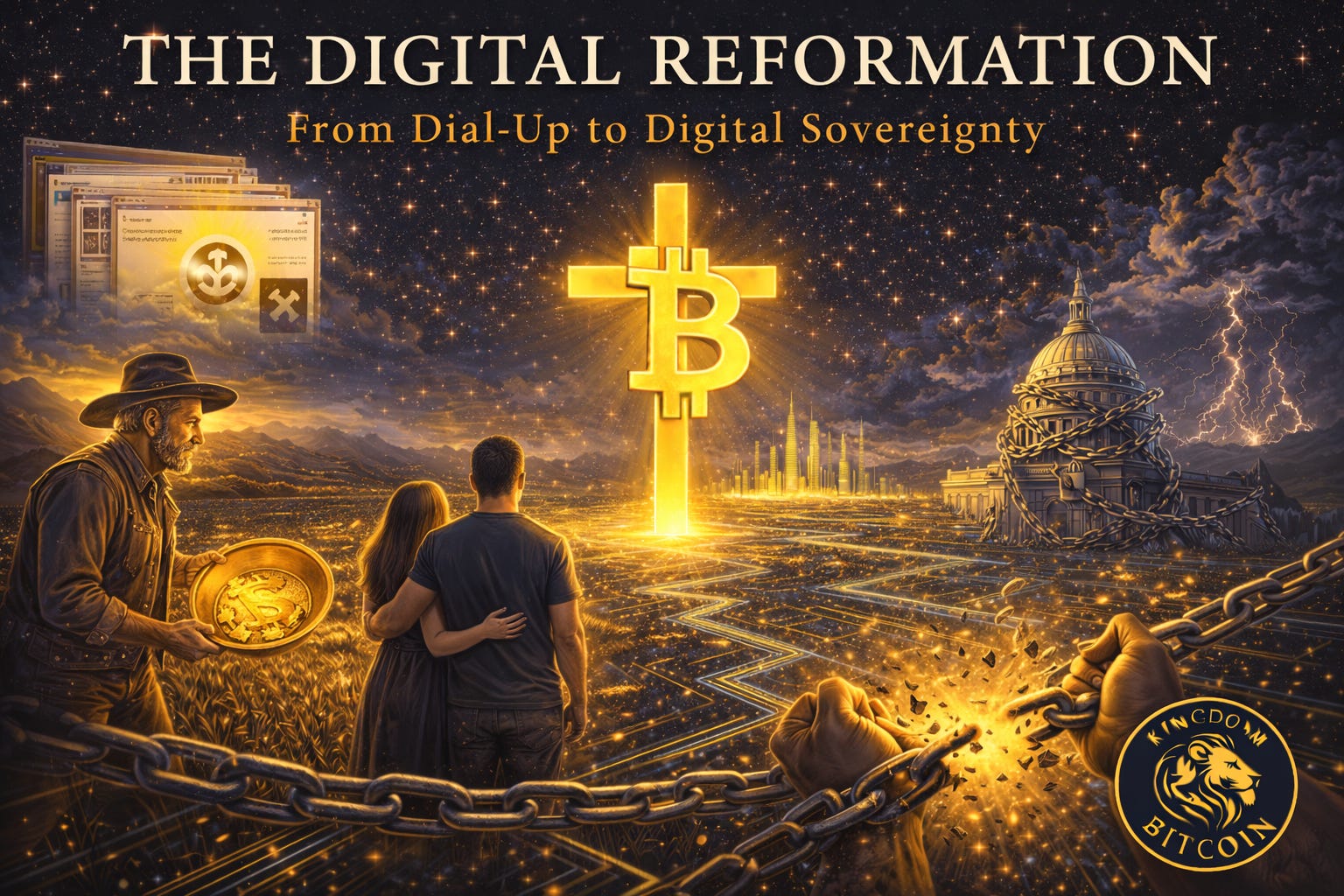
Locating ourselves in a once-in-a-generation shift
He leaned back in his chair, eyes fixed on the screen as numbers flickered in real time. “It’s over,” someone said, the kind of statement that carries more emotion than certainty. Across the table, another voice responded without hesitation. “No. We’re still early.” The room filled with conviction, but not clarity. Charts were pulled up. Narratives were quoted. Confidence rose and fell with the last piece of data someone had seen. Everyone had an opinion. Very few had perspective. They were asking the wrong question.
What year is it?
Not the year printed on a calendar, or defined by headlines, or measured in quarters and election cycles. Those markers are useful, but they rarely capture what matters most. They tell you when you are. They do not tell you where you are. And in moments of transformation, where you are matters far more than when you are.
History does not move in straight lines. It moves in phases. There is a quiet period of formation where very little appears to be happening. Then comes visibility, when something that already exists begins to enter broader awareness. What follows is often a surge of speculation, as belief moves faster than understanding. That excess eventually corrects, sometimes violently, giving way to a period of refinement. Only then, often without announcement, does what truly endures begin to take hold at scale.
Most people misread the phase they are in. They do not miss the future because it is hidden from them. They miss it because it does not yet look finished.
In 1998, the internet did not feel inevitable. It felt incomplete. Websites loaded slowly, if they loaded at all. Interfaces were clunky. Navigation was inconsistent. For most people, the idea that this system would redefine commerce, communication, and culture was far from obvious. The question of whether it would matter at all was still being asked in earnest. “Why would anyone buy a book online?” was not a punchline. It was a reasonable challenge.
And yet, beneath that uncertainty, something irreversible was forming. Google had just been founded, operating out of a garage just a few doors from where I once lived with a superior approach to organizing information that very few recognized at the time. Amazon was still primarily an online bookstore, unprofitable, underestimated, and nowhere near the scale it would eventually reach. The infrastructure of the internet was visible, but its ultimate expression had not yet been realized.
This is the moment most people misunderstand. It was not early in the sense of being speculative, and it was not late in the sense of being obvious. It was formative. The distinction is subtle, but it is decisive. If you believe you are early, you tend to speculate. If you believe you are late, you hesitate. But if you understand that you are in a period of formation, you behave differently. You observe more carefully. You ask better questions. You position yourself with patience rather than urgency.
Very few people recognize this in real time. In the early stages, most dismiss what they do not understand. As visibility increases, many begin to speculate, often without grounding. By the time clarity arrives, the majority are chasing what has already been built. The opportunity was not hidden. It was simply misread.
We are living through a similar moment now.
Bitcoin is not new. The protocol has operated for more than a decade, continuously and without interruption. It has endured skepticism, dismissal, attack, and repeated cycles of excess surrounding it. Each time, the same pattern has played out. The narrative rises. Speculation accelerates. Excess builds. Then it corrects. And through all of it, the underlying system continues, unchanged in its core design.
The broader crypto landscape tells a different story. Innovation is happening rapidly. New platforms are introduced. Tokens are created. Narratives form and dissolve at a pace that can feel overwhelming. Capital flows toward what is gaining attention, often before it has proven durability. From a distance, it can appear chaotic. But this is not chaos in the destructive sense. It is sorting. It is the process by which signal separates from noise.
The parallels to the late 1990s are difficult to ignore. The rails are being laid. Institutional pathways are forming. Regulatory frameworks, while incomplete, are beginning to take shape. The introduction of spot bitcoin ETFs has opened access for a class of capital that previously remained on the sidelines. Movement is not explosive. It is measured. Intentional. Gradual in a way that often goes unnoticed.
At the same time, the experience remains unfinished. Wallets are still difficult for many to navigate. Security requires a level of understanding that has not yet reached the mainstream. Interfaces are improving, but they are not yet intuitive enough to remove hesitation entirely. This combination, proven foundation beneath, incomplete experience above, is precisely what formation looks like.
The American founders stood in a comparable moment, though their domain was governance rather than technology. They were structuring it in a way that could endure. They understood that principles, no matter how true, require systems that can preserve them over time. Without that structure, truth becomes vulnerable to distortion. They did not rush the process. They debated, refined, and constructed with an awareness that what they built would extend beyond their own lives. They were not optimizing for speed. They were building for permanence.
Scripture captures this tension with precision. “The end of a matter is better than its beginning, and patience is better than pride.” — Ecclesiastes 7:8 (NIV). Patience, in this sense, is not passive. It is disciplined. It is the ability to see what is forming without attempting to force it into completion before its time.
This is where many struggle. Formation does not reward urgency. It does not offer the immediate clarity that speculation provides. It asks for restraint in a culture that celebrates speed. It requires the willingness to sit within uncertainty while remaining attentive to what is actually taking shape.
There is a natural desire to define the moment with certainty. To declare that we are at the beginning or at the end. But the more accurate answer is more nuanced. We are not waiting for bitcoin to arrive. It has already arrived. What is happening now is that the world is learning how to recognize it.
The infrastructure is forming. Understanding is building. The signal is becoming clearer as the noise begins to separate. And when that process matures, it will not feel like something new has emerged. It will feel like something has finally been understood.
So what year is it?
It is not the beginning. It is not the end. It is the build. And in moments like this, the advantage does not belong to those who move the fastest, but to those who see the clearest. Because the shift will not begin when it is announced. It will begin when it is understood.
Kingdom Principles
Discernment reveals what urgency obscures
Formation requires patience, not reaction
What endures is built with clarity over time
God’s timing is precise, not rushed
Prayer 🙏✝️🔥
Father,
You are not bound by time, yet You guide us through it with purpose and precision. In moments where the world feels uncertain, give us clarity to understand where we truly are. Guard us from misreading the season, from rushing ahead in pride or holding back in fear.
Teach us to walk with patience and discernment. Help us to recognize what is forming, what is real, and what will endure. Strengthen us to build with intention and to trust Your timing over our own desire for immediacy.
Let our lives reflect wisdom, steadiness, and alignment with truth as You bring clarity to what is unfolding.
In Jesus’ name, Amen. 🙏✝️🔥
Thanks for your wonderful writing Jeff. May the Lord bless you indeed.