

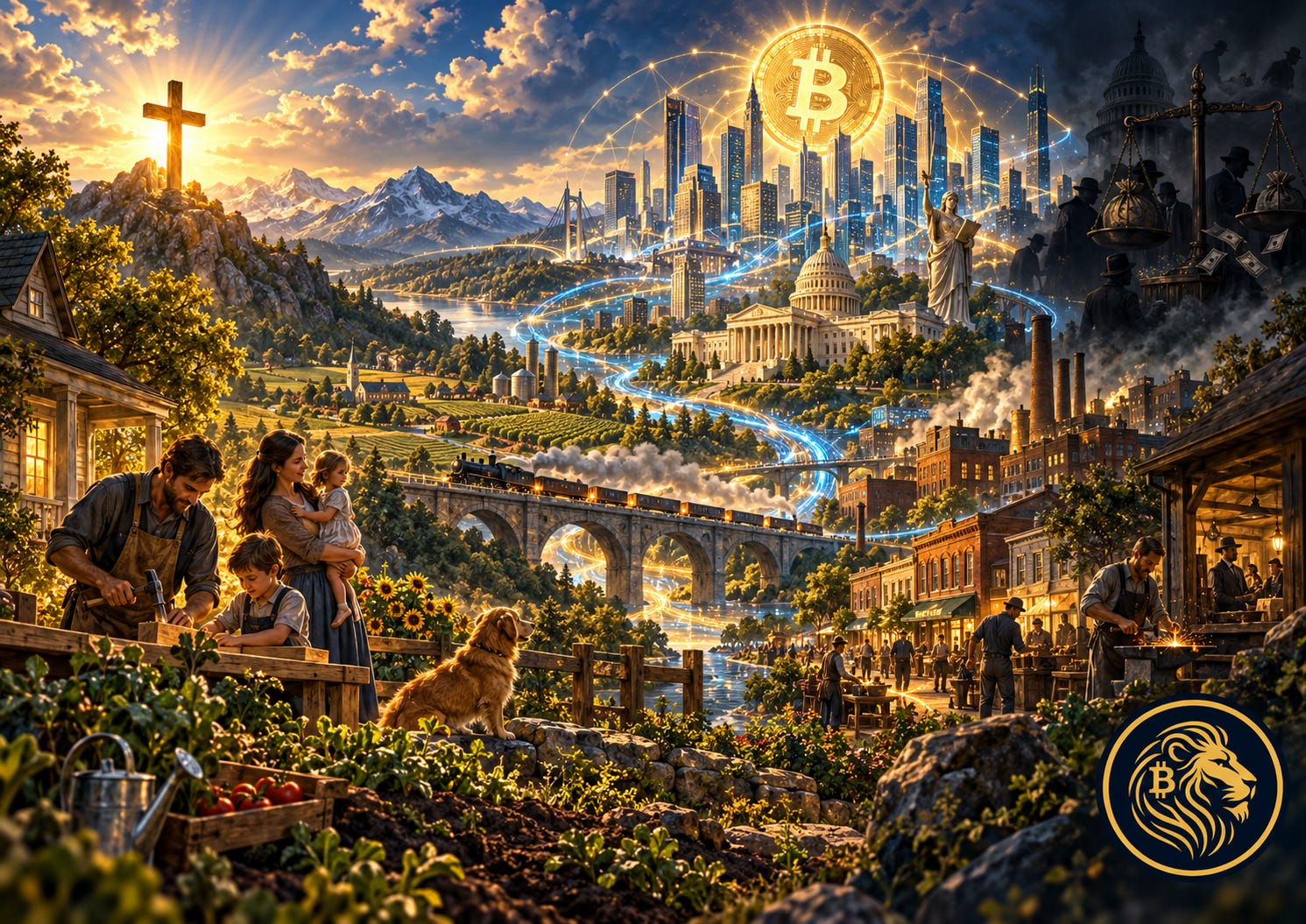
How America Built the Architecture That Allowed Enterprise to Flourish
Nehemiah did not return to Jerusalem simply to admire the ruins. The walls were broken, the gates burned, and the city’s vulnerability had become a visible symbol of a people whose institutions had collapsed. So Nehemiah organized the work, assigned responsibility, secured the gates, and helped restore the architecture that allowed a community to function again. Freedom without structure would not have been enough. The city needed walls, rules, work, and people willing to build.
That is a useful way to think about American capitalism. The Revolution declared independence, but independence did not magically create a functioning national economy. The Constitution gave Congress powers over interstate and foreign commerce, borrowing, coinage, bankruptcy, weights and measures, and intellectual property, creating legal architecture within which enterprise could grow. It also gave inventors and authors limited rights over their creations, an extraordinary recognition that ideas could become economically valuable when the law protected the builder long enough to benefit from the building. Freedom needed infrastructure.
Alexander Hamilton understood that perhaps better than anyone in the Founding generation. As Treasury secretary, he wrote major reports on public credit, a national bank, a mint, and manufacturing because he believed the young republic needed institutions capable of turning political independence into economic durability. He was not a pure laissez-faire philosopher, and the fierce Hamilton-Jefferson arguments remind us that Americans have debated the proper relationship between government and markets from the beginning. That debate is not evidence that the system failed. It is part of the system.
The architecture kept expanding. The first federal patent law arrived in 1790, and George Washington signed the first U.S. patent that July, while Thomas Jefferson served on the original Patent Board. The Constitution also anticipated bankruptcy, which matters because capitalism requires risk and risk occasionally produces failure. A nation of builders needs a lawful way to survive being wrong. If honest failure becomes permanent economic exile, fewer people will take the risks from which new companies, inventions, and industries emerge.
Then came land, transportation, industry, and capital formation on a scale the Founders could not have imagined. The Homestead Act of 1862 offered qualified settlers a path to claim and eventually receive title to public land after residence and improvement, although the westward expansion it accelerated also came with profound costs for Native peoples that should not be erased from the story. Railroads connected markets, corporations gathered larger pools of capital, immigration supplied talent and labor, and expanding financial markets increasingly turned savings into investment. American capitalism did not appear fully formed in 1776. It was constructed, contested, corrected, and rebuilt across generations. National Archives
That should matter to every household because we live inside this architecture even when we barely notice it. The mortgage that helps a family buy a home, the LLC that lets an entrepreneur start a company, the patent protecting an invention, the retirement account owning shares in productive businesses, and even bankruptcy protection all rest on institutional rules created long before we arrived. Free enterprise is not merely people wanting to get rich. It is a system that allows ideas to become businesses, savings to become capital, work to become ownership, and failure to become another attempt rather than a permanent sentence.
Nehemiah’s builders understood that rebuilding required more than inspiration. Scripture says, “The people worked with all their heart.” That is where the biblical and American stories meet for me, not because capitalism is sacred or because the Constitution is Scripture, but because freedom always asks something of the people who inherit it. God gives gifts, abilities, opportunities, and resources, and Jesus repeatedly teaches that what is entrusted will eventually be accounted for. The Holy Spirit forms the character that institutions themselves cannot manufacture.
Bitcoin now enters that longer American argument about property, markets, money, infrastructure, and permission to build. It offers a digitally native form of ownership and a settlement network that does not require a central gatekeeper for every transaction, but it still depends on builders, law, energy, capital, software, and human responsibility around it. The deeper lesson is larger than Bitcoin. The Revolution declared freedom; generations afterward had to build the machinery capable of carrying it, and our generation has inherited the same assignment.
Kingdom Principle 👑
Freedom creates opportunity, but institutions determine whether opportunity can endure.
A declaration of liberty is powerful, but free people still need laws that protect property, contracts that can be trusted, money that can function, courts capable of resolving disputes, and enough room for builders to risk being wrong. Healthy capitalism is not merely individual ambition. It is an architecture in which productive ambition can become useful creation.
For Christians, the architecture still sits beneath a higher authority. Institutions can protect freedom, but they cannot create righteousness. Markets can direct capital, but they cannot tell us what human beings are worth. The Holy Spirit must form in us what no Constitution, corporation, or protocol can produce: wisdom, honesty, self-control, courage, and love.
Prayer 🙏
Heavenly Father, thank You for the freedom to build, work, invent, own, create, and begin again. Thank You for the generations who built institutions that allowed ordinary people to turn ideas into enterprises and labor into opportunity. Give America wisdom to protect free enterprise while remembering that liberty requires law, responsibility, and moral character.
Holy Spirit, make us builders worthy of the freedom we inherited. Keep Jesus Christ above our institutions, businesses, markets, and ambitions. May we build structures that expand opportunity rather than privilege, reward useful work rather than political access, and leave the next generation more freedom, more possibility, and stronger foundations than we received. In Jesus’ name, Amen. 🙏📖🇺🇸🧱🏗️💡⚖️₿🕊️👑