

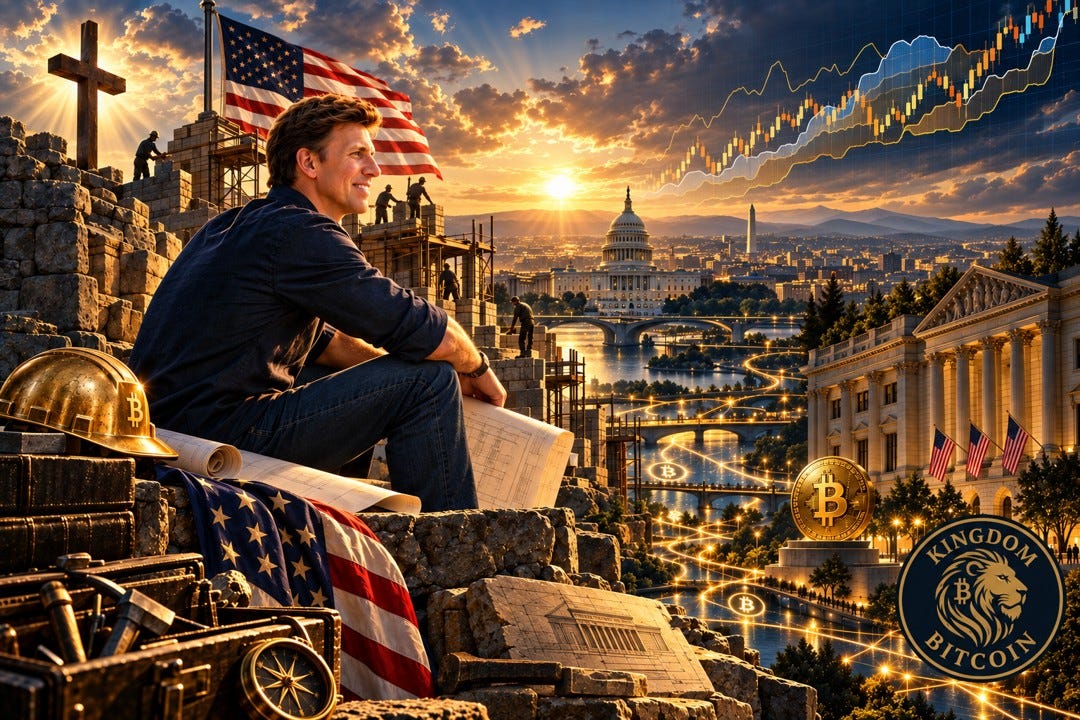
When I first read Satoshi Nakamoto’s Bitcoin white paper in December 2013, I was not staring at a finished financial system. I was looking at nine pages describing an idea that almost everyone around traditional finance could still comfortably dismiss. Bitcoin had no ETF, no Strategic Bitcoin Reserve, no stablecoin law, no major asset manager building around digital assets, and certainly no congressional committee debating how to regulate an industry that barely existed. Yet the builders were already building. They had been building before I arrived, and they have never really stopped.
That is what September 2026 reminded me again.
The biblical story that keeps coming to mind is Ezra. The people had returned to Jerusalem and begun rebuilding the Temple, but the work became entangled in opposition, bureaucracy, questions of authority, and letters sent to kings asking whether these people actually had permission to build. In Ezra 5, local officials challenged the project and sent the matter to King Darius, yet Scripture says, “The eye of their God was watching over the elders of the Jews, and they were not stopped until a report could go to Darius.” They respected authority, answered the questions, and kept laying stones while the policy process caught up.
September felt a little like that.
On September 15, the Senate failed to advance the CLARITY Act when a procedural vote fell short, 49–50, of the sixty votes needed to proceed. The legislation was intended to create a more durable federal framework for digital-asset markets, including clearer responsibilities across the SEC and CFTC. Its failure did not settle the policy argument, and a motion to reconsider remained available, but Congress did not deliver the comprehensive market-structure statute many builders had hoped for this month.
Then something fascinating happened. Two days later, the SEC moved anyway.
On September 17, the Commission granted temporary, conditional relief allowing certain venues to experiment with onchain trading of tokenized U.S. stocks. Chairman Paul Atkins explicitly framed the move as a bridge toward more durable rulemaking after Congress had failed to advance CLARITY earlier that week. The exemption is not permanent legislation, and the SEC itself acknowledged that lasting rules still matter, but the message was difficult to miss: the plumbing continues being rebuilt even when Congress has not finished drawing the blueprint. SEC
And the plumbing is changing far beyond crypto regulation.
On September 16, the Federal Reserve raised its target rate by a quarter point to 3.75%–4.00%, reinforcing a monetary environment very different from the easing cycle many expected entering 2026. Meanwhile, Treasury’s larger long-dated bond buybacks became effective September 9, doubling the maximum size of certain operations from $2 billion to at least $4 billion as officials sought to support liquidity in longer-maturity government debt. One institution tightened the price of short-term money while another adjusted how it manages the market for America’s long-term promises. That is financial plumbing, and plumbing rarely makes dinner-table conversation until the pipe breaks.
Stablecoins tell the same story about how slowly real infrastructure changes. Congress passed the GENIUS Act, but passing a law was only the beginning. The OCC has been working through reserve requirements, reporting forms, custody rules, anti-money-laundering standards, and the detailed obligations that turn a congressional sentence into something a bank, fintech company, or stablecoin issuer can actually operate against. That work is painfully unglamorous, which is usually how you know it is important. Financial revolutions eventually require spreadsheets, lawyers, risk officers, APIs, and people willing to read the footnotes.
America has done this before.
Alexander Hamilton understood that a republic could declare political freedom in an afternoon but still require years to build the financial architecture capable of sustaining it. Public credit, a functioning Treasury, reliable markets, property rights, banking institutions, and confidence in contracts did not appear magically after the Constitution was signed. The Founders argued fiercely about the proper architecture, sometimes with a level of personal affection that would make modern cable news seem restrained. Yet underneath those disagreements sat a remarkable experiment: could free people build institutions strong enough to support commerce without surrendering the liberty those institutions existed to protect?
That remains the American question.
Capitalism requires more than capital. It requires trust, property rights, honest rules, enforceable contracts, room for experimentation, and the freedom to fail without government attempting to choose every winner in advance. Regulation has a legitimate role because fraud is real and markets require accountability. But regulation should create durable boundaries inside which builders can build, not require entrepreneurs to discover the rules only after someone sends a subpoena.
Bitcoin adds something unusual to that American experiment.
The network keeps operating while Washington deliberates. A new block does not ask whether cloture passed. Open-source developers do not stop thinking because a committee calendar changed. Entrepreneurs continue improving custody, settlement, payments, mining, tokenization, and financial infrastructure because technology evolves on a different clock than legislation.
That does not mean law is irrelevant. It means builders rarely wait for perfect clarity.
They build, regulators respond, lawmakers debate, institutions adapt, mistakes get made, bad actors expose weaknesses, and eventually architecture begins to emerge. That process can be frustrating because we want transformation to arrive as an announcement. Usually it arrives as thousands of people solving boring problems for years until one day everyone calls the result inevitable.
Jesus described the Kingdom through seeds more often than monuments. Something is planted. Most people cannot see what is happening underneath the soil. Then growth appears.
That does not make Bitcoin the Kingdom of God. It reminds me that meaningful construction often happens before recognition. Faithful builders understand that fruit usually arrives after long seasons when the work looks ordinary.
September did not settle digital-asset policy. It did something more instructive. It showed us again that policy changes, policy stalls, interest rates move, agencies improvise, and financial infrastructure continues evolving beneath all of it.
The builders keep building. They always have.
Kingdom Principle 👑
Faithful builders do not confuse delay with defeat.
Scripture repeatedly shows God’s people building through uncertainty. Ezra’s generation respected lawful authority without allowing bureaucracy to erase the assignment before them. They answered questions, endured opposition, and kept laying stones because they understood what had been entrusted to them.
That same posture belongs in markets and technology. We should pursue clear rules, honest regulation, strong consumer protection, and institutions worthy of trust. But we should also remember that progress is usually built by people willing to keep working while everyone else waits for perfect conditions.
Prayer 🙏
Heavenly Father, bless the builders, entrepreneurs, engineers, policymakers, regulators, investors, and leaders working to create financial systems that are more truthful, resilient, and worthy of free people. Give our lawmakers wisdom to establish clear boundaries, our regulators humility to understand new technologies before judging them, and our builders character strong enough to pursue innovation without abandoning responsibility.
Help us remember that no financial system, protocol, market, or law can replace You. May the Holy Spirit guide our work, may Jesus Christ remain the cornerstone beneath everything we build, and may the freedoms entrusted to America be stewarded with courage, wisdom, honesty, and gratitude for generations still to come.
In Jesus’ name, Amen. 🙏📖🧱🇺🇸⚖️🏛️₿🕊️👑