

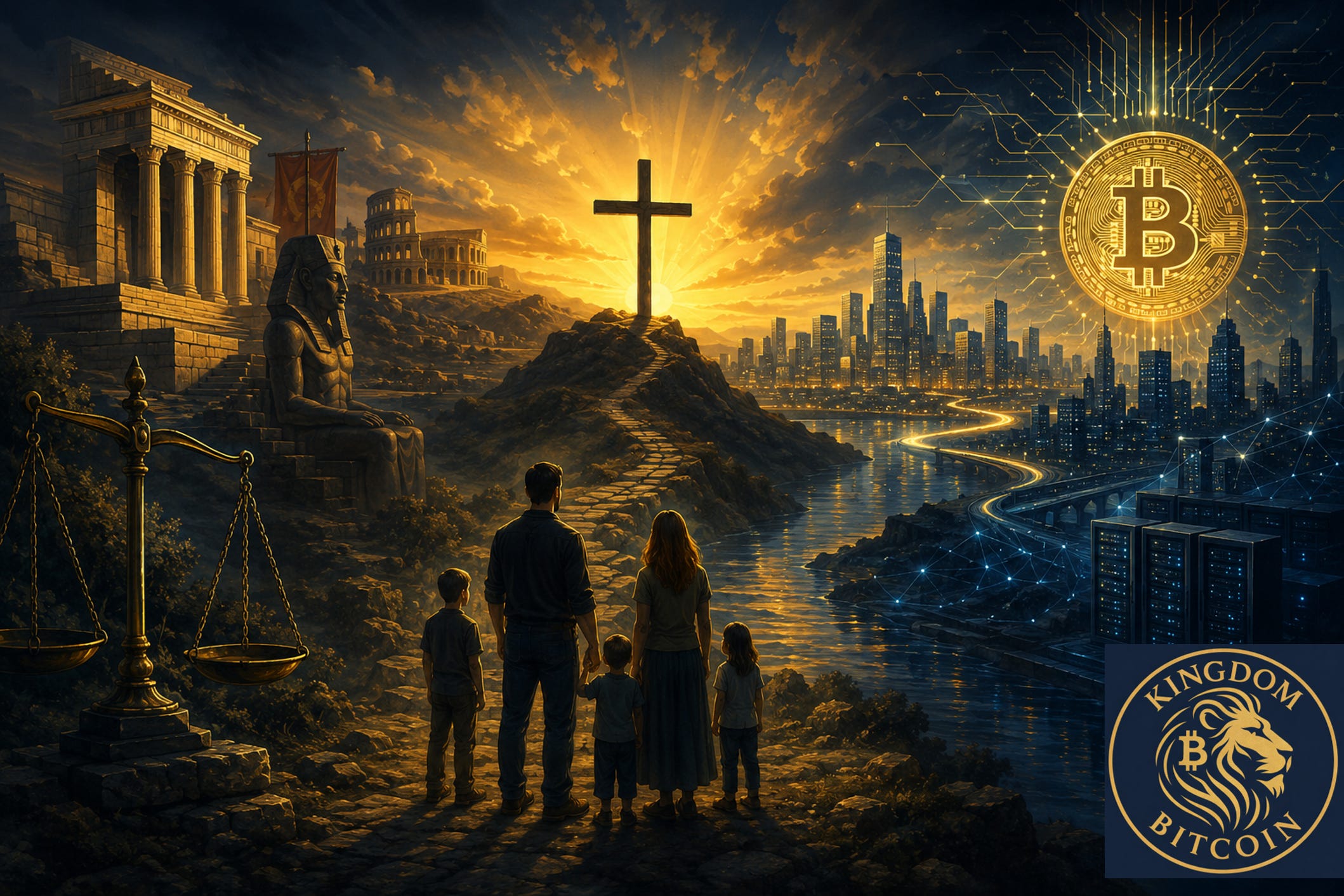
Who Controls the Measure Controls More Than Money
Money is not merely something we spend. It measures labor, stores time, shapes behavior, distributes power, and influences how far into the future we are willing to love. When the measure bends, households and civilizations eventually bend with it.
A Roman coin lands in the palm of Jesus.
The question surrounding it is political, legal, and deliberately dangerous. Should taxes be paid to Caesar? Jesus looks at the coin and asks, “Whose image is this?” They answer exactly as expected: Caesar’s.
Then Jesus turns the trap inside out. “Give back to Caesar what is Caesar’s and to God what is God’s.” The coin bears Caesar’s image. The human being standing before Him bears God’s. That distinction establishes a boundary no empire has the right to erase.
Civil authority has legitimate claims. Scripture is not anarchic. Romans 13 teaches that governing authority has a real role in preserving order, administering justice, and restraining wrongdoing. Yet legitimate authority is not ultimate authority, and every earthly institution becomes dangerous when it forgets the difference.
Caesar’s coin carried more than purchasing power. It carried a message about sovereignty, taxation, order, and who possessed the right to define the terms of economic life. Money has always done this. Whoever controls the measure influences more than commerce because the measure reaches wages, debt, savings, inheritance, and the future claims one generation places upon another.
That is why August 15, 1971 still matters.
On that evening, President Richard Nixon announced that the United States would suspend the convertibility of dollars into gold for foreign governments. It did not cause every monetary problem that followed, nor should it be turned into conspiracy mythology. But it marked a structural turning point. An external monetary constraint had been removed, and the dollar moved more fully into a system dependent upon managed credibility, institutional judgment, and the willingness of people to trust that those controlling the measure would exercise restraint.
The change was profound because a monetary system with fewer external constraints places greater weight upon human discretion. That discretion can be used wisely. It can also be stretched by emergencies, political incentives, debt, and the understandable temptation to solve present problems by creating obligations for the future.
George Washington warned against precisely that temptation. In his Farewell Address, he urged Americans to cherish public credit and avoid unnecessarily throwing upon posterity the burden of debts that the present generation ought to bear. His concern was not merely fiscal bookkeeping. It was stewardship between generations.
James Madison approached the same problem from the architecture of power. Men are not angels, he reminded the young republic, which is why government itself requires internal restraints. Power must be checked because virtue cannot simply be assumed.
That insight belongs inside monetary thinking as well.
A system should not depend entirely upon the hope that those closest to the lever will always refuse to pull it too far. Bitcoin reintroduces constraint in a very different form. Not gold convertibility. Protocol constraint.
Bitcoin’s monetary rules are public and enforced across a distributed network. Its supply cannot be expanded merely because a president, central banker, legislature, corporation, or miner decides that greater flexibility would be convenient. Changing the fundamental monetary rules would require widespread coordination among participants who remain free to reject the change.
That does not make Bitcoin perfect or remove human influence. Exchanges can fail. Custodians can act dishonestly. Regulation can change. Markets can become distorted.
But the core monetary architecture begins with a different assumption: important rules should be difficult for powerful actors to rewrite.
That is more than engineering. It is a view of human nature.
The Founders understood that free societies require boundaries because sophistication does not eliminate temptation. Scripture understood it long before them. Pharaoh took. Kings took. Caesar claimed. And again and again, God reminded rulers that their authority remained beneath His.
The question is therefore not whether government should exist or whether institutions deserve trust. The question is whether trust should ever become unlimited.
The coin may belong to Caesar. The person never does. And if centralized trust creates vulnerabilities around the measure itself, we are finally ready to ask the next question:
What exactly did Bitcoin attempt to solve?
Kingdom Principle 👑
Power should be bounded because human nature has not improved merely because our institutions became sophisticated.
God establishes authority, but He never grants earthly institutions ultimate ownership over human beings. The state may govern, tax, regulate, and preserve order, yet every ruler remains accountable to a higher law. The image of Caesar belongs on the coin. The image of God belongs on the person.
Faithful stewardship therefore requires both respect for legitimate authority and discernment about concentrated power. A healthy system should not depend upon perfect rulers. It should contain boundaries strong enough to withstand imperfect ones.
Prayer 🙏
Heavenly Father, give wisdom to those entrusted with authority and humility to those who exercise power. Protect our institutions from the temptation to confuse temporary responsibility with ultimate ownership, and teach us to honor rightful authority without placing our deepest trust in human systems.
Help us build households and communities that think beyond the present generation. Give us courage to preserve what should be preserved, restrain what should be restrained, and refuse to burden our children with obligations created by our own lack of discipline. Keep every government, market, technology, and monetary system beneath the authority of Jesus Christ, whose Kingdom alone has no end.
In Jesus’ name, Amen. 🙏📖🪙⚖️🇺🇸₿🕊️👑