

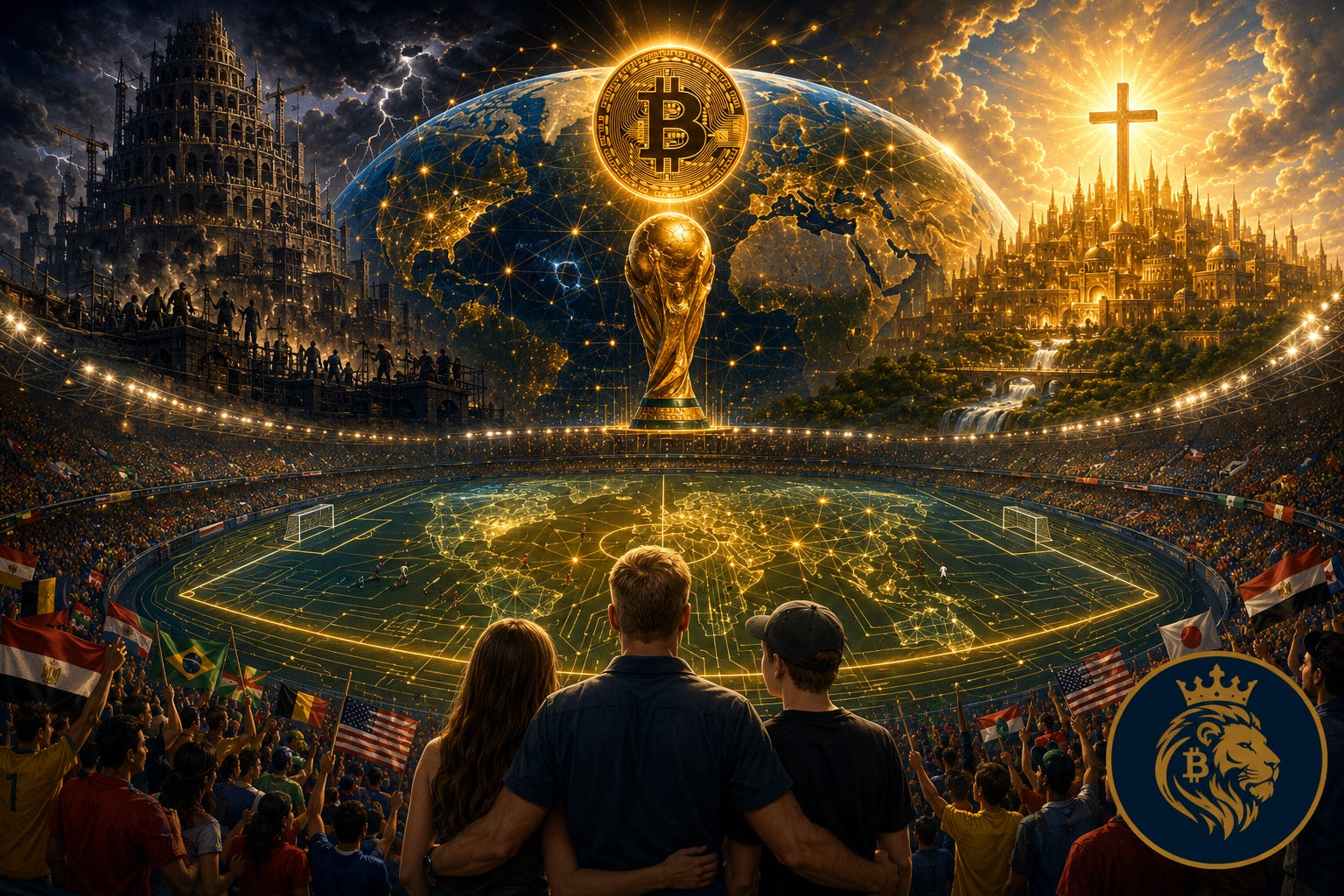
What the World Cup Hints At and Eternity Fulfills
Every World Cup ends the same way.
A captain lifts a trophy toward the sky. Confetti falls. Cameras flash. A nation celebrates. Children run into the streets. Grown men cry. Songs are sung. Flags wave. For a brief moment, it feels as though time itself has stopped.
Then the stadium empties.
The crowds disappear. The banners come down. The television crews pack their equipment. Players return home. The world moves on to the next story.
What felt eternal suddenly becomes a memory.
There is something profoundly human about this cycle. We gather. We celebrate. We create moments that feel larger than ourselves. Yet no matter how magnificent the event, it eventually ends. Every empire, every championship, every dynasty, every human achievement ultimately reaches the same conclusion.
The Bible ends differently.
Near the end of Revelation, the Apostle John is given a vision that stretches beyond history itself. As he struggles to describe what he sees, it becomes apparent that language is almost inadequate for the task. Before him stands a multitude so vast that counting becomes impossible. Nations fill the horizon. Languages blend together. People from every corner of the earth stand before the throne of God.
John writes:
“After this I looked, and there before me was a great multitude that no one could count, from every nation, tribe, people and language, standing before the throne and before the Lamb.”
— Revelation 7:9
Pause and consider the significance of what John sees. Every nation. Not some nations. Every tribe. Not a select few tribes. Every people. Every language.
Throughout history, humanity has repeatedly attempted to solve the problem of unity. Empires have sought it through conquest. Politicians have sought it through power. Economists have sought it through trade. Technologists increasingly seek it through networks. Yet every human effort eventually encounters the same obstacle.
The human heart.
The Tower of Babel was humanity’s first great attempt at global unity. The builders spoke one language, shared one vision, and possessed one ambition. Yet the project collapsed because it was built upon pride rather than truth.
Pentecost revealed something different. God did not erase languages. He honored them. He did not remove diversity. He redeemed it. The miracle was not that everyone suddenly became the same. The miracle was that people remained different while being united around Christ.
Revelation brings that story to its ultimate conclusion. The Kingdom of God does not erase nations. It redeems them. That may be one of the most countercultural ideas in all of Scripture.
Modern culture often assumes that unity requires sameness. Political movements seek it. Corporations seek it. Institutions seek it. The assumption is simple: if everyone thinks alike, acts alike, and speaks alike, harmony will emerge.
God’s vision is dramatically different.
He created diversity intentionally. Different cultures. Different languages. Different peoples. Different stories. The beauty of Revelation is not that diversity disappears. The beauty is that diversity finally finds its proper center.
Jesus.
The World Cup offers a fascinating glimpse of this longing. For a few weeks every four years, nations gather peacefully around a common experience. Rivalries remain, differences remain, identities remain, yet people share something together. It is not the fulfillment of Revelation. It is only a shadow. Yet shadows exist because something real stands behind them.
The World Cup hints at humanity’s longing for unity. The Gospel explains why that longing exists.
One of the reasons bitcoin has intrigued me for so many years is that buried beneath the technology sits a surprisingly biblical principle. Open participation. Open access. Open rules. The network does not ask where you were born. It does not care about your nationality, ethnicity, social status, or political affiliation. The invitation remains open.
This does not make bitcoin salvific. It does not make bitcoin sacred. Technology has never redeemed a single soul.
Yet good systems often reflect deeper truths. Bitcoin reflects the idea that human dignity should not be determined by geography. Every participant enters under the same rules. Every participant receives the same opportunity to engage. In that sense, Bitcoin points beyond itself toward a principle that Scripture has proclaimed for centuries: all people possess equal dignity before God.
The Founding Fathers borrowed from a similar idea when they adopted E Pluribus Unum — “Out of many, one.” At its best, the phrase captured something deeply biblical. Unity without erasing identity. Shared purpose without forced conformity. It was imperfectly applied, as every human project inevitably is, but it reflected an aspiration that echoes throughout Scripture.
The Kingdom accomplishes what every human system can only imitate. The Kingdom creates unity without coercion. The Kingdom creates belonging without exclusion. The Kingdom creates peace without domination.
This is why Revelation remains one of the most hopeful books in the entire Bible. It reminds us that history is moving somewhere. The story does not end in fragmentation. It does not end in tribalism. It does not end in endless conflict.
It ends in worship.
One day the trophies will tarnish. Stadiums will crumble. Markets will evolve. Technologies will be replaced. Nations themselves will rise and fall.
Yet Revelation describes a Kingdom that cannot be shaken and a gathering that never disperses.
The World Cup points toward it imperfectly. Bitcoin hints at it economically. The Gospel fulfills it eternally.
Every tribe. Every tongue. Every nation.
Not because humanity finally learned how to unite itself. Because God finally completed what humanity never could.
Kingdom Principles 👑
God does not eliminate diversity; He redeems it
The Kingdom is not uniformity but unity centered on Christ
Every nation, tribe, people, and language has a place in God’s redemptive story
Pentecost honored diversity while creating spiritual unity
Human systems can reflect Kingdom principles but cannot replace the Gospel
Bitcoin points toward open participation, but only Jesus offers redemption
Human flourishing reaches its fullest expression when rooted in worship
History ultimately moves toward the Kingdom of God
Prayer 🙏✝️🔥
Lord,
Thank You for being the God of every nation, tribe, people, and language.
Thank You for creating a world rich in diversity, beauty, culture, and story. Forgive us for the ways we allow differences to become divisions and temporary identities to overshadow our eternal citizenship in Your Kingdom.
Help us see humanity through Your eyes. Teach us to celebrate the dignity You have placed within every person while remaining anchored in the truth of Your Word.
Holy Spirit, enlarge our vision beyond our own interests, communities, and nations. Give us hearts that long for what You long for and eyes that see the world through the lens of redemption rather than division.
Jesus, thank You for building a Kingdom that cannot be shaken and extending an invitation that reaches every corner of the earth. May we live faithfully as citizens of that Kingdom while pointing others toward the hope found only in You.
And as we watch the nations gather, whether on a football pitch or around a table, remind us of the day when every tribe, every tongue, and every nation will gather before Your throne in worship.
In Your mighty name, Amen. ⚔️🕊️✝️🔥🌍⚽₿👑