

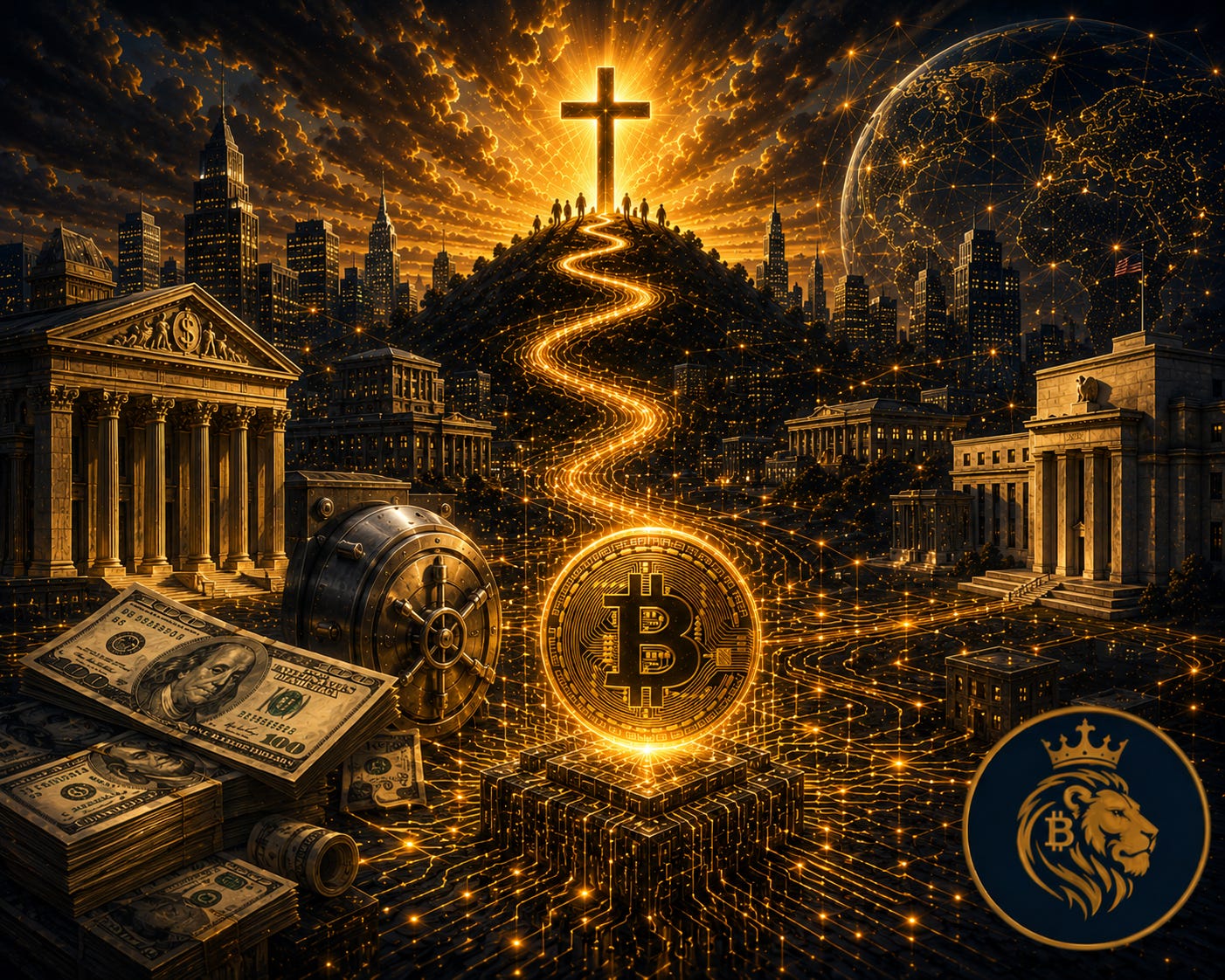
Most people think they understand money because they can see a number on a screen.
A bank account balance.
A brokerage account.
A retirement portfolio.
A credit card app elegantly designed to create the comforting illusion that wealth exists as a static object safely stored somewhere behind polished interfaces and password-protected dashboards.
For decades, this became the dominant mental model of modern finance. Deposit money and the number increases. Spend money and the number decreases. The system feels stable because the interface feels simple.
Yet beneath the surface, most people do not actually possess what they think they possess.
They possess claims. Permissions. Promises. Liabilities recorded inside centralized databases controlled by institutions requiring trust.
Bitcoin fundamentally changes that relationship.
Perhaps one of the most important parts of understanding bitcoin is first unlearning how modern finance trained us to think about ownership itself.
When most people first encounter bitcoin, they naturally import their banking assumptions into the experience. They open a wallet, see a balance displayed at the top of the screen, and assume bitcoin operates like a digital bank account.
Bitcoin is not a bank account.
That distinction may sound technical initially, but it carries profound implications spiritually, philosophically, and economically.
Traditional banking systems operate through centralized ledgers. Your “balance” is essentially a database entry maintained by an institution recording liabilities owed to you. The system functions because people collectively trust the institution maintaining the ledger.
Bitcoin operates entirely differently.
At the protocol level, Bitcoin does not actually recognize accounts or balances. Instead, the network tracks discrete units of value known as UTXOs, or Unspent Transaction Outputs. In simpler terms, Bitcoin behaves less like a spreadsheet and more like physical cash.
Imagine opening your wallet and finding three fifty-dollar bills inside. Your total wealth may equal $150, but there is no singular object called a “balance.” There are only separate pieces of value you control directly. When you purchase something costing $80, you do not shave pieces off one bill. You hand over complete bills and receive change back.
Bitcoin functions remarkably similarly.
Every transaction consumes existing outputs entirely and creates new ones in their place. Your wallet software simply aggregates these separate pieces together and presents them as a clean, unified balance because human beings prefer simplicity over underlying complexity.
The balance itself is largely an interface illusion.
That realization changes everything.
Because once people understand Bitcoin properly, they begin recognizing how deeply modern society has outsourced stewardship to centralized systems built almost entirely on trust, opacity, and abstraction.
Scripture repeatedly warns about this tendency.
The Bible consistently ties stewardship to responsibility, awareness, and honest measure. In the Parable of the Talents, servants are held accountable not merely for possession, but for stewardship of what had been entrusted to them. Proverbs warns repeatedly against dishonest scales because distorted measurement eventually distorts trust itself. Even in Genesis, humanity’s first stewardship assignment involved responsibility over creation rather than passive dependency upon centralized authority.
God never designed people merely to consume systems blindly. He designed humanity to steward responsibly.
Modern finance increasingly encourages the opposite. Most people no longer understand the underlying systems governing their money, debt, savings, inflation, or ownership structures. Convenience replaced comprehension. Trust replaced verification. Financial life became abstracted behind institutions most citizens could never realistically audit themselves.
Bitcoin quietly challenges that arrangement.
Not because everyone suddenly becomes their own bank overnight.
Not because technology itself redeems humanity.
But because bitcoin reintroduces personal responsibility into money.
Self-custody requires awareness.
Scarcity requires discipline.
Verification requires participation.
Those characteristics feel radically different inside a world increasingly optimized around passive dependency.
And perhaps this is where bitcoin becomes deeply spiritual in ways many people still underestimate.
Throughout Scripture, bondage often begins when people surrender stewardship voluntarily in exchange for comfort, security, or convenience. Israel repeatedly desired kings “like the other nations” because centralized control felt easier than covenant responsibility. Yet centralized power consistently produced dependency, corruption, and eventual loss of freedom.
Freedom always carries responsibility.
That is true spiritually.
That is true politically.
Increasingly, it is true financially.
The Founding Fathers understood this tension deeply. America’s constitutional system distributed authority precisely because concentrated power eventually drifts toward abuse without accountability. Bitcoin reflects remarkably similar instincts through distributed verification, open participation, and transparent monetary rules enforced through code rather than centralized decree.
In many ways, bitcoin represents the rediscovery of ownership itself in the digital age.
Not ownership as appearance.
Ownership as responsibility.
Bitcoin often feels less like learning a new technology and more like unlearning decades of assumptions about trust, stewardship, money, and control.
Because the deeper truth is this: The balance was never the thing that mattered most. Stewardship was.
Kingdom Principles 👑
Stewardship requires understanding, responsibility, and honest measure
Modern financial systems often prioritize convenience over true ownership
Bitcoin challenges passive dependency through verification and self-custody
Freedom always carries responsibility across spiritual and financial systems
Honest measurement and transparency strengthen long-term trust
True ownership involves stewardship, not merely possession
Prayer 🙏✝️🔥
Lord,
Teach us to become wise stewards rather than passive consumers of the systems surrounding us.
Give us discernment to understand truth beneath appearances and courage to take responsibility for what has been entrusted into our hands. Protect us from blindly surrendering stewardship for the illusion of comfort or convenience.
Help us build lives rooted in integrity, wisdom, discipline, and honest measure. And may we always remember that true freedom requires responsibility, humility, and dependence upon You above every earthly system.
In Jesus’ name,
Amen. ⚔️🕊️₿