

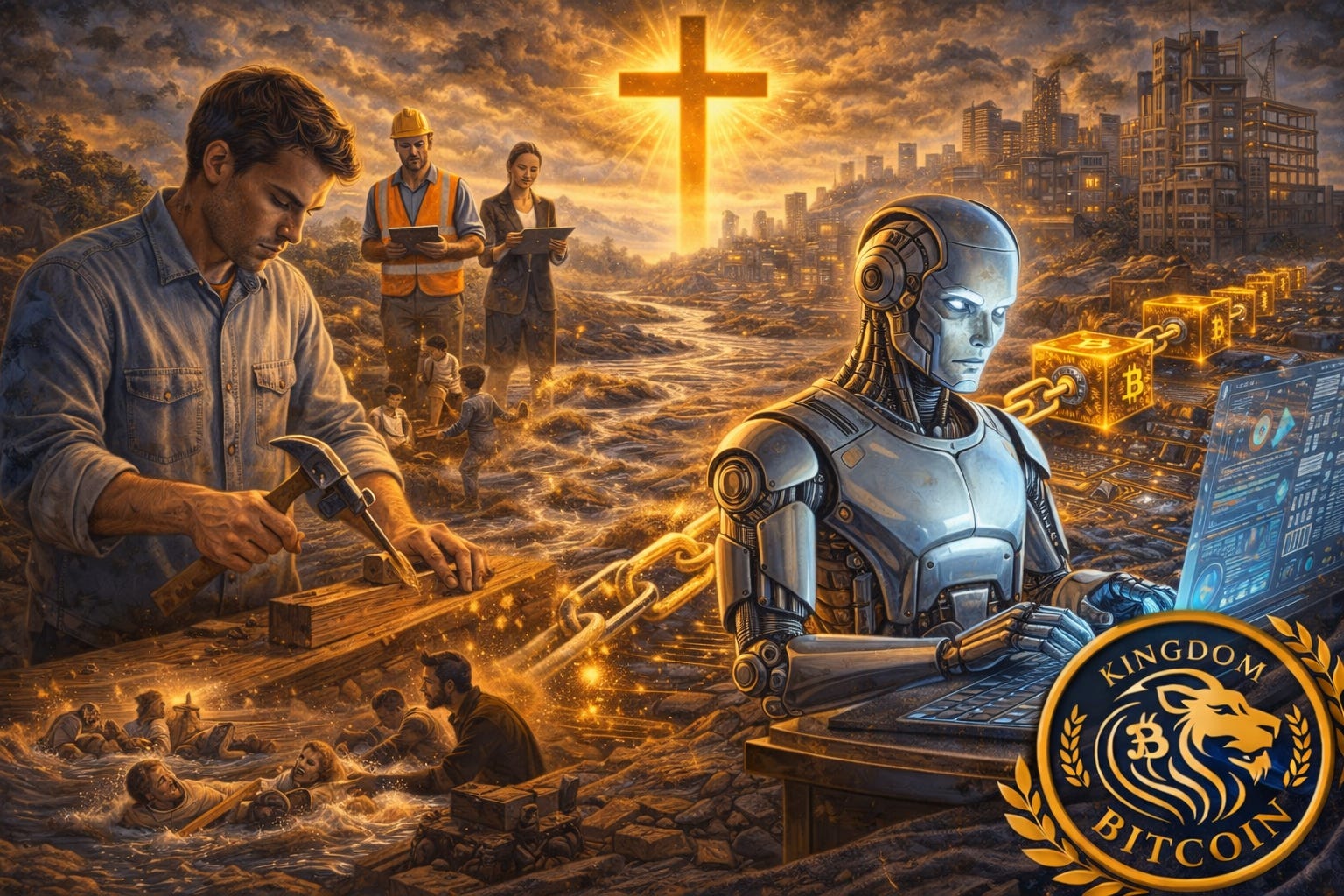
Every civilization eventually faces a defining question. What are human beings for?
For most of history the answer seemed obvious. People worked. They built. They cultivated land, raised families, and participated in the great project of civilization.
Work was never merely economic. It was formative.
Through work people learned discipline, responsibility, and service. Apprentices became craftsmen. Young workers became leaders. Character was forged alongside productivity.
Civilizations did not simply produce goods. They produced people. A new technological era is beginning to challenge that ancient pattern.
Artificial intelligence is advancing at a breathtaking pace. Systems that only a few years ago struggled with basic tasks are now capable of writing software, generating research, analyzing data, and automating complex workflows.
Some researchers believe that within the next decade AI agents could complete a month of human work in a single hour.
That possibility raises a deeper question than technological capability.
If machines begin performing much of the work humans once did, what will humans be for? This question is not merely technological. It is civilizational.
For generations the workplace has served as one of society’s most powerful institutions of formation. Entry level work was rarely glamorous, but it taught something essential. Young workers learned to show up early. They learned to take responsibility for mistakes. They learned to serve customers, cooperate with colleagues, and finish difficult tasks.
In short, they learned how to become adults. If artificial intelligence begins replacing many of the early tasks that once trained the next generation, society will face a new challenge. Who forms the young?
Who teaches responsibility, discipline, and perseverance when machines perform the work that once cultivated those virtues?
Technology can accelerate productivity. It cannot replace formation.
Algorithms can optimize workflows. They cannot cultivate character.
Artificial intelligence can train machines to perform tasks.
Civilization must still train human beings to carry responsibility as humans were never created merely to execute tasks. We were created for relationship, creativity, stewardship, and service.
The opening pages of Scripture reveal something remarkable. God places Adam in the garden “to work it and keep it.” Work existed before sin entered the world. It was not punishment. It was design.
Work was always meant to shape both the world and the worker.
This truth becomes even more important in an age of intelligent machines.
The danger of artificial intelligence is not merely job displacement. The deeper danger is misplaced trust. As these systems grow more capable, people increasingly turn to them for answers, direction, even emotional guidance.
But machines cannot replace truth. They simulate intelligence. They do not possess wisdom. They generate language. They do not possess moral judgment. They process information. They do not bear the image of God.
The coming decades will require an extraordinary level of discernment. The more powerful our tools become, the more carefully humanity must guard its moral compass.
This is where systems built on transparency and integrity become increasingly valuable. Bitcoin represents one such system.
While artificial intelligence introduces unprecedented computational power, bitcoin introduces something equally important. It anchors trust in a world where trust is increasingly fragile.
Bitcoin operates through simple, verifiable rules. Its monetary supply is predictable. Its ledger is public. No central authority can quietly alter the record or expand its issuance for political convenience.
Energy secures the network. Mathematics enforces the rules.
In a world growing more complex by the day, systems grounded in simplicity can provide extraordinary stability.
Artificial intelligence will likely accelerate scientific discovery, medical breakthroughs, and economic productivity. It may become one of the most powerful tools humanity has ever developed.
Human flourishing requires more than technological advancement. It requires purpose and our purpose comes from the Creator.
The Bible teaches that human beings are made in the image of God. Our dignity does not come from productivity alone. It comes from the identity bestowed upon us by the One who created us.
Technology may change how we work. It does not change who we are.
Christians should approach this new technological age with both optimism and humility. Innovation is a gift when stewarded wisely. Wisdom must guide innovation if civilization is to flourish.
Artificial intelligence may reshape the nature of work, however it cannot answer the question of human purpose. Only the Creator can do that.
The defining question of the coming century will not simply be whether machines can think. The defining question will be whether human beings remember why they exist.
Prayer 🙏🤖
Dear Father,
Give us wisdom as we enter this new technological age. Help us use innovation for good while guarding our hearts from placing our trust in machines instead of You.
Remind us that our dignity comes from being created in Your image, not from our productivity alone. Teach us to steward technology responsibly and to guide the next generation with truth, discipline, and purpose.
And anchor our hearts in Christ as we navigate the opportunities and challenges of this new era.
In Jesus’ name, Amen. 🙏🤖