

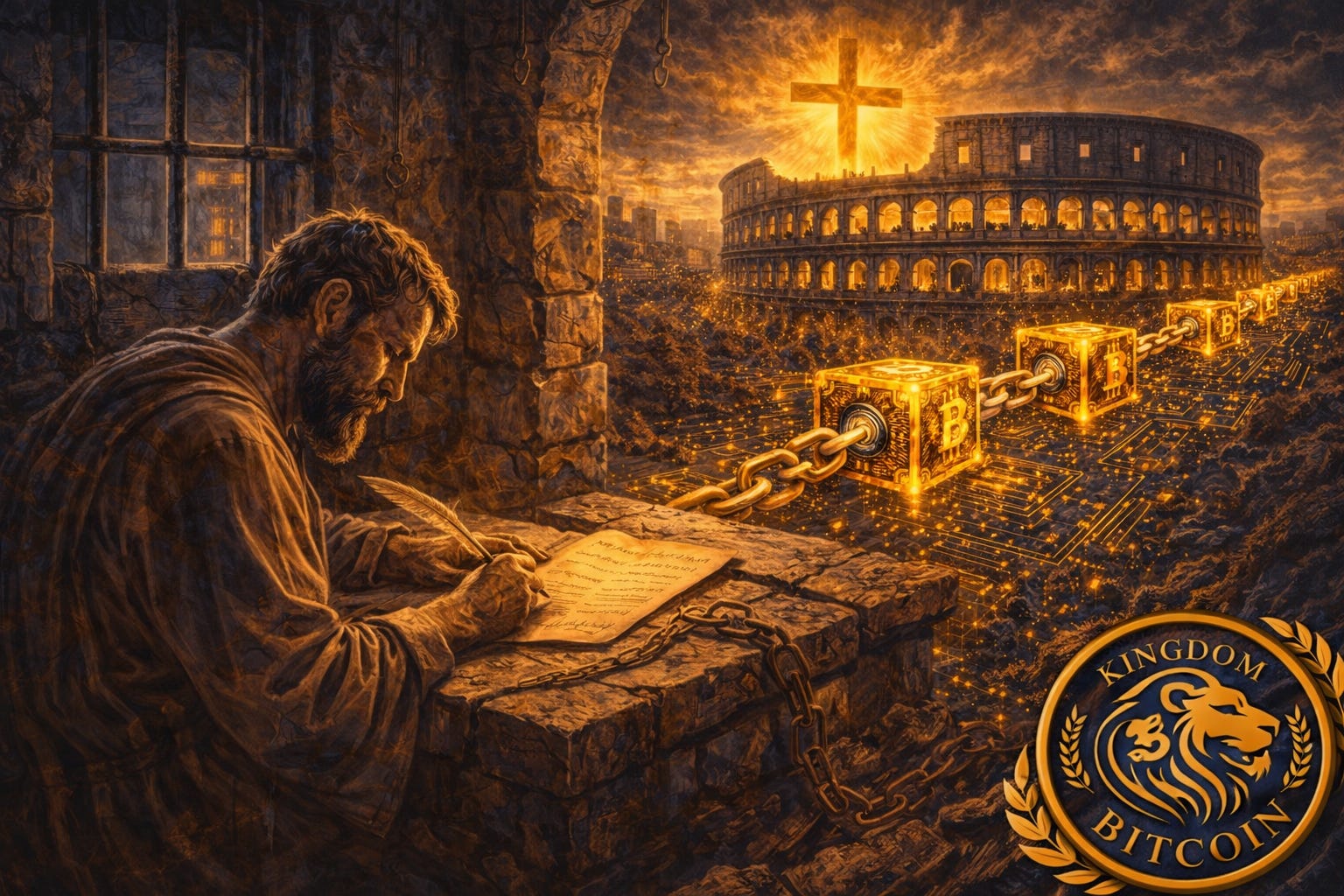
Paul writes some of his most powerful words not from a place of comfort, but from confinement. When he writes to the Corinthians, he is addressing a people who have begun to misunderstand freedom. They believed freedom meant the full expression of their rights, the ability to act without constraint, and the permission to indulge what was available to them. Paul does something striking in response. Rather than correcting them with abstract theology alone, he reaches for something they would immediately understand. He points them to the arena.
In 1 Corinthians 9, Paul unfolds a deeply layered argument. He begins by establishing that he has rights. As an apostle, he has the right to provision, the right to support, and the right to be sustained by his work in the gospel. He supports this claim through experience, through common practice, and even through Scripture itself. By every measure, he is justified in exercising those rights. And then, almost unexpectedly, he reveals that he has chosen not to use them.
This is the turning point of the chapter.
Paul is not merely defending his authority. He is redefining freedom. True freedom, he shows, is not found in the exercise of rights but in the ability to lay them down for something greater. He willingly limits himself so that nothing would hinder the message he has been called to carry. The gospel, not his comfort, becomes the governing force of his life.
This is where Paul’s thinking moves from explanation to illustration. He turns to the world of athletics, something the Corinthians would have known intimately through the Isthmian Games held near their city. These were not casual competitions. They were rigorous, demanding, and public displays of discipline, endurance, and focus. Paul draws from that shared cultural understanding and reframes the Christian life through it.
“Do you not know that those who run in a race all run, but only one receives the prize? Run in such a way that you may obtain it.” - 1 Corinthians 9:24
The force of that statement is often softened in modern reading. Paul is not encouraging casual participation. He is calling for intentional pursuit. The image is not of someone jogging aimlessly, but of an athlete who trains with precision, competes with purpose, and runs to win.
As someone who has lived within that world, I have never been able to separate that imagery from how I approach life. Long after the games end, the arena remains. There is something formed in you as an athlete that does not disappear. You wake up with a sense that there is a standard to meet. You prepare with the understanding that effort matters. You step forward knowing that progress requires resistance. You get knocked down, and you get back up, not because it is easy, but because it is necessary.
That instinct, I have come to realize, is not accidental. It is deeply aligned with what Paul is describing. The Christian life is not passive. It is not a spectator experience. It is lived in the arena.
Paul deepens this imagery in the closing section of the chapter, where he shifts from the runner to the fighter. “I do not run aimlessly,” he writes. “I do not box as one beating the air.” The contrast is vivid. An aimless runner wastes effort. A boxer who strikes the air makes noise but has no impact. Both may appear active, but neither is effective.
Paul refuses that kind of life. He describes instead a form of discipline that is direct, intentional, and costly. “I discipline my body and keep it under control,” he says, “lest after preaching to others I myself should be disqualified.” The language here is not casual. It carries the force of training, of bringing oneself into alignment with a standard that must be met.
This introduces one of the most sobering realities in the chapter. Paul acknowledges that even he is not exempt from the risk of disqualification. The one who teaches must also live the truth he proclaims. The one who calls others to discipline must embody it. Freedom does not remove that responsibility. It heightens it.
This idea would not have been lost on the Corinthians. The athletes they watched trained relentlessly for a prize that would fade within days. A wreath made of leaves, celebrated briefly and then gone. Paul draws a sharp contrast. If such effort is given for something perishable, how much more should one give for what is eternal.
The implication is clear. The Kingdom of God is not entered casually. It is pursued with intention, shaped through discipline, and sustained through endurance. This is not about earning salvation, but about aligning one’s life with the reality of what has been given.
Paul reinforces this same posture in his letter to the Philippians, written from prison yet filled with energy and forward momentum. “Forgetting what lies behind and straining forward to what lies ahead, I press on toward the goal.” There is no nostalgia in that statement. No fixation on past success or failure. There is only focus. Forward movement. A life oriented toward the prize.
That posture requires trust. It requires the willingness to release what is behind and commit fully to what is ahead. The warning embedded in Scripture is clear. Looking back, as in the case of Lot’s wife, leads to paralysis. The Kingdom moves forward. Those who follow must do the same.
But this race is not run alone. Paul reminds us elsewhere that we are surrounded by a great cloud of witnesses. The imagery is unmistakable. A stadium. A crowd. A community that sees, supports, and participates. There are those who run beside us, those who coach us, and those who have gone before us. The race is individual in responsibility but communal in encouragement.
This is where the modern world has drifted. We have retained motion but lost direction. We have activity without discipline, noise without progress, commentary without commitment. The arena has been replaced by observation.
Paul calls us back.
He calls us into a life where freedom is not the removal of constraint but the presence of purpose. Where discipline is not punishment but preparation. Where endurance is not optional but essential.
And it is here that something begins to connect beyond the individual.
Because the same principle that governs the disciplined life also governs the systems we build. Systems, like people, either drift or they are held to a standard. They either respond to pressure by bending, or they remain anchored in something unchanging.
This is part of why I have such deep conviction about bitcoin. It is not simply a technology. It is a system that, at its core, refuses to drift. It operates with a kind of discipline that is rare in human institutions. It follows its rules without exception, without favoritism, and without regard for convenience.
That kind of structure should feel familiar. Because it reflects a deeper truth.
Freedom without discipline does not lead to flourishing. It leads to collapse. But discipline, rightly ordered, creates the conditions where true freedom can exist.
Paul understood that. Athletes understand that. Builders must understand that.
And for those who have spent time in the arena, the distinction is unmistakable. There is a difference between movement and progress, between effort and effectiveness, between appearing engaged and actually advancing.
Paul’s words are not simply encouragement. They are instruction. Run with purpose. Train with intention. Live in such a way that you finish.
Prayer 🙏🏁
Dear Lord,
Train us for endurance in a world that resists discipline. Help us to embrace the process of growth, to pursue what is right with intention, and to live with clarity of purpose.
Strengthen us to let go of what is behind and press forward into what You have called us to. Surround us with the right people, the right guidance, and the right focus. And teach us to run our race in a way that honors You.
In Jesus’ name, Amen. 🙏🕊️