


The Hardware Wallet is the “Checking Account” of your estate. It is a dedicated physical device often looking like a small remote or a thumb drive designed with one singular purpose: to keep your Private Keys completely offline.
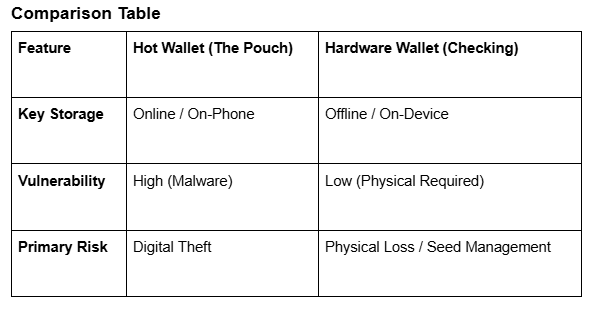
The core distinction here is the Air Gap. When you use a Hot Wallet, your keys live on a phone that is constantly talking to the internet. A hardware wallet generates and stores the keys inside a “Secure Element” chip that never touches the web. Even when you plug it into a computer to move funds, the device “signs” the transaction internally, only sending the finished authorization back to the computer.
What Problem It Solves: The Malware Shield
It solves the Insecure Environment problem. Computers and smartphones are “general-purpose” devices; they run social media, games, and web browsers, all of which are potential entry points for viruses. A hardware wallet is a “single-purpose” device. It doesn’t browse the web; it only manages signatures. By moving the “Signing” process to this dedicated hardware, you ensure that even if your computer is crawling with malware, your Bitcoin remains untouched.
The Friction Framework: Security vs. Accessibility
Ease of Use: Moderate. It requires a physical step finding the device and clicking physical buttons to confirm a transaction.
The “Spouse Test”: This is where many stewards fail. If the device is hidden in a safe and the PIN is only in the steward’s head, the family’s wealth is effectively locked away if the steward becomes incapacitated.
Separation of Concerns: This model separates the Signing Device (the vault) from the Wallet Interface (the software window on your computer used to view the balance).
Who It’s For: The Household Steward
This is the “Gold Standard” for families holding significant allocations. It is for the person who has moved past the “learning” phase and is now building a legitimate storehouse. It is for “Working Capital” funds that aren’t spent daily but need to be accessible within minutes if a major opportunity or need arises.
Risks & Tradeoffs: Physical Responsibility
Risks shift from digital to Physical. This includes supply chain risks (tampered devices) and the risk of physical loss. It also introduces the “5-Dollar Wrench” attack having a physical device is a signal of ownership. Discretion and physical security of the device and its backup (the seed phrase) become the primary concerns of the steward at this stage.
The Data Trail: Breaking the Institutional Link
Hardware wallets allow for a much cleaner privacy profile. Most allow you to “choose your own interface” (using software like Sparrow or Electrum). This means you can use the device without ever giving your name or email to the manufacturer. You are no longer a “user” in a database; you are a sovereign participant on the network.
Common Mistakes: Misunderstanding the Tech
A common mistake is treating the device as the Bitcoin. The Bitcoin is not “inside” the little plastic device. It lives on the blockchain; the device merely holds the keys. If you break the device, your Bitcoin is fine, provided you have your seed phrase. Another mistake is Seed Phrase mismanagement writing the words on a flimsy piece of paper and leaving it in a kitchen drawer where it could be thrown away or destroyed by water.
The Kingdom Perspective: Setting the Doors
In Nehemiah’s day, the restoration of Jerusalem wasn’t complete just because the people had returned; it was complete when the walls and gates were rebuilt (Nehemiah 7:1). A hardware wallet is the “setting of the doors” for your family’s digital estate. Stewardship requires us to recognize that as our “city” (our wealth) grows, the gates must be strengthened.
However, Nehemiah did not just build walls; he appointed gatekeepers. In a family context, this means education. If you are the only one who knows how to operate the “gates,” you have built a wall that traps your own heirs. A Kingdom steward ensures that the “Technical Gatekeeping” is shared with a spouse or a trusted successor, moving from a temporary tent into a permanent, fortified home.
Scripture for Reflection
“By wisdom a house is built, and by understanding it is established; by knowledge the rooms are filled with all precious and pleasant riches.” — Proverbs 24:3-4
A hardware wallet is the “understanding” that establishes your storehouse.