


In the journey of stewardship, the first step is often the most humble. To understand where we are going, we must first understand where we begin. For most, the entry point into the world of Bitcoin is not a private vault, but a Custodial Model. In this model, you do not hold the Bitcoin itself; rather, you hold a legal claim to it. You have outsourced the technical responsibility of security to a third party—typically a centralized exchange.
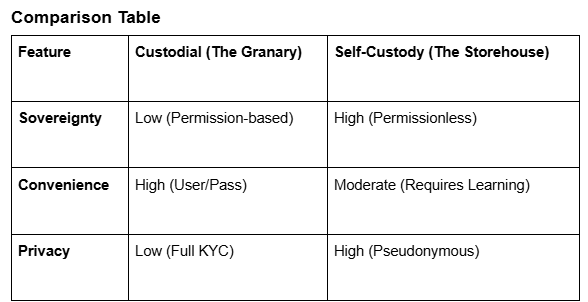
This is the modern equivalent of the “Public Granary.” While the grain belongs to you in name, it sits behind the thick stone walls of a fortress managed by others. You hold a receipt, and your ability to access that grain is entirely dependent on the gatekeeper’s permission. The relationship here is one of Counterparty Risk. When you log into an app and see a balance, you are looking at a database entry, not a direct view of the blockchain. You are trusting three things: the company’s technical ability to keep hackers out, the company’s internal honesty, and the company’s regulatory compliance. If any of these pillars fail, your claim may vanish.
What Problem It Solves: The Low Barrier
The custodial model exists primarily to solve the problem of friction. For many, the prospect of managing cryptographic keys is a daunting barrier. A custodial service offers a familiar user experience: a username, a password, and a “Forgot Password” button. It provides immediate liquidity and bridges the gap between the traditional banking world and the new digital frontier. It allows the steward to focus on the why of Bitcoin—its scarcity—before being overwhelmed by the how of technical security. For a family office or a first-time buyer, this is the “on-ramp” that invites participation without the fear of immediate technical loss.
The Friction Framework: Accessibility vs. Control
In our stewardship framework, we must balance security with the “Spouse Test” and inheritance.
Ease of Use: Exceptional. It mirrors the experience of a standard brokerage app.
Emergency Access: High accessibility for the user, but high red tape for heirs. If a steward passes away, the family must navigate a corporate legal department to prove inheritance, a process that can take months.
The Paradox: While it is the easiest model to “get into,” it can be the most difficult to “get out of” during times of extreme market volatility, technical outages, or political instability.
Who It’s For: The Explorer
This stage is for the Explorer. This includes first-time buyers learning price behavior, busy professionals prioritizing simplicity while they educate themselves, and families testing the waters. For these personas, custodial Bitcoin functions like training wheels. The risk is not starting here—it’s staying here unintentionally.
Risks & Tradeoffs: The Institutional Bet The primary risk is Institutional. You are vulnerable to exchange hacks (the “honey pot” effect), corporate insolvency, or “censorship,” where a platform freezes your account due to regulatory shifts.
The Bankruptcy Reality: One of the most sobering tradeoffs is the legal status of your assets. In the traditional banking world, deposits are often insured (like FDIC in the US). In the Bitcoin exchange world, if a platform fails, the law often views your Bitcoin as the company’s property, not yours. In a bankruptcy proceeding, the exchange may be legally permitted to use “your” Bitcoin to pay off its own debts, creditors, and legal fees. You are pushed to the back of the line as an “unsecured creditor.”
For a novice, this model mitigates Internal Risk (the fear of losing a device before you are trained), but it replaces it with Structural Risk. You are trading the risk of your own mistake for the risk of a corporation’s insolvency.
The Data Trail: The Cost of Convenience
Holding Bitcoin on an exchange creates an extensive Data Footprint. To comply with regulations, these platforms require KYC (Know Your Customer) documentation: your ID, address, and tax information. This creates a permanent digital link between your identity and your wealth. For families thinking generationally, this data persists. In the custodial model, financial privacy is non-existent, and this data trail is itself a security risk if the company’s database is ever breached.
Common Mistakes: The “Set It and Forget It” Trap
The most dangerous mistake is Complacency. Many stay in this model far longer than they should, treating the exchange like a long-term savings account. A steward must remember: an exchange is a marketplace, not a storehouse. Another mistake is Over-Allocation—keeping a life-changing amount of wealth on a single platform is a violation of basic prudence.
The Kingdom Perspective: The Theology of Dependency
In the biblical tradition, stewardship is the management of resources that ultimately belong to the Creator. The custodial model represents a state of “dependence.” While it is a necessary starting point, it mirrors the era of Joseph in Egypt. During the famine, the people brought their silver to the centralized granary. It saved their lives, but eventually, their reliance on that central authority led to a loss of autonomy.
True stewardship requires a progression toward responsibility. To be a steward of a “Family Storehouse” is to be the one who holds the keys. If a third party can “turn off” your ability to provide for your children at their whim, you have not yet achieved the full measure of sovereign stewardship. You are still a beneficiary of someone else’s permission. As your storehouse grows, the weight of responsibility must grow with it. Moving from a claim on Bitcoin to actual Bitcoin is an act of taking your family’s future into your own hands. It is the transition from being a “consumer” of a financial product to being a “guardian” of a generational asset.
Scripture for Reflection
“A good man leaves an inheritance to his children’s children.” — Proverbs 13:22
Inheritance is not accidental; it is intentional. This verse reminds us that provision extends beyond accumulation to preparation