

Every harvest season, a farmer carried grain into the village market. He had worked through heat, failed rains, and long days. His family depended upon the sale. The merchant greeted him warmly, placed the grain upon the scale, and announced the weight. The farmer never noticed that one side leaned slightly lower than the other. It was not enough to provoke suspicion. It was only enough to steal a handful from every bag.
At first, the loss seemed insignificant. But the same scale was used the following week, the next season, and the year after that. The farmer worked harder and brought a greater harvest to market, yet somehow his labor purchased less. His children needed shoes. The roof needed repair. The merchant had not robbed him with a weapon. He had robbed him through the measure.
That is where any honest conversation about money must begin.
Most people first encounter Bitcoin through its price. They hear that it surged, collapsed, recovered, or crossed another milestone. But price is not the proper starting point. Before asking what bitcoin is worth, we should ask what money is measuring.
Money is not merely paper, metal, or numbers inside a banking application. It is a measuring instrument. It measures the value of work, the cost of time, the weight of debt, and the sacrifice stored for the future. When a family saves, money carries yesterday’s labor into tomorrow.
That means the integrity of money matters.
The issue reaches beyond economics because a corrupted measure quietly changes how people live, what they fear, how long they plan, and whom they must trust. It reaches into the household.
Scripture does not treat dishonest measurement as a technical accounting error. Proverbs tells us, “The Lord detests dishonest scales, but accurate weights find favor with him.” God cares not only about whether a transaction occurs. He cares whether the measure inside it is truthful.
Modern inflation is more complicated than a merchant leaning upon a scale, but the consequence can feel similar. Inflation is often described as prices going up. Yet prices rise for many reasons. Monetary inflation occurs when the supply of money expands faster than the goods and services available. More units of currency begin competing for the same underlying value.
The effect is rarely announced as a tax. No invoice arrives explaining that part of your savings has been removed. The loss appears gradually. The same paycheck covers less. A family that believed it was saving discovers that the measuring instrument itself has changed.
This does not mean every increase in the money supply is malicious. But good intentions do not make the scale honest. The question remains whether those who produce, save, and plan can trust the unit in which their labor is measured.
Bitcoin introduces a radically different answer.
Its monetary policy is not decided in a closed meeting. Its issuance schedule is public. New bitcoin enters circulation according to rules written into the protocol, and the total supply cannot exceed twenty-one million. Thousands of independent participants verify those rules. No central bank can create more because markets are frightened.
The rule is visible because the decision has already been made.
Scarcity alone does not create value. Bitcoin’s significance comes from combining predictable scarcity with security, portability, divisibility, global accessibility, and a network people choose to use. Scarcity is not the entire argument. It is the foundation of monetary integrity.
That distinction matters because bitcoin is often presented as though its primary promise is wealth. Buy it, wait, and become richer. That message may attract attention, but it misses the deeper lesson. Bitcoin asks whether money should have rules that rulers cannot casually change. It asks whether savers deserve a measure that remains consistent. It asks whether the fruit of labor should be preserved by mathematics or political discretion.
For Christians, this is not a command that every believer must own bitcoin. Bitcoin can be misunderstood, mishandled, idolized, and lost.
The deeper Kingdom question is whether followers of Jesus should care about honest measurement.
Scripture answers without hesitation.
God is truthful, consistent, and just. He does not place one weight upon the powerful and another upon the poor. His character does not inflate, drift, or respond to political convenience. Honest measures matter because they reflect something about the nature of the God we serve.
Money also shapes behavior. When savings are steadily weakened, people are encouraged to consume quickly, borrow more, and search for risky ways to stay ahead. When the measure is dependable, patience becomes possible. Families can plan further into the future. Builders can think beyond the next quarter. Generosity can be sustained because resources are not constantly fleeing from time.
Bitcoin does not make people righteous. An honest monetary rule cannot purify a dishonest heart. Yet systems influence what they reward. Predictable scarcity can encourage patience, responsibility, and long-term stewardship. Endless expansion can reward leverage, urgency, and dependence upon those closest to newly created money.
The farmer did not need a more generous merchant. He needed a truthful scale.
Our generation should ask for the same.
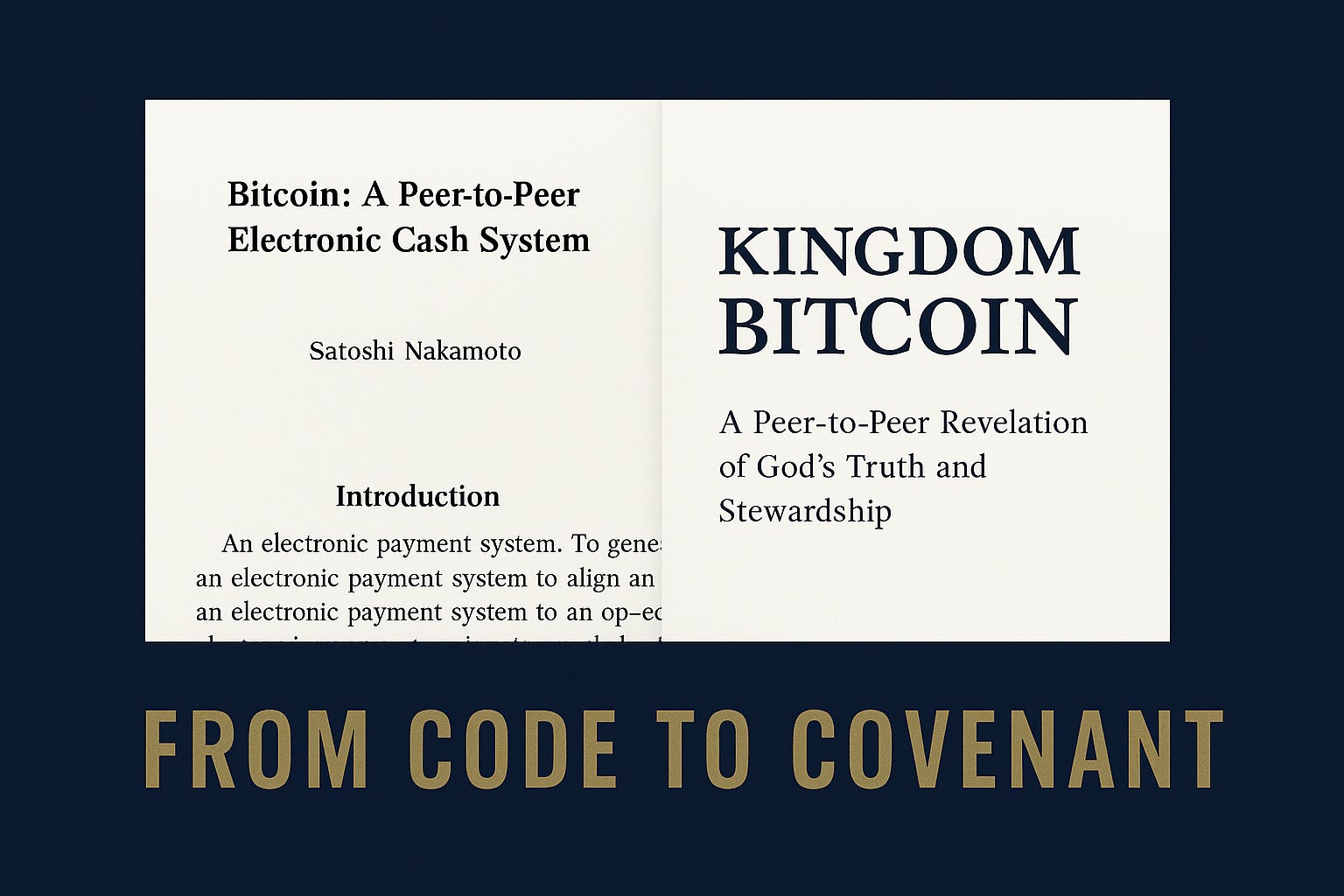
Bitcoin begins as a response to the problem of manipulable money. It does not solve every economic injustice or eliminate greed, foolishness, and sin. But it places a public, fixed measure into a world accustomed to flexible ones.
The rebirth of honest money is not a rebellion. It is a repentance.
Once we recognize that money has become difficult to trust, the next question becomes unavoidable: how can a digital system create truth without requiring us to trust another powerful institution?
Kingdom Principle 👑
Honest stewardship requires an honest measure.
God does not separate economic integrity from spiritual integrity. The same Lord who commands truth in our words also commands truth in our weights, wages, contracts, and exchanges. A dishonest scale injures more than a transaction. It distorts relationships, punishes patience, rewards proximity to power, and quietly transfers the fruit of one person’s labor into the hands of another.
Bitcoin does not replace righteousness, nor can mathematics redeem the human heart. Yet its fixed monetary rules challenge us to reconsider what honest measurement should look like. As followers of Jesus Christ, we should care deeply about any system that measures human labor, preserves family savings, and carries value between generations. Honest money cannot create honest people, but honest people should desire honest money.
Prayer 🙏
Heavenly Father, You are the God of truth, justice, and perfect measure. Nothing in You is manipulated, diluted, or hidden. Forgive us for the ways we have accepted dishonest scales simply because they were familiar, complicated, or endorsed by powerful institutions.
Give us wisdom to understand the money we earn, save, spend, and entrust to future generations. Protect us from fear, greed, speculation, and the temptation to make wealth an idol. Teach us to recognize the difference between price and value, scarcity and wisdom, ownership and stewardship.
Strengthen families whose labor no longer seems to stretch as far as it once did. Defend workers whose wages have been quietly diminished and savers whose patience has been punished. Give our leaders courage to pursue truthful measures, even when honesty requires sacrifice.
May every resource placed into our hands be measured faithfully, managed wisely, and directed toward Your purposes. Let our finances reflect integrity, our generosity reflect Your heart, and our trust remain anchored in Jesus Christ alone.
In Jesus’ name, Amen. 🙏📖⚖️🌾₿🕊️👑