

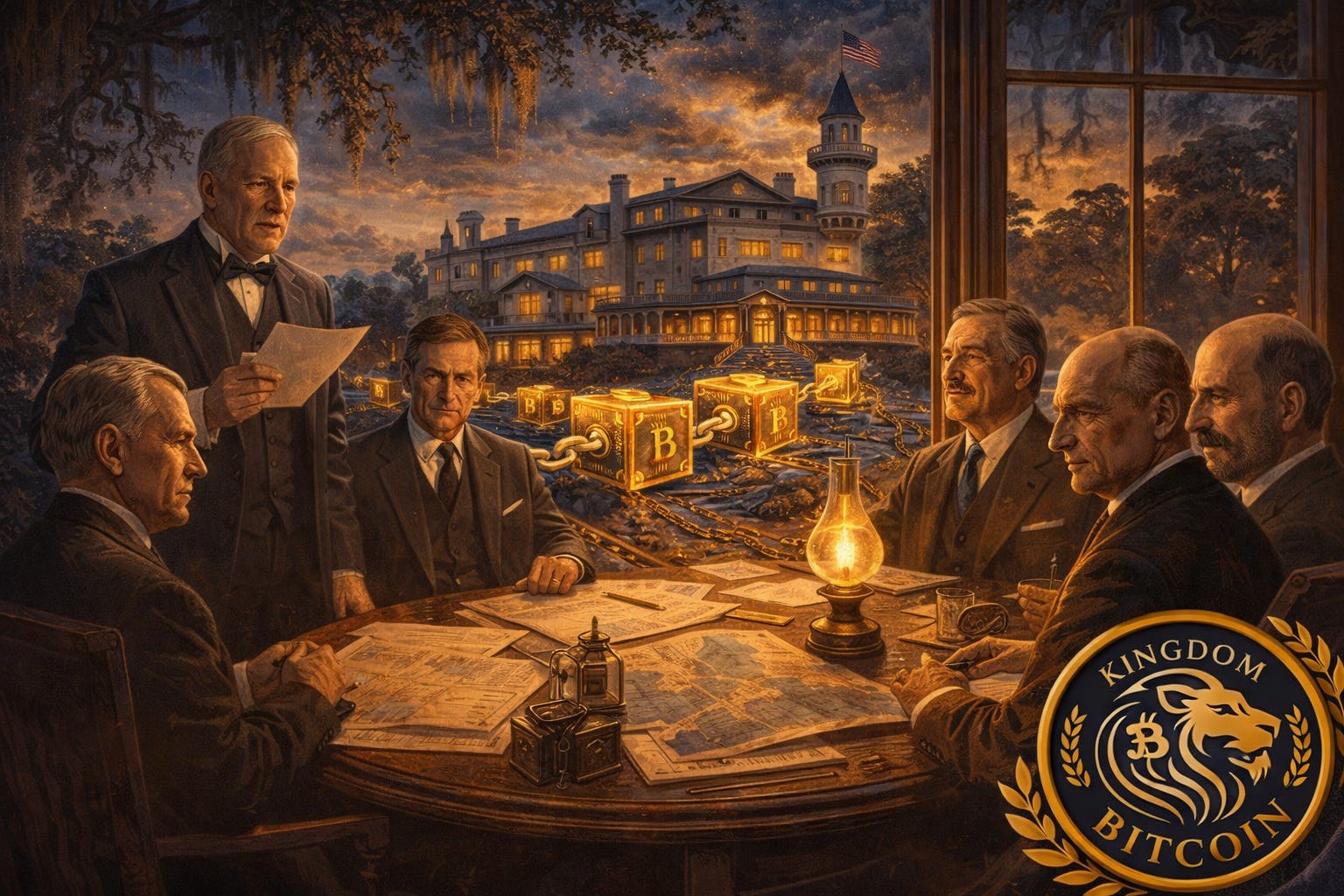
Last weekend I stood in a place few Americans ever visit, yet one that quietly reshaped the financial architecture of the modern world.
Jekyll Island, Georgia.
Standing there, it is difficult to imagine that beneath the calm beauty of this island, one of the most consequential monetary decisions in American history was quietly conceived.
It is a peaceful place today. Moss hangs from ancient oaks. The Atlantic breeze rolls across the driftwood beach and marshland. Families ride bicycles along quiet roads where some of the most powerful financial minds in American history once traveled under extraordinary secrecy.
In November of 1910, a carefully selected group of financiers and policymakers at the exclusive Jekyll Island Club. Their journey itself was carefully orchestrated. The men departed from a private railcar in Hoboken, New Jersey. The windows were drawn. The press was kept at distance. Participants were instructed not to use their last names during the journey so that even train staff would not recognize the prominence of those aboard.

The six men who gathered on that island were led by Senator Nelson Aldrich and included Henry P. Davison of J.P. Morgan & Company, Frank Vanderlip of National City Bank, Paul Warburg of Kuhn Loeb & Company, Benjamin Strong, who would later become the first governor of the New York Federal Reserve Bank, and A. Piatt Andrew, then Assistant Secretary of the Treasury. Each man represented a different pillar of influence.
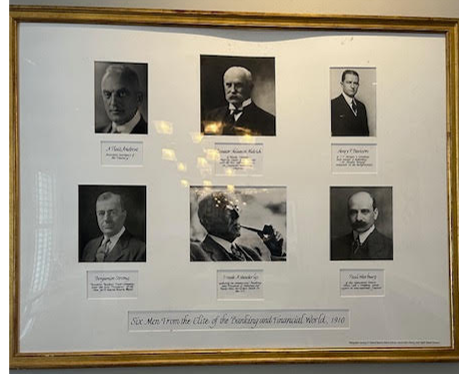
Aldrich carried the authority of Washington and chaired the National Monetary Commission, which had spent years studying European banking systems after the Panic of 1907. Davison represented the stabilizing influence of the J.P. Morgan banking house. Vanderlip brought the power of National City Bank, one of the largest financial institutions in the country.
Among them, Paul Warburg carried perhaps the most influential intellectual framework. A German-born banker trained in European finance, Warburg had studied the structure of institutions such as the Bank of England and the German Reichsbank. For years he had been publishing essays arguing that America’s fragmented banking system made financial panics more likely.
Benjamin Strong would later become one of the most influential central bankers of the early twentieth century. From that position he helped shape monetary policy throughout the 1920s and worked closely with European central banks.
Their mission was not recreational.
They came to design a new monetary system.
The Panic of 1907 had shaken confidence in American banking and set the stage for what would happen next.
At the height of that financial panic, the American banking system nearly collapsed. Trust evaporated. Depositors rushed banks. Markets froze. There was no central authority capable of stabilizing liquidity across the financial system.
In that moment, the nation turned not to a government institution, but to a single private banker. J.P. Morgan.
Morgan famously summoned the most powerful bankers and trust executives in New York to his private library on Madison Avenue. The doors were closed. The group remained inside for hours while Morgan demanded they examine the failing institutions one by one and commit capital to stabilize the system.
Legend holds that Morgan refused to allow the bankers to leave the room until they had agreed on a rescue plan. Whether every detail of that night has been polished by history or not, the lesson was unmistakable.
A modern financial system had been stabilized through the authority of one individual.
That reality unsettled the nation.
It also convinced policymakers that the United States needed a permanent structure capable of managing financial crises without relying on the personal influence of a single banker.
Three years later, the men who gathered quietly on Jekyll Island attempted to design that structure.
The Federal Reserve.
To understand the moment properly, we must return to a principle deeply understood by our Founding Fathers. Money is not merely economic. It is structural power.
Thomas Jefferson warned repeatedly about centralized banking authority. James Madison understood that monetary control could quietly reshape a republic. Andrew Jackson fought an entire political battle over the Second Bank of the United States because he believed concentrated financial power threatened liberty itself.
The Founders debated money because they knew that whoever governs the measuring stick eventually influences the entire marketplace.
Scripture speaks to this concern with remarkable clarity.
“You shall do no wrong in judgment, in measures of length or weight or quantity. You shall have just balances, just weights.”
- Leviticus 19:35–36
Honest measurement is not simply accounting. It is a moral category.
Money measures value across time. When the measurement changes unpredictably, trust begins to erode. Savers become cautious. Incentives shift. Political pressures grow around the ability to expand or restrict the supply of money.
The Federal Reserve was created with a mandate to stabilize the financial system. In moments of crisis it has indeed acted as a lender of last resort. Yet over the century that followed, the United States also entered an era of unprecedented monetary expansion.
Dollars multiplied. Debt accelerated. Asset prices rose. Inflation quietly eroded purchasing power across generations.
This was not always malicious. Often it was simply the path of least resistance in moments of crisis.
Expansion is politically easier than restraint. And that is precisely why the Founders worried about centralized control of money. Power invites temptation.
There is one final detail from that 1910 gathering that still captures the imagination. To conceal the true purpose of the trip, the participants told reporters and associates they were traveling south on a duck hunting excursion. The explanation was simple and believable. Wealthy men traveling with sporting gear raised no suspicion. Yet inside the quiet halls of the Jekyll Island Club, far from public view, the blueprint for a new monetary era was being drafted.
It is striking that one of the most consequential monetary systems in modern history began in secrecy, while the next great monetary experiment began in public code for anyone in the world to examine.
History is often shaped in rooms the public never sees. Now more than a century after that quiet meeting on Jekyll Island, a new monetary system has emerged from a very different origin.
Bitcoin did not begin in a private club among powerful financiers. It began as open source code released to the world.
No closed room.
No private charter.
No privileged access.
Anyone can verify it.
Lowercase bitcoin functions as a currency moving across the network. Uppercase Bitcoin is the network itself, a distributed system secured by mathematics, energy, and global consensus rather than institutional decree.
Its monetary policy is transparent. Its issuance schedule cannot be quietly altered. No committee meets in secret to adjust the supply.
The first block of the Bitcoin network was mined in January 2009. Embedded within it was a simple line taken from a newspaper headline that day.
“The Times 03/Jan/2009 Chancellor on brink of second bailout for banks.”
It served as both a timestamp and a quiet observation about the monetary moment in which Bitcoin was born.
A system conceived in secrecy on a private island in 1910. A system released publicly in code to the world in 2009. Two very different responses to the same enduring question. How should money be governed?
Standing on Jekyll Island last weekend, I could not help but reflect on the quiet irony of that moment.
In 1910 a small group of powerful men gathered privately under the cover of a duck hunting trip to design a centralized monetary system.
Nearly a century later, in 2009, an anonymous developer released code that allowed anyone on earth to participate in a decentralized one.
One was built on secrecy and institutional authority. The other is built on transparency and verification. Both reveal something enduring about human civilization.
Money always reflects the structures of trust we build beneath it. And the search for honest weights never truly ends.
Perhaps history will one day remember Jekyll Island not only as the birthplace of the Federal Reserve, but also as the place where many first began asking a deeper question.
Whether money itself could be built on truth again.
Prayer 🙏⚡🕊️
Father God,
You are the source of truth, justice, and order. Teach us to pursue honest weights in every area of life, including the systems that govern money and commerce.
Give wisdom to leaders, humility to builders, and discernment to those stewarding financial systems that impact millions of families.
Protect us from pride, greed, and manipulation. Anchor our trust not in institutions or markets, but in Christ alone.
May we steward innovation with integrity and use our work to serve others and glorify You.
In Jesus’ name, Amen. 🙏⚡🕊️
Great read! My hope is to grasp a deeper understanding of just weights and measures from a biblical perspective.