

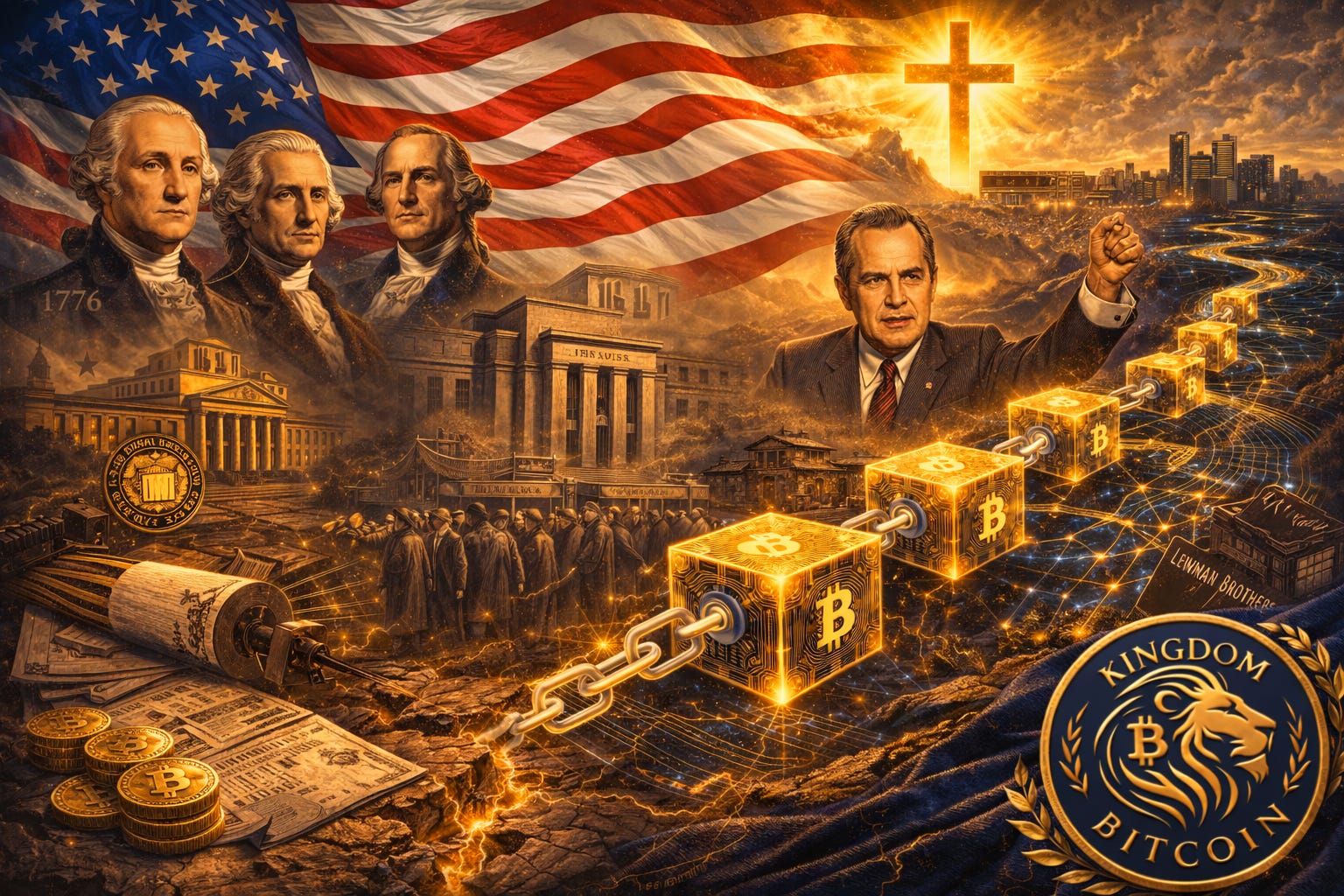
Series Throughline
America was not founded on the assumption that men are good.
It was founded on the assumption that men are fallen.

The Founders built restraint because they believed power tempts.
Scripture declares, “For there is nothing covered, that shall not be revealed; neither hid, that shall not be known.” - Luke 12:2.

From the Continental collapse to the creation of the Federal Reserve, from the Great Depression to the closing of the gold window in 1971, and from 2008 to today, every monetary era has been tested under pressure.

Inflation exposed weakness. Elasticity expanded power. Contraction revealed fragility. Bailouts exposed moral hazard.

When money can be altered quietly, trust erodes slowly.
When trust erodes, control consolidates.

Bitcoin does not assume virtue. It assumes temptation.

The Founders separated powers because they did not trust kings.
Bitcoin separates monetary authority because it does not trust committees.

This series is not nostalgia. It is about design under revelation.

What kind of monetary system survives when hidden things come to light?
That is the question.
America did not begin with optimism about human nature. It began with a sober understanding of it.
“The heart is deceitful above all things, and desperately wicked: who can know it?” - Jeremiah 17:9.
The Founding Fathers did not invent that anthropology. They inherited it from a civilization shaped by Scripture. They built a nation assuming power tempts, incentives drift, and unchecked authority corrodes.
That conviction shaped our Constitution. It also shaped our money.
In 1776, America declared independence before “the Laws of Nature and of Nature’s God.” Yet while the colonies fought political tyranny, they learned monetary fragility the hard way. War required funding. The Continental Congress lacked taxing authority. Paper currency became the expedient solution.
Between 1775 and 1779, hundreds of millions of dollars in Continental bills were issued. Confidence cracked. By 1779 the currency had depreciated to a fraction of its face value. Inflation surged. “Not worth a Continental” entered the American language as a warning about broken promises.
This was not merely bad policy. It was moral injury.
Soldiers were paid in paper that lost value before it reached their hands. Merchants demanded hard coin. Contracts became unstable. Inflation does not knock on the door announcing theft. It transfers value quietly, eroding trust between neighbors.
Scar tissue followed.
Article I, Section 10 of the Constitution restricts states from coining money, emitting bills of credit, or making anything but gold and silver coin legal tender. That was not ornamental language. It was restraint born from experience.
James Madison wrote in Federalist No. 44 that paper money had “poisoned the faith of government” and weakened confidence between citizens. He understood something profoundly biblical: dishonest measurement corrupts social trust.
Scripture states plainly, “A false balance is abomination to the LORD: but a just weight is his delight.” - Proverbs 11:1.
Weights and measures are moral categories. They are not merely economic instruments. When measurement shifts quietly, trust fractures slowly.
In 1792, Congress passed the Coinage Act. The dollar was defined by specified weight in silver, with a statutory gold-to-silver ratio of fifteen to one. Money was anchored to something tangible. Measurement was physical, not rhetorical.
Even then, incentives exposed tension. The statutory ratio diverged from the global market ratio, encouraging gold coins to be exported or melted. Markets obey incentives before they obey speeches. The Founders learned again that design matters more than intention.
Alexander Hamilton valued public credit and argued that honoring revolutionary debt was essential to national legitimacy. Thomas Jefferson feared concentrated banking power and warned of distant financial control. Washington governed between them, aware that theory yields to consequence.
This is where the conservative instinct rooted in Christian thought becomes clear. The Constitution separates powers because men are fallen. It restrains government because authority drifts. It assumes sin without surrendering to cynicism.
Money requires the same architecture. Political independence without monetary integrity is fragile liberty.
The American experiment began with a declaration before God. It matured through restraint forged in inflation. The Founders did not trust kings. They also did not trust themselves.
Bitcoin enters this historical arc not as nostalgia and not as rebellion. It is technological restraint in a fallen world.
Bitcoin assumes temptation exists. It minimizes discretionary alteration of the measuring stick. Its issuance schedule is transparent. Its rules are visible. Its ledger is public. It does not depend on a committee preserving credibility. It does not negotiate supply through speeches.
It encodes constraint.
Bitcoin is not salvation. Christ alone redeems the heart. Law restrains sin. The Holy Spirit produces self-control. But systems that account for human fallenness align more closely with biblical realism than systems that assume virtue will prevail under pressure.
The Founders separated powers because they did not trust concentrated authority. Bitcoin separates monetary authority because it does not trust concentrated discretion.
That is not utopian. It is anthropological.
America’s first monetary lesson was written in depreciating paper and disillusioned soldiers. The Constitution carried that lesson forward in restrained clauses about coin and tender. The question for our generation is whether we understand the scar tissue or merely inherit the comfort.
Honest measurement is not optional for a free people. It is foundational. If money becomes elastic without accountability, liberty drifts quietly. If measurement remains constrained, trust compounds slowly.
The American story began with independence before God. It matured through restraint shaped by inflation. Bitcoin does not replace that story. It reflects an old instinct through new technology.
Design around temptation. Constrain power. Honor honest weights. That instinct is older than 1776.
Prayer
Dear Father,
You are the Author of truth and the Judge of dishonest scales. Forgive us when we trust systems more than we trust You. Give us discernment through Your Holy Spirit to recognize where power drifts and where restraint is required. Teach us to steward money, influence, and opportunity with integrity rooted in Christ, not fear. Build in us self-control that no market can manufacture.
May our confidence rest not in paper promises, but in Your unchanging character.
In Jesus’ name, Amen. 🙏📖⚖️🟠