

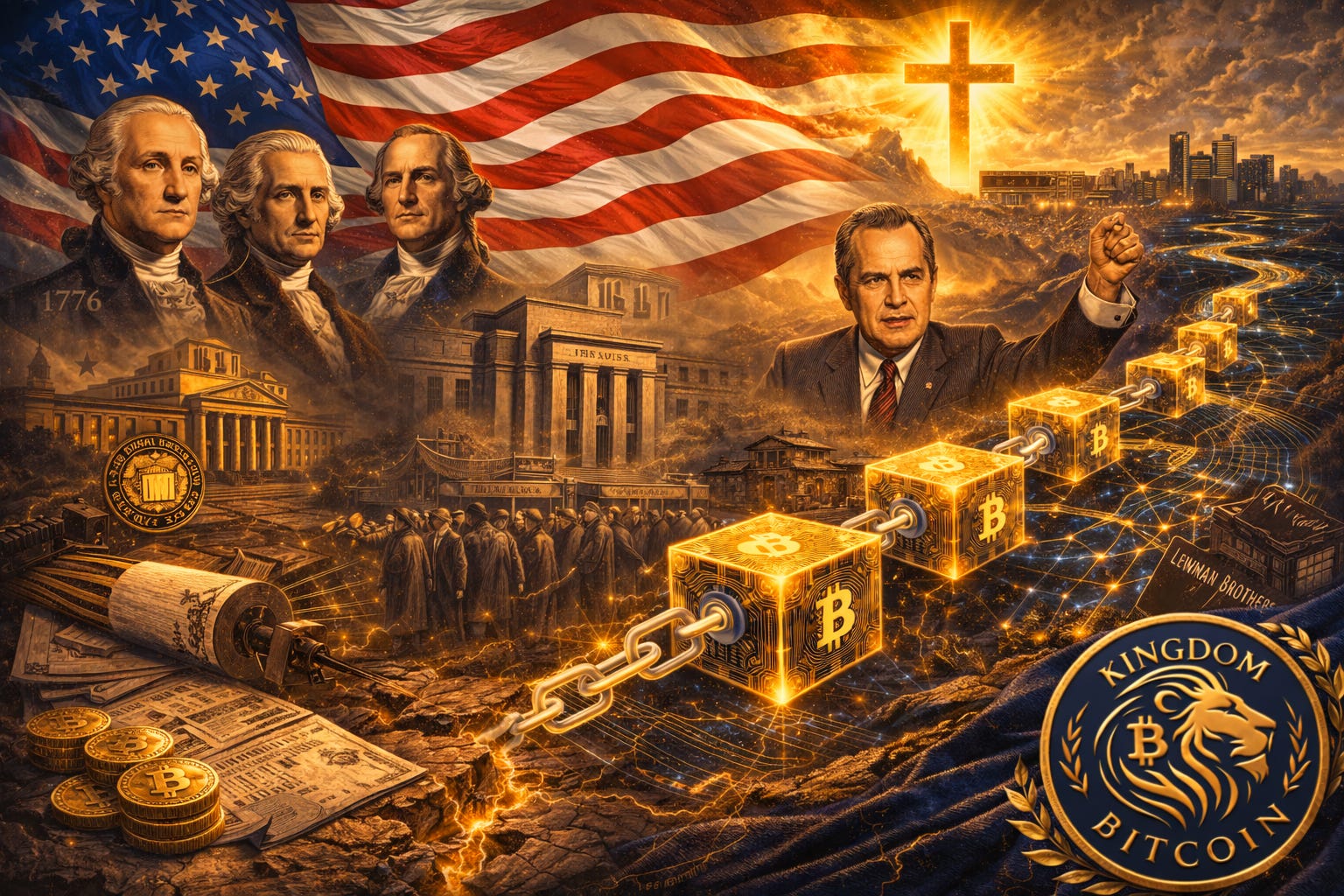
Series Throughline
America was not founded on the assumption that men are good.
It was founded on the assumption that men are fallen.

The Founders built restraint because they believed power tempts.
Scripture declares, “For there is nothing covered, that shall not be revealed; neither hid, that shall not be known.” - Luke 12:2.

From the Continental collapse to the creation of the Federal Reserve, from the Great Depression to the closing of the gold window in 1971, and from 2008 to today, every monetary era has been tested under pressure.

Inflation exposed weakness. Elasticity expanded power. Contraction revealed fragility. Bailouts exposed moral hazard.

When money can be altered quietly, trust erodes slowly.
When trust erodes, control consolidates.

Bitcoin does not assume virtue. It assumes temptation.

The Founders separated powers because they did not trust kings.
Bitcoin separates monetary authority because it does not trust committees.

This series is not nostalgia. It is about design under revelation.

What kind of monetary system survives when hidden things come to light?
That is the question.
The American experiment began with restraint forged in inflation. Restraint does not eliminate fear. And fear, when left unresolved, centralizes power.
In 1907, panic spread through the financial system. Credit tightened. Liquidity evaporated. Depositors rushed to withdraw funds. The banking system, fragmented and exposed, had no formal lender of last resort.
Into that vacuum stepped J.P. Morgan.
From his private library in New York, Morgan coordinated emergency liquidity among banks, persuading institutions to support one another and stem collapse. It worked. But the message was clear. The stability of the American financial system had depended not on constitutional architecture, but on the decisiveness of one man.
Fear birthed centralization.
In November 1910, a small group of powerful bankers and policymakers met discreetly at Jekyll Island, Georgia. The meeting was intentionally private. They drafted the blueprint for what would become the Federal Reserve System. There was no theatrical conspiracy. There was strategic intention. The country needed a backstop. The architecture would change.
On December 23, 1913, President Woodrow Wilson signed the Federal Reserve Act into law. On November 16, 1914, the twelve regional Federal Reserve Banks opened for business.
The Act stated its purpose plainly: to furnish an elastic currency. Elasticity was the answer to panic. Elasticity would prevent liquidity freezes and would smooth shocks. while reducing reliance on private titans.
Elasticity is not evil. However, combined with incentives, drifts.
In Part I, the Founders responded to inflation with restraint. Now the nation responded to fear with flexibility. The measuring stick would not be physically altered, but liquidity could expand and contract according to policy judgment.
This is the pivot from scar tissue restraint to managed discretion.
Central banking is not merely about interest rates. It is about timing. When liquidity is abundant, asset prices rise and credit expands. When liquidity tightens, strain appears. The power lies not in printing alone, but in when and how much.
Scripture gives us a lens that transcends economics. “The rich ruleth over the poor, and the borrower is servant to the lender.” - Proverbs 22:7.
Debt is leverage. Leverage is influence. Influence, when centralized, becomes authority over timing. Central banking does not command armies. It moves liquidity.
Institutions rarely admit weakness early. They protect credibility before they acknowledge fragility. That is not villainy. It is human nature at scale.
The Federal Reserve was created to stabilize. And in many moments it has. But a system built on elasticity must constantly balance restraint against expansion. The tension never disappears.
The Great Depression would test that tension. 1971 would redefine it. 2008 would stretch it to the breaking point. The principle began here. A currency that can stretch must be stewarded by men. And men are fallen.
The Founders separated legislative, executive, and judicial powers because they understood temptation. The Federal Reserve concentrated monetary discretion because stability demanded coordination.
Both impulses are understandable. Both reflect responses to fear. The Kingdom question is not whether elasticity is useful. It is whether discretion without constraint drifts over time.
Christ warned that what is hidden will be revealed. Luke 12:2. Monetary systems are no exception. Liquidity expansion eventually reveals asset bubbles. Liquidity contraction reveals leverage.
Elasticity magnifies both.
Bitcoin emerges in this historical arc as something fundamentally different. It does not furnish an elastic currency. It furnishes a predetermined one. Its issuance does not expand because panic strikes. It does not contract because committees vote. It follows a transparent schedule embedded in code.
Bitcoin is not holy. It is auditable.
It does not rely on the wisdom of governors. It relies on mathematical consensus. It does not adjust supply to preserve institutional credibility. It preserves credibility by refusing adjustment.
That does not eliminate volatility. It eliminates discretion.
The Federal Reserve was born out of fear that private coordination was insufficient. Bitcoin was born out of fear that centralized coordination was too powerful.
One concentrates judgment. The other distributes validation. Both reflect responses to crisis. The deeper issue remains unchanged from 1776. Power tempts. Incentives drift. Systems must account for both.
The question is not whether central banking should exist. The question is what happens when elasticity becomes expectation rather than emergency.
When liquidity becomes policy tool rather than crisis response, markets begin to anticipate expansion. When markets anticipate expansion, risk adjusts upward. When risk adjusts upward, fragility builds quietly.
And eventually, something reveals it.
Restraint and elasticity represent two different philosophies of control. One trusts structure to limit human impulse. The other trusts governance to manage it.
The Kingdom lens is clear. Only the Holy Spirit transforms the heart. No committee can legislate virtue. No monetary policy can manufacture integrity.
But systems that minimize discretionary temptation align more closely with biblical realism than systems that depend on it.
The Federal Reserve was born to prevent panic. It also introduced sanctioned elasticity into the American monetary bloodstream.
The consequences would unfold over decades. And the revelation would come in cycles.
Prayer
Dear Father,
You see what is hidden and what is revealed. Guard us from placing ultimate trust in institutions built by men. Give us discernment to understand power, liquidity, and influence through Your wisdom, not through fear. Teach us to steward resources with humility and foresight. Where discretion tempts, grant restraint. Where fear drives control, grant clarity.
May our confidence rest not in elasticity, but in Your sovereignty.
In Jesus’ name, Amen.🙏📖⚖️🏛️🟠