

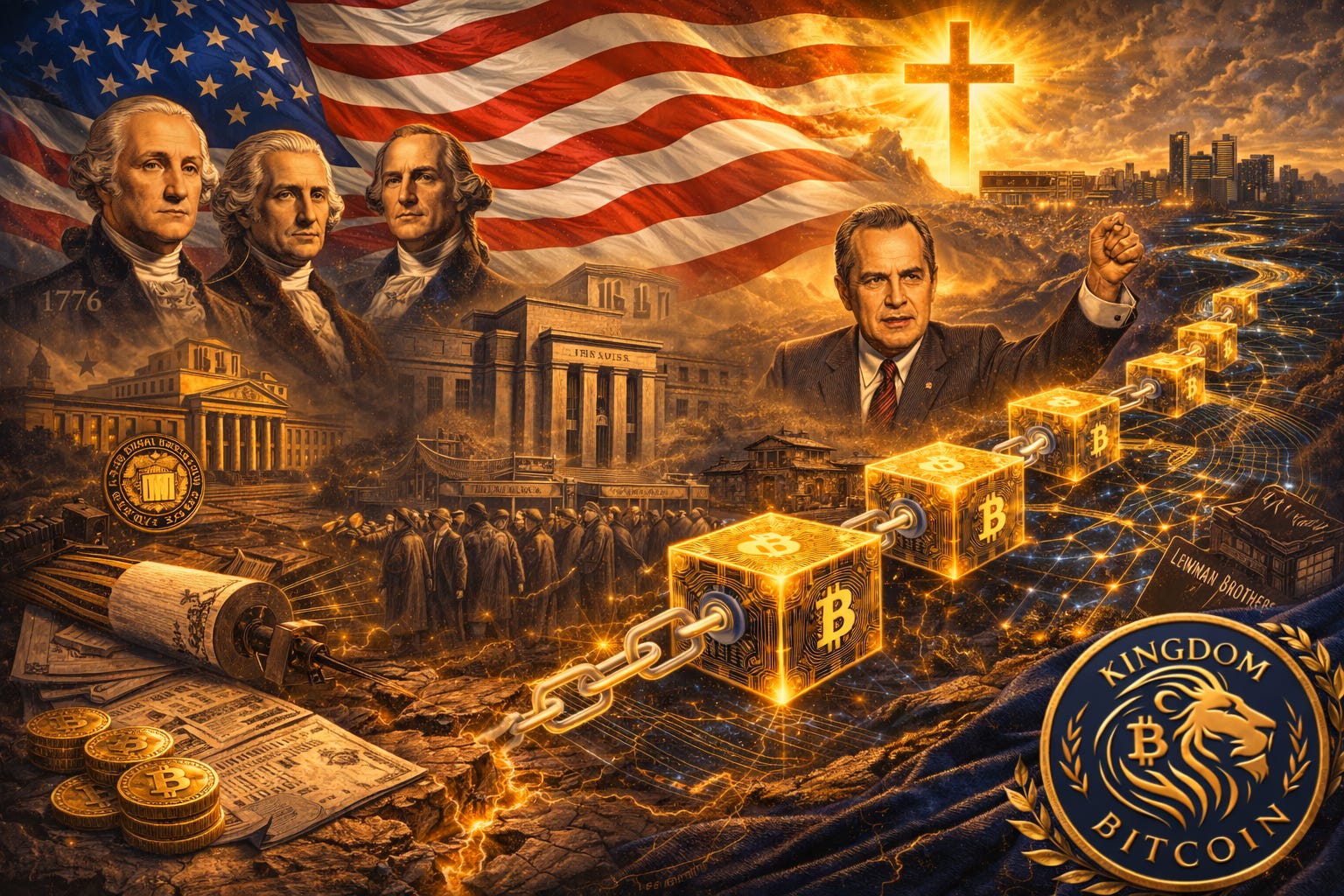
Series Throughline
America was not founded on the assumption that men are good.
It was founded on the assumption that men are fallen.

The Founders built restraint because they believed power tempts.
Scripture declares, “For there is nothing covered, that shall not be revealed; neither hid, that shall not be known.” - Luke 12:2.

From the Continental collapse to the creation of the Federal Reserve, from the Great Depression to the closing of the gold window in 1971, and from 2008 to today, every monetary era has been tested under pressure.

Inflation exposed weakness. Elasticity expanded power. Contraction revealed fragility. Bailouts exposed moral hazard.

When money can be altered quietly, trust erodes slowly.
When trust erodes, control consolidates.

Bitcoin does not assume virtue. It assumes temptation.

The Founders separated powers because they did not trust kings.
Bitcoin separates monetary authority because it does not trust committees.

This series is not nostalgia. It is about design under revelation.

What kind of monetary system survives when hidden things come to light?
That is the question.
Elasticity was designed to prevent panic.
Then panic came anyway.
Between 1930 and 1933, the American money supply contracted by nearly 30 percent. That is not a market dip. That is oxygen leaving the room. Credit shrank. Banks failed. Loans were called. Prices fell. Debts became heavier in real terms. When money contracts, obligation expands.
By 1933, unemployment reached approximately 24.9 percent. One in four Americans who wanted work could not find it. This was not theoretical fragility. It was fathers at kitchen tables. It was breadlines. It was dignity tested.
Trust fractured.
Banks began failing in waves. Depositors rushed to withdraw cash. Institutions that looked stable on Friday were shuttered by Monday. Confidence is fragile. Once doubt spreads, it moves faster than liquidity.
In early March 1933, newly inaugurated President Franklin D. Roosevelt declared a nationwide bank holiday. Banks closed. Doors locked. The financial system paused so that fear could be contained. Emergency legislation followed. The government stepped in to restore confidence because the market no longer could.
Then came April 5, 1933.
Executive Order 6102 restricted private ownership of gold. Citizens were required to deliver most gold coins, bullion, and certificates to the Federal Reserve in exchange for paper currency. Penalties for noncompliance were severe. Gold had been legal tender. Now it was restricted.
The measuring stick moved again.
On June 16, 1933, the Glass-Steagall Act was signed into law, separating commercial and investment banking. That same legislation created the Federal Deposit Insurance Corporation. On January 1, 1934, FDIC insurance began, protecting deposits up to $2,500 per account. Confidence would now be backstopped by federal guarantee.
Trust fractured. Then rules changed.
This is the pattern of monetary history. Crisis exposes fragility. Policy responds. Architecture shifts. Incentives reset.
The Great Depression was not merely an economic downturn. It was a revelation of leverage, timing, and institutional limits. Elasticity had not prevented contraction. Centralization had not eliminated panic. When confidence evaporated, even sanctioned flexibility proved insufficient.
Scripture offers language that feels almost written for such moments. “They shall not be ashamed in the evil time: and in the days of famine they shall be satisfied.” - Psalm 37:19.
That verse does not promise exemption from crisis. It promises endurance through it.
Crises reveal foundations.
If a system depends on perpetual expansion, contraction exposes it. If banks operate with thin reserves and heavy leverage, contraction magnifies it. If trust depends solely on confidence rather than transparency, panic unmasks it.
The Depression taught America that liquidity timing alone cannot create resilience. The system required deposit insurance, structural separation of banking activities, and federal guarantees to stabilize trust.
Guarantees are powerful. They also reshape incentives.
When deposits are insured, depositors worry less about bank risk. When banks know deposits are insured, risk calculus can drift. Safety nets protect households. They also alter behavior.
None of this is accusation. It is observation.
Christ warned that what is hidden will be revealed. Monetary systems are no exception. Contraction reveals leverage. Leverage reveals fragility. Fragility reveals dependence.
The Kingdom lens is not cynicism. It is realism. Human beings build systems that reflect both wisdom and weakness. The Depression did not invent fear. It exposed it. It did not create leverage. It revealed it.
And yet, through all of it, life continued. Families endured. Faith communities strengthened. Industry eventually revived. The nation recovered.
Resilience is not built in headlines. It is built in quiet stewardship long before crisis arrives.
Now enter bitcoin into this historical arc. Bitcoin does not stop contraction. It does not prevent recession. It does not eliminate unemployment. It is not a macroeconomic panacea. But it does something simple and profound. It settles without permission.
It does not close for a bank holiday. It does not require a presidential order to move value. It does not confiscate its own supply. Its issuance does not shrink because panic spreads. Its rules do not change because fear rises.
Bitcoin removes counterparty dependence from settlement. It removes discretionary elasticity from issuance. It cannot prevent crisis. It can function through it.
That distinction matters.
The Great Depression revealed that even centralized elasticity cannot guarantee stability. It revealed that guarantees reshape incentives. It revealed that trust must sometimes be federally reinforced because private confidence collapses.
Bitcoin reflects a different design philosophy. Instead of reinforcing trust through authority, it reinforces trust through transparency. Instead of stabilizing through discretion, it stabilizes through predictability.
It does not depend on men being wise. It depends on rules being visible. The Depression was a collapse of trust. It was also a restructuring of it. The question is not whether government should have acted. The question is what lessons endure.
Crises reveal what was built on sand.
If money requires perpetual confidence in institutional judgment, contraction will test it. If money operates on transparent, predetermined rules, contraction may hurt but it does not alter the measuring stick.
The Great Depression marked a moment when fear forced redesign. It did not end monetary tension. It advanced it.
The revelation would continue in 1971.
Prayer
Lord,
In seasons of contraction and uncertainty, anchor our hearts in You. Teach us to build on foundations that endure beyond headlines and beyond panic. Guard us from fear-driven decisions and from pride that ignores warning signs. Grant us wisdom to steward resources faithfully before crisis arrives. Strengthen our trust in Your provision when systems tremble.
You are our refuge when markets falter. In Jesus’ name, Amen. 🙏📖🏦⚖️🟠